

Pi is one of the most fascinating constants in mathematics, connecting simple geometry to advanced physics and even architecture.
For students and curious minds across India and around the world, understanding this constant offers a clear, easy path into the beauty of numbers.
What Is Pi?
Pi is defined as the ratio you get when you divide a circle’s circumference by its diameter, and this value always comes out close to.
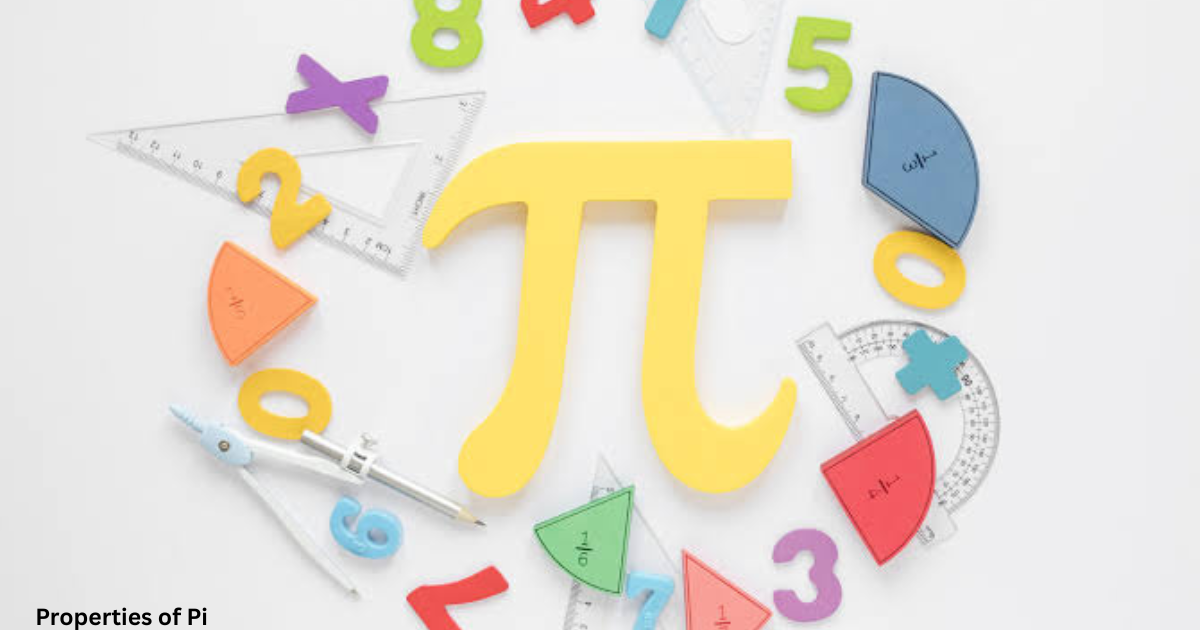 This consistency never changes, whether you measure a small coin or a large wheel, which is why pi is called a mathematical constant.
Origin of the Symbol π
The symbol π was first used by British mathematician William Jones in 1706, as a shorthand for the Greek word periphery.
It gained wider acceptance decades later when Swiss mathematician Leonhard Euler helped standardize it as the universal symbol for this constant.
Pi Is Irrational
Pi cannot be written as an exact fraction of two whole numbers, which makes it an irrational number. Common approximations like are useful for daily calculations, but they remain estimates rather than exact values.
Pi Is Transcendental
Beyond being irrational, pi is also transcendental, meaning it is never the root of a polynomial equation with rational coefficients.
 This property proves that certain classical constructions, such as squaring the circle with a compass and straightedge, are mathematically impossible.
Pi’s Decimal Expansion Never Ends or Repeats
Because pi is irrational, its decimal digits continue forever without forming any repeating pattern. This endless sequence has inspired memorization contests and pushed computers to calculate trillions of digits.
Pi Is a Universal Constant
No matter the size of a circle, from a small coin to a massive planet, the ratio of its circumference to its diameter always equals pi. This universal quality makes pi one of the most reliable constants in geometry.
Pi Connects to Circle Area, Not Just Circumference
Pi also connects a circle’s radius to its area through the formula Area This simple relationship is used constantly in real-world calculations, from architecture to everyday measurements.
Pi Appears Beyond Geometry
Pi shows up far beyond geometry, appearing in trigonometry, probability, and infinite series across mathematics. It also plays a role in physics formulas involving pendulum motion, wave vibrations, and even aspects of Einstein’s equations.
A Brief History of Pi
The significance of pi dates back nearly 4,000 years to the Babylonians and Egyptians, who used it for construction and measurement.
 Later, around 250 B.C.E., the Greek mathematician Archimedes used inscribed and circumscribed polygons to approximate its value with impressive accuracy.
Common Uses of Pi
Pi helps calculate Properties of Pi volume of everyday shapes like circles, cylinders, spheres, and cones. It is also essential in physics and engineering formulas involving vibrations, currents, and trigonometric functions.
Fun Fact: Pi Day
Pi Day is celebrated every year on March 14th, a tradition started in 1988 by physicist Larry Shaw at San Francisco’s Exploratorium. The U.S. Congress officially recognized it as National Pi Day in making it a global celebration of mathematics.
FAQs About Properties of Pi
What is the value of pi?
The value of pi is approximately 3.14159, and its decimal digits continue infinitely without repeating.
Why is pi called an irrational number?
Pi is called irrational because it cannot be expressed as an exact fraction of two whole numbers.
Where is pi used in real life?
Pi is used to calculate the circumference, area, and volume of circular objects, and it also supports physics and engineering formulas involving waves and pendulums.