
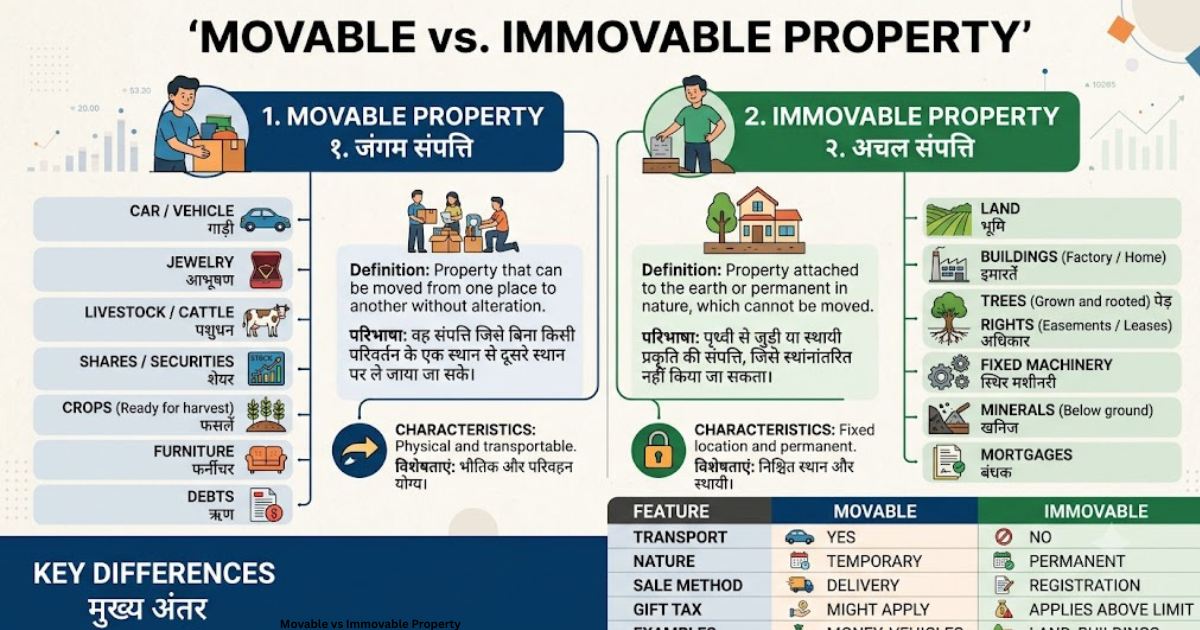
When we talk about movable property, we mean any asset that can be carried from one location to another without losing its basic nature.
Under Indian law, this category covers everything from furniture, vehicles, and electronic gadgets to jewellery, cash, shares, and stocks items whose portability makes them easy to buy, sell, gift, or inherit.
Common examples include movable assets like machinery that can be relocated, or crops and grass once they are severed from the land, such as growing crops or standing timber after it has been cut and picked up.
Because these items don’t need to stay physically rooted anywhere, transfers of ownership usually happen simply through delivery or a sale, without compulsory registration, unlike immovable property, and without the risk of damaging the item just by moving it.
What is Immovable Property?
Immovable property, on the other hand, is defined by its permanence it stays fixed to the earth and cannot be relocated like movable assets or general movable property. This category includes land, buildings, houses, residential plots, factories, and other physical structures, along with permanent fixtures such as wells that are attached to a structure and meant to last for the long term.
It also covers benefits arising out of land, including fishery rights, mining rights, and the right to collect rent, all of which are permanent in nature and typically appreciates in value over time.
Because these assets are permanently attached to a plot, any transfer demands registration and stricter legal formalities, and often needs government approval, whereas trees, fruits, or timber are only classified as immovable until they are cut from the ground.
Legal Definitions Under Indian Law
Several Indian statutes work together to complete the legal picture around property. The Transfer of Property Act 1882 defines immovable property through exclusion, describing it as property of every other description other than standing timber, growing crops, or grass, while the General Clauses Act 1897 under Section 2(9) adds benefits arising out of land and things attached to the earth to this definition.
The Registration Act 1908, in Section 22, also treats standing timber and fruits on trees as movable property once severed, and the Indian Penal Code 1860 further classifies corporeal property as anything fastened or permanently attached to the land.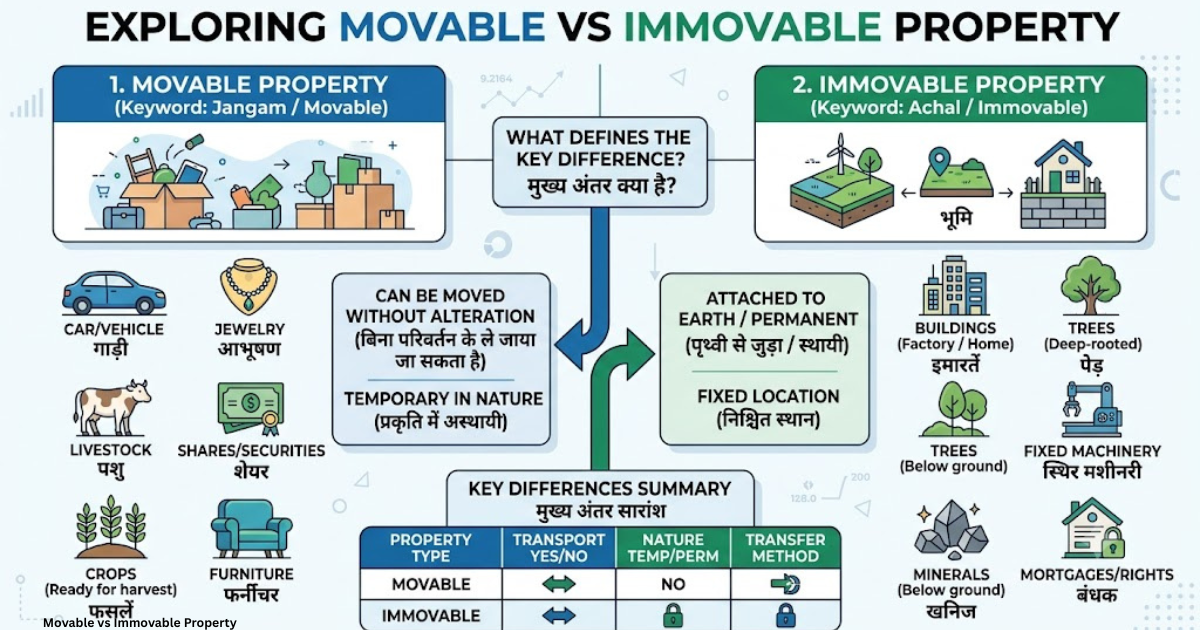 Meanwhile, the Sale of Goods Act 1930 deals with movable property like stock, shares, money, sugarcane juice, and other crops, and even recognises actionable claims as a form of movable interest not physically attached to the earth.
Key Differences Between Movable and Immovable Property
The clearest difference between the two lies in mobility: movable property can be physically transported from place to place, while immovable property stays fixed to the earth because of its permanent nature.
This affects the mode of transfer as well movable items change ownership through simple delivery, whereas immovable assets need a sale deed and a registered title deed under the Registration Act 1908, along with strict registration requirements.
Taxation also differs sharply: movable goods like jewellery attract GST or sales tax, and vehicles attract road tax, while land and buildings attract stamp duty, municipal property tax, and capital gains tax once a certain threshold is crossed, though some transfer situations remain exempt.
Under civil property law and criminal law, disputes over movable property usually involve theft or destroying an item, whereas immovable property disputes often involve criminal trespass or altering boundaries, and each carries its own legal consequences, its own way of being valued, and its own limited nature or tendency to depreciates rather than grow, unlike most immovable assets do.
Examples of Movable and Immovable Property
To picture this more clearly, think of everyday movable property like cars, vehicles, furniture, electronic gadgets, jewellery, cash, money, shares, and stocks, and even your monthly salary, which counts as a transferable monetary benefit and a movable asset rather than a fixed asset.
Immovable property, in contrast, includes houses, apartments, commercial buildings, residential plots, agricultural land, and factories, all of which stay attached to the land along with permanent fixtures like wells.
Machinery bolted into a factory floor is usually treated as immovable, but once it is unbolted, it behaves like ordinary movable property, just as trees or standing timber turn movable the moment they are cut down from where they stood.
Taxation on Movable and Immovable Property
Taxes on movable property and immovable property follow different rulebooks entirely. When vehicles are sold or purchased, road tax applies under state motor vehicle laws, and everyday goods attract GST or sales tax at the point of purchase, with payment collected from the buyer directly.
Immovable property, however, involves stamp duty and registration charges paid by the seller or buyer, plus municipal property tax every year, and under the Income Tax Act, homebuyers must deduct 1% TDS whenever the transaction value of a property crosses ₹50 lakh, alongside capital gains tax once the asset is finally sold.
Transfer and Registration Process
Transferring movable property is refreshingly simple a plain sale invoice or a small document, combined with physical delivery, is usually enough to hand over ownership to buyers, whether the transaction is a purchase or a gift.
Immovable property works very differently, since it requires mandatory government registration at the sub-registrar’s office, with a proper sale deed stamped and paid for with stamp duty, sometimes for as little as ₹100 in symbolic value but often much more.
Skipping this step means failure to register, and under the Registration Act 1908, any unregistered deal becomes legally invalid in the eyes of the law, no matter how genuine the underlying registration or intent may be.
Why This Classification Matters for Real Estate Investors
For real estate investors, getting this distinction right is not just academic it can save real money. Misclassifying an asset as movable when it is actually immovable, or the other way around, often leads to wrong tax filing, delayed deals, and even financial loss for both buyers and sellers.
Every property transaction, whether it’s a straightforward purchase, a sale, or part of an inheritance, depends on correctly classifying fixtures, fittings, and standing crops attached to the land, since incomplete or careless documentation can trigger costly legal complications and lasting disputes between the parties involved.
FAQs About Movable vs Immovable Property
What is the difference between movable and immovable property?
Movable property, such as vehicles and jewellery, can be shifted or relocated from one place to another without damaging its basic nature, while immovable property like land and buildings stays permanently fixed in one place.
Which law defines movable and immovable property in India?
In India, the Transfer of Property Act 1882 and the General Clauses Act 1897 define immovable property, while the Registration Act 1908 and the Indian Penal Code 1860 also help regulate and clarify what counts as movable property.
Is standing timber movable or immovable property?
Under Indian law, standing timber is considered attached to the earth and therefore immovable until it is cut, after which it becomes movable property.
Does movable property require registration in India?
No, movable property usually transfers ownership through simple delivery or a basic sale document, and does not need compulsory registration like land or buildings do.
What taxes apply to immovable property in India?
Immovable property attracts stamp duty and registration charges at the time of purchase, yearly municipal property tax, capital gains tax on sale, and 1% TDS whenever the deal value crosses ₹50 lakh.
Is salary considered movable property?
Yes, salary is treated as a monetary asset and a form of movable property, since it can be transferred or received without needing to be physically fixed anywhere.
Can trees be classified as immovable property?
Trees are generally treated as immovable property because they remain attached to the land, but once they are cut down, they become movable property.