
Getting a Texas brokers license online is partly possible, because Texas lets you finish most of the broker path remotely while keeping a few steps outside your screen.
You can study through approved courses and file your license application through the state’s online system. You still need the required experience, a background check, and a passing exam score.
Treat the process as a hybrid, with online registration and coursework on one side and a licensing examination on the other. TREC takes applications through its online licensing service, which makes tracking your status straightforward from home.
What Is a Texas Broker License and Who Issues It?
A Texas broker license is the state credential that lets an individual run a real estate brokerage and sponsor sales agents. The Texas Real Estate Commission, known as TREC, issues it and enforces its professional standards. Every broker starts as a sales agent, so the brokers license sits one tier above it.
TREC publishes its eligibility criteria, fee schedule, and an online license holder search. A brokers license stays valid for two years, and holders complete continuing education to renew in active status.
Who Qualifies for a Texas Broker License in 2026?
You qualify when you hold a Texas sales agent license, show four years of active experience in the last five years, and reach 720 experience points.
Senate Bill 1968 doubled the old 360-point minimum on January 1, 2026. You also need the required education and a fingerprint-based background check.
TREC wants brokers with real transaction history, so applicants document that history on a qualifying experience report. Every point must fall inside the five years before you apply. Applicants who exceed the minimum can swap up to 300 experience points for education hours.
How Does TREC Calculate the 720 Experience Points?
TREC awards points for real estate transactions you complete as a licensee, and you list them on the Qualifying Experience Report.
Residential, commercial, and leasing activity each earn points, and TREC publishes the current values on its form. Only experience from the five years before you apply counts toward your total. Keep transaction records or broker verification ready, because you must back up every point you claim.
How Many Education Hours Does Texas Require?
Texas requires 270 hours of qualifying real estate courses, including a 30-hour brokerage course, plus 630 hours of related education. Together that makes 900 hours for most applicants.
Many sales agents already hold 180 of those hours from their first license. An accredited bachelor’s degree now covers up to 300 hours of the related education, down from the old 630-hour credit.
The six-hour Broker Responsibility Course counts inside the 630 hours. You should print TREC’s course checklist and tick off each course to avoid duplicate purchases.
Can You Take the Required Courses Online?
Yes, TREC approves qualifying courses in online, correspondence, and classroom formats, and its searchable database filters by delivery method.
Several approved schools advertise fully online broker packages. Confirm that the provider appears on TREC’s approved list before you pay for any course.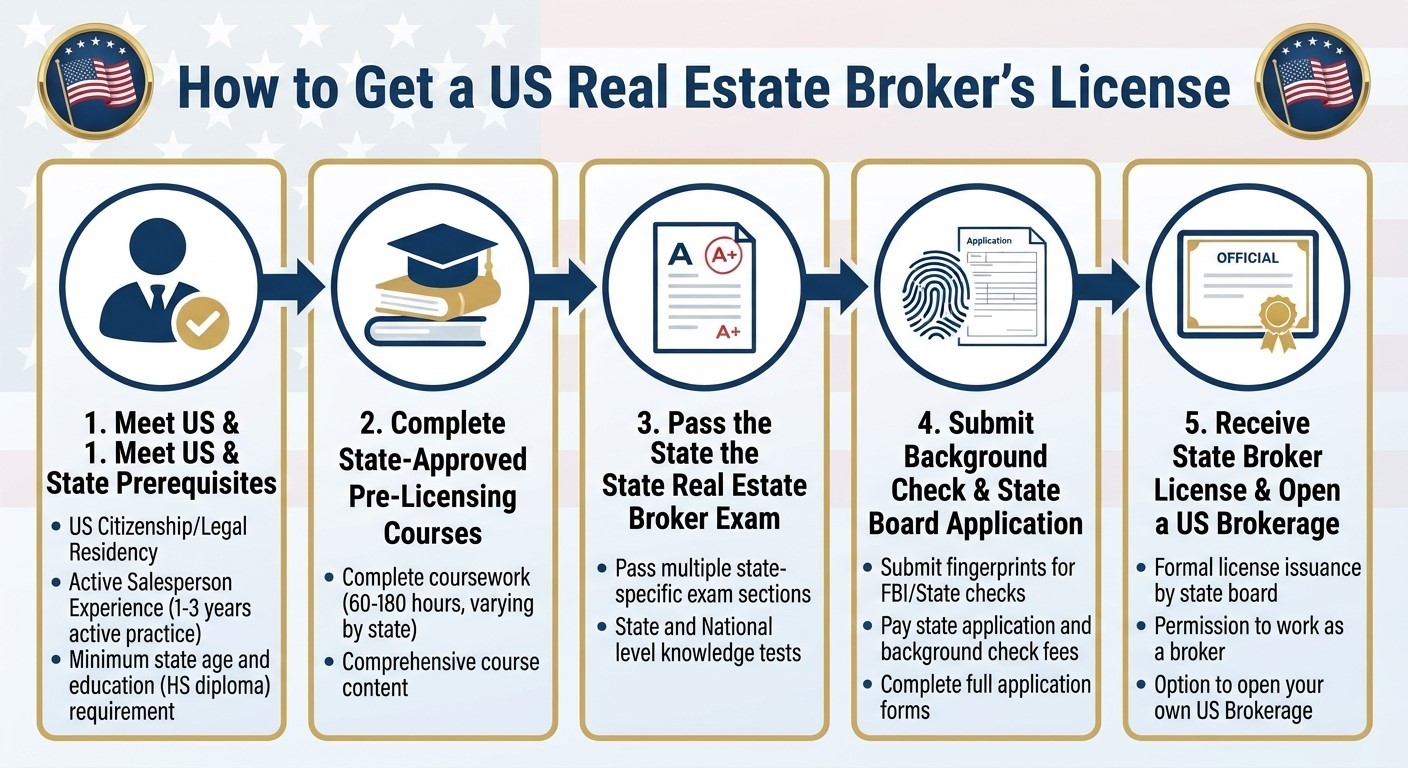 Online study suits working agents because you can finish each 30-hour course around client appointments. Each course ends with a final exam, and some providers add exam prep and proctoring. Compare each provider’s study guide and mock exam access before you buy.
How Much Does a Texas Broker License Cost?
Getting a Texas broker license involves several state and education fees that you pay at different stages. Under TREC’s fee schedule effective September 1, 2026, the individual broker application totals $308, fingerprinting through IDEMIA costs $40 if TREC does not already have your prints, and the broker exam fee paid to the exam provider is $58.
Your largest expense will be the required qualifying education, and prices vary widely by school and by how many hours you still need. Add exam prep if you want it, and budget for renewal, which totals $218 every two years for an active individual license.
What Happens After You File Your Application?
TREC reviews your file, checks your experience report and education certificates, and then sends instructions for fingerprints and the exam.
You complete the background check through TREC’s approved vendor. Texas gives you one year from the filing date to meet every requirement.
Applicants who already gave fingerprints to the Texas Department of Public Safety for a sales agent license usually skip a second round.
TREC issues the broker license once you satisfy every item. Active brokers then keep the credential current through license renewal and continuing education every two years.
Can You Take the Broker Exam Remotely?
Not as far as TREC and Pearson VUE confirm today. Pearson VUE administers the Texas real estate broker exam, and its September 2026 Texas Real Estate Candidate Handbook describes testing at Pearson VUE test centers without mentioning online proctoring.
The licensing examination includes both a national portion and a Texas state law portion, and you must pass both to qualify. Review the handbook and TREC’s site before scheduling, because exam delivery options can change.
How Does Texas Treat Out-of-State Brokers?
Texas has no reciprocity agreements with other states, so out-of-state brokers must still apply. Applicants who hold or recently held a license elsewhere may qualify for certain education, experience, or national exam waivers.
TREC decides which waivers apply to each applicant. Out-of-state applicants without fingerprints on file with the Department of Public Safety must complete fingerprinting.
Gather your license history and education transcripts before filing. Expect a fresh application with a modest head start.
What Can You Do Once You Receive Your Broker License?
Once TREC issues your broker license, you can operate independently as an individual broker or sponsor sales agents under your own brokerage.
Solo brokers can represent buyers and sellers directly without working under a sponsoring broker. If you plan to sponsor agents, you must complete the six-hour Broker Responsibility Course, and a business entity such as an LLC needs its own business entity broker license from TREC.
Every active broker must also follow trust account rules, advertising requirements, and supervision duties to keep the license in good standing.
FAQS
How long does the Texas broker process take?
TREC gives you one year after filing to meet every requirement, but the experience clock starts earlier. You need four years of active licensed experience within the last five years and 720 points. Newcomers without that experience should plan on several years.
Can a degree replace some courses?
Yes, a degree replaces part of the education requirement. An accredited bachelor’s degree covers up to 300 hours of related education, and surplus experience points can replace up to 300 more hours. You still need the 30-hour brokerage course.
How much does it cost to apply for a Texas broker license?
Expect to pay $308 for the individual broker application, $40 for fingerprinting if TREC does not have your prints, and $58 for the exam. Qualifying courses add more, depending on the school and how many hours you still need.
Can I sponsor agents immediately after getting my broker license?
Yes, once your broker license is active and you have completed the six-hour Broker Responsibility Course, you can sponsor Texas sales agents. If you operate under a business entity such as an LLC, TREC also requires a business entity broker license.
Where Should You Start Your Texas Broker License Path?
Start by downloading TREC’s Qualifying Experience Report and course checklist to see how many of the 720 points and 900 education hours you already have. Once you confirm your eligibility, enroll in an approved online school to finish your remaining coursework at your own pace. With careful preparation and accurate documentation, you can complete most of the Texas broker licensing process from home, with fingerprinting and the exam as the in-person steps.