
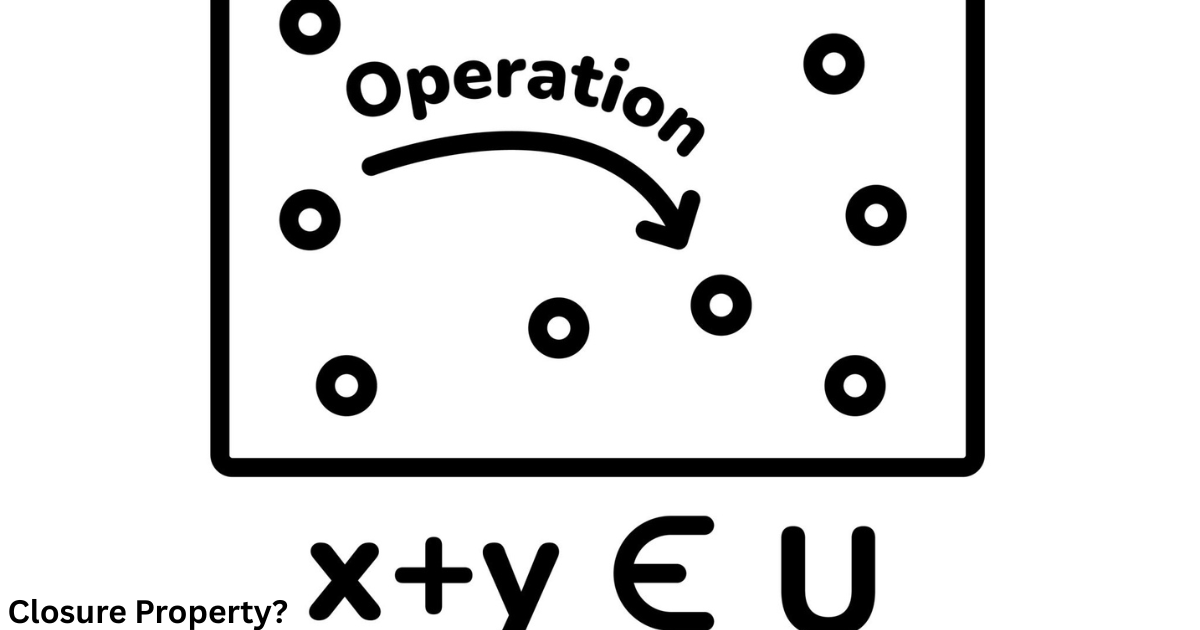
Every basic operation in math follows certain rules, and one concept works as the backbone of how numbers behave together.
This fundamental idea is called the closure property, and it answers a simple question: when you use arithmetic like addition, subtraction, multiplication.
Or division on whole numbers, does the answer stay inside the same set, or does it escape somewhere else after dividing two values.
Many students ask questions about this definition early on, and a few examples make the whole operation click faster than any formula ever could.
Once you get comfortable with this basic operation, you can move toward advanced topics like group theory, rings, and fields inside abstract algebra.
Where every result belongs to a pattern that behaves predictably across countless operations.
What is Closure Property?
The closure property simply means a set stays closed whenever you run a mathematical operation on any pair of numbers from it, and the result never crosses the boundaries of the original set.
Think of number systems such as natural numbers, whole numbers, integers, rational numbers, and real numbers each system behaves differently depending on which operation you pick, and no single number escapes without reason.
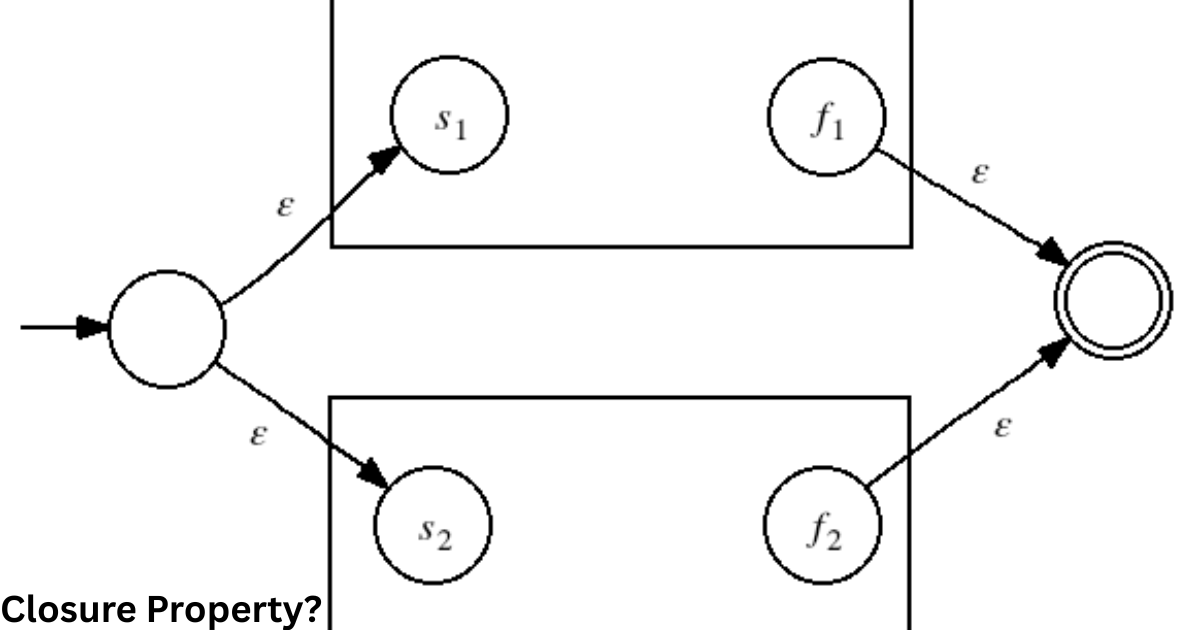 When you pull two numbers from a set and the answer lands outside, that operation fails the test, so the set is called not closed for that case.
Closure Property Formula
Every closure property formula boils down to one neat idea: pick any elements a and b from set S, apply an operation, and the result stays put.
Mathematicians write this using symbols like R for real numbers, and the general formula covers addition, subtraction, multiplication, and division in one shot.
For real numbers, everything works smoothly except division by zero, which stays undefined no matter how you slice it so the rule holds as long as never shows up as the divisor.
Keeping the whole set genuinely closed, with 0 treated as the only real troublemaker on this list.
Closure Property of Addition
Addition stays the most consistent operation of them all, and almost every set you can think of as whole numbers, natural numbers, integers, rational numbers, and real numbers remains closed under it.
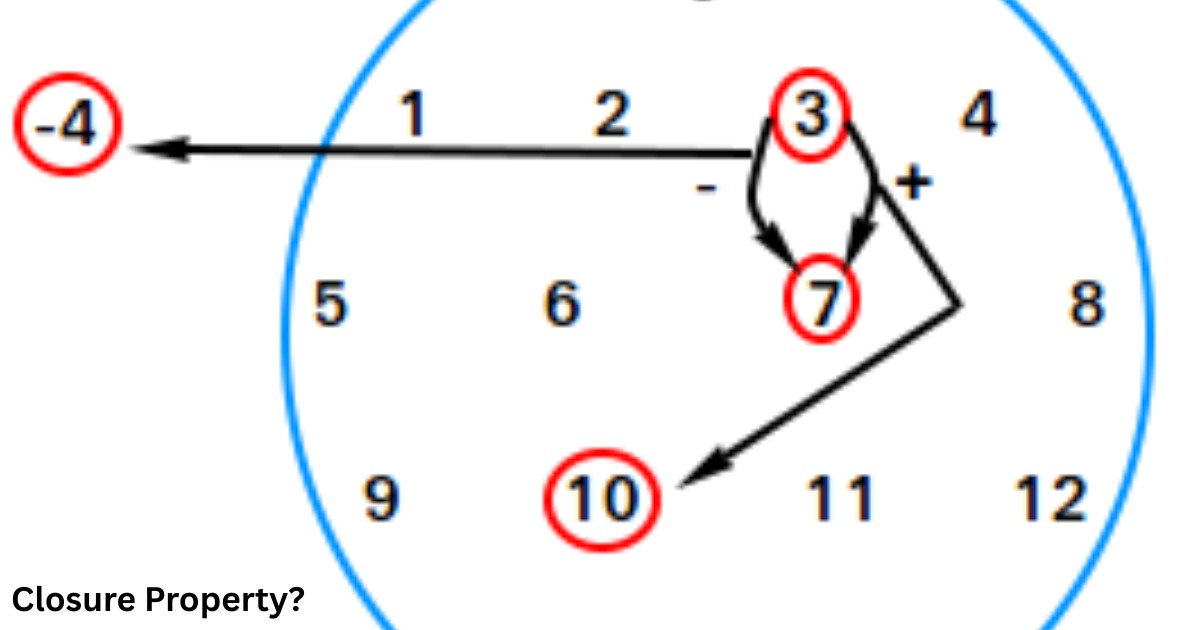
Take a quick example: 3 plus 4 equals 7, and since all three values sit comfortably inside whole numbers, this closure holds firm without exception.
Adding any two numbers from these sets keeps producing a fresh number that belongs right back where it started, and this pattern repeats across countless operations you can imagine.
Whether the values are rational or whole; even if a and b stand for any pair you pick, the sum never wanders off.
Closure Property of Subtraction
Subtraction doesn’t behave consistently the way addition does, and that’s what makes it tricky for beginners.
Integers, rational numbers, and real numbers stay closed under this operation, but natural numbers and whole numbers are not closed at all.
Look at this example: 3 minus 6 gives you -3, a negative number that no longer fits inside natural numbers, even though both starting values were natural to begin with.
Meanwhile, if a and b represent any integer, their difference always remains an integer too, proving how differently each set reacts to the very same operation.
Closure Property of Multiplication
Multiplication follows almost the same pattern as addition, since natural numbers, whole numbers, integers, rational numbers, and real numbers all stay closed whenever you’re multiplying values from within them.
Take two integers, call them a and b; their product always turns out to be an integer, no surprises there.
But there’s one interesting exception: irrational numbers are not closed under this operation, and here’s an example that proves which simplifies down to 4, a plain rational number rather than something irrational.
This single result shows that multiplying two irrational values doesn’t guarantee an irrational answer at all.
Closure Property of Division
Division is where closure most often breaks down, since natural numbers, whole numbers, and integers are all not closed under it.
Here’s a simple example and that decimal really just a fraction in disguise refuses to fit back inside the original set of whole numbers, even though both two numbers we started with belonged there.
What Is Closure Property for rational numbers and real numbers, which stay closed across most sets, apart from one big exception: division by zero.
Whenever the divisor turns out to be zero, the result becomes undefined, so dividing by it breaks every rule we’ve discussed so far.
Why is the Closure Property Important?
This isn’t just a textbook rule memorized for exams; the closure property plays a genuinely practical role across many fields.
In education, it helps students move past rote procedures and build real understanding of how a number system actually works, rather than just following steps blindly.
Beyond the classroom, this same logic supports computer science, where consistent data types rely on predictable number behavior so that algorithms and data structures deliver predictable results every single time.
It also forms the foundation for algebraic structures like groups, rings, and fields inside abstract algebra, and even shows up in cryptography and coding theory, where reliable operations matter enormously.
Without it, equations wouldn’t stay solvable, calculations across different number systems would grow chaotic, and entire mathematical systems would lose the consistent, dependable behavior we rely on daily.
Closure Property vs Other Properties
People often mix up the closure property with the commutative property and the associative property, but each one answers a completely different question.
Closure property asks whether the answer stays inside the same set; commutative property checks whether you can swap the order of numbers.
Without changing the outcome, written simply as an associative property asks whether you can regroup values freely.
Shown as and c can be arranged in any sequence and the result stays the same, that’s a different story from closure altogether and these questions matter more than most students realize.
Quick Reference Table
To sum up quickly, Natural Numbers and Whole Numbers stay Closed under Addition and Multiplication, but turn Not Closed the moment you try Subtraction or Division.
Integers hold up a little better, staying Closed for Addition, Subtraction, and Multiplication, though Division still trips them up.
Rational Numbers and Real Numbers manage to stay Closed across nearly every operation, landing at Closed only for division, while Irrational Numbers end up Not Closed almost everywhere you test them.
FAQs About What Is Closure Property?
What is the closure property in simple words?
In simple words, the closure property means that when you take two numbers from a set and perform an operation like addition or multiplication on them, the answer always turns out to be a number that belongs to that very same set.
What does it mean for a set to be “closed” under an operation?
A set is called closed under an operation whenever every result you get by combining its elements lands back inside the same set; nothing ever escapes that particular set.
Is the set of whole numbers closed under division?
No, whole numbers are not closed under division. Dividing and since that decimal, or fraction, doesn’t count as a whole number, the set can’t be called closed here.
Are natural numbers closed under subtraction?
No, natural numbers aren’t closed under subtraction. Subtracting a larger value from a smaller one, like minus, gives a negative result that simply doesn’t exist among natural numbers.
Why does division by zero break the closure property for real numbers?
Division by zero simply doesn’t work in mathematics, since any result with zero as the divisor stays undefined. That’s why real numbers count as closed under division only when the divisor isn’t zero.
Is the closure property applicable to irrational numbers?
Not really irrational numbers don’t reliably satisfy the closure property under multiplication.