

A deposited plan is an official drawing of a parcel of land that a registered surveyor files with a government land registry. The drawing shows the legal boundaries, each lot number and every easement that crosses the land. Once the registry accepts it, the plan becomes a public record that anyone can order it.
Think of the plan as the map behind the paperwork. It records lot dimensions and area measurements in metres, so you can check what a seller actually owns. Vancouver buyers meet it whenever a listing mentions a lot, a subdivision of land or a strata building.
Why Does a Deposited Plan Matter When You Buy a Home?
A deposited plan matters because it defines exactly what you are buying. It fixes the lot boundaries, so you avoid a boundary dispute with a neighbour later. It also tells your solicitor which rights and limits travel with the land.
Lenders care about it too. A mortgage lender wants a clear legal description before it registers a mortgage, and the plan supplies that description. A first home buyer who skips the plan can discover a shared driveway or a building height restriction only after signing.
What Information Does a Deposited Plan Show?
A deposited plan shows the lot number, lot size, property shape and lot boundaries for each parcel. It also lists area measurements, and the surveyor adds a plan number so you can find the same plan again. Together, those details form the legal description of the property.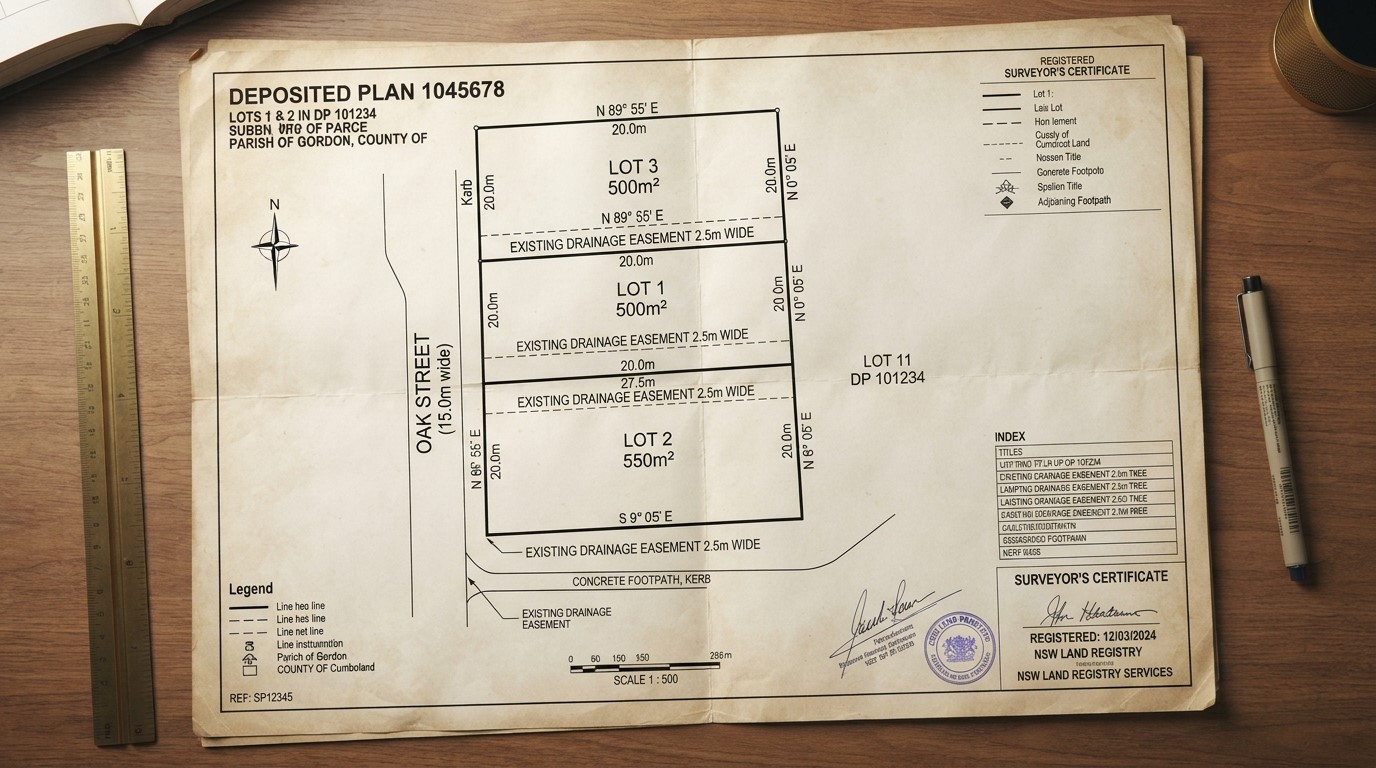 Some plans add a building sketch, and others mark fences, roads and trees that sit near a boundary. Those marks help you compare the drawing with the site. I suggest walking the boundary with the plan in hand, because a fence half a metre off the line costs far more to fix after settlement.
How Do Easements Appear on a Plan?
A plan draws each easement as a labelled strip across the lot, and a note names its purpose. A utility easement lets a provider run pipes or cables, while a right of way gives a neighbour access. Access rights like these stay with the land when ownership changes.
HouseMe Legal’s glossary explains the two sides: the burdened land carries the obligation, and the benefited land receives the right. An easement in gross benefits a named person or company instead of a neighbouring lot. In New South Wales, a Section 88B instrument sits beside the plan and spells out the terms.
What Is the Difference Between an Easement and a Covenant?
An easement gives someone a right to use part of your land, while a covenant limits what you can do with it. A restrictive covenant might impose a building height restriction or ban a second dwelling. A land covenant can also demand action, such as keeping a lawn trimmed.
Both stay with the land. A caveat protects another person’s unregistered interest, and an encumbrance covers mortgages and similar burdens on the title. A resumption, where a government reclaims land also appears in the records.
How Does a Deposited Plan Differ From a Strata Plan?
A deposited plan divides land into lots, while a strata plan divides a building into units plus common property. Apartments and townhouses sit inside a strata scheme, and each owner holds a strata title. Fynd describes the strata plan as the document an owner lodges when individually owned lots share common property.
Each unit carries a unit entitlement that sets its share of costs. In British Columbia, a strata corporation runs the scheme, while New Zealand uses a body corporate that charges body corporate levies and enforces operational rules. Townhouse and unit developments often rely on strata subdivision, and the plan marks shared facilities as common property.
What Other Plan Types Should I Know About?
Plan type changes from place to place. New South Wales, South Australia and the Northern Territory use a deposited plan with a DP number such as DP 825510, while Queensland uses a registered plan with a plain number. A Crown plan covers Crown land, and Title Check says these plans date back to 1792.
Ownership forms add their own paperwork. New Zealand buyers meet a cross-lease title, a leasehold title or a unit title, and each one limits how an owner alters a home. HouseMe Legal’s glossary also calls a deposited plan a title plan, which helps when a contract uses that older name.
How Do I Read a DP Number and a Title Reference?
A DP number identifies one plan, such as DP 896528, which Fynd uses as its example. You pair it with a lot number to describe a property, like Lot 2 Deposited Plan 54321 in the HouseMe Legal glossary. The title reference then links that lot to its ownership record.
A certificate of title, which New Zealand now calls a record of title, lists the registered proprietor, the volume and folio and the plan. A registered owner with a fee simple title faces few limits beyond council rules. Fynd also notes that DP numbers from 750000 to 759999 have no paper image, so you need a Crown plan for those.
How Does Subdivision of Land Create a Deposited Plan?
Subdivision of land creates a deposited plan when an owner splits one parcel into several lots. A surveyor measures the site, drafts the plan, prepares the final linen plan and lodges it for plan registration. After approval, each new lot receives its own title reference, and a primary application supports the new land titles.
Apollo Survey lists rural subdivision, urban residential subdivision, commercial and industrial subdivision, community title and neighbourhood subdivision on its subdivision page. Large projects run as a multi-stage development, and each stage needs its own plan lodgement. Some minor jobs qualify as exempt development or complying development in New South Wales, so ask the council before you file a development application.
Who Prepares a Deposited Plan?
A registered surveyor prepares a deposited plan, and the law requires that licence in most places. In British Columbia, a BC Land Surveyor signs the plan, while New South Wales uses a registered surveyor. Fynd notes that owners lodge a plan from a licensed surveyor whenever they create or subdivide a parcel.
Other professionals join the work: a town planner handles the council side, a civil engineer designs roads and drains, and an architect or building designer shapes the house. A certifier checks compliance, a developer funds the project and an owner-builder often manages a smaller job. Surveyors also run a cadastral survey, boundary survey, identification survey or detail and contour survey, and they mark boundaries and fencing for boundary definition when neighbours disagree about a boundary adjustment or boundary realignment.
Which Searches Should I Order Before Buying?
Order a title search, a plan search and a property search before you buy. The title search returns property ownership details, mortgages and caveats, and the plan search returns the deposited plan itself. A Land Information Memorandum, which New Zealand councils issue, adds local rules.
A guaranteed search confirms that no unregistered dealings wait to land on the record before settlement. Title Check lists instruments and dealings, a sewer service diagram, an underground utility check and property monitoring, while Fynd’s plan inquiry covers plans in the Integrated Titling System. A dealing is a registrable instrument under the Real Property Act, and Land Registry Services in New South Wales holds the land registry records that an information broker retrieves.
How Does a Deposited Plan Fit Into Conveyancing?
Conveyancing, or property conveyancing, is the legal work of moving a property from vendor to purchaser, and the deposited plan sits inside that file. Your conveyancer or solicitor checks the plan against the agreement for sale and purchase. Any mismatch becomes a condition or a question before settlement.
A conditional agreement lets you finish due diligence first, while the settlement statement shows the balance you pay on settlement day. Disbursements, such as search fees, pass from your lawyer to you, and a discharge of mortgage clears the seller’s loan before the transfer of ownership. A real estate agent, a property investor and a first home buyer all rely on the same file, and a pre-settlement inspection confirms it.
What Should I Look for in a Service Provider?
Look for a provider that names its sources, lists its services and explains its coverage clearly. A good provider also states which registry supplies the documents. Fynd, for example, says it is an authorised information broker for the New South Wales registry.
Check regulatory compliance, because a provider that handles searches must follow local rules. Ask whether the service covers a planning certificate, development controls, an approval pathway and council requirements, since those shape development feasibility and property value. Zoning, land use, flood risk, contamination issues and unconsented building works also deserve a question, and a building inspection finishes the checklist.
How Do Fynd, InfoTrack and Title Check Compare?
Fynd, InfoTrack and Title Check all supply property records in Australia, and each lists its own services. Fynd lists a title search, deposited plan, strata plan, Section 88B instrument, dealing and plan inquiry. Title Check lists a title search, survey plans, property monitoring, sewer service diagrams that show private wastewater pipes, instruments and dealings, an underground utility check and a subdivision feasibility report.
InfoTrack lists searches and certificates, a seller disclosure tool, contract review and settlement services, although its homepage does not name a deposited plan. Title Check says it covers every Australian state and territory except Tasmania, and it credits InfoTrack Pty Ltd for its information. Each brand offers the services shown on its own website, so confirm the details there.
Which Brands Help Buyers, Surveyors and Planners?
HouseMe Legal helps New Zealand buyers, while Apollo Survey serves surveying and planning clients around Queanbeyan and the Canberra region. HouseMe Legal lists legal services for buying a home, selling a home and refinancing. Apollo Survey lists subdivision and easements, boundary marking, identification surveys, detail and contour surveys and town planning.
HouseMe Legal also publishes a glossary, a knowledge base and a first home buyer academy. Apollo Survey adds subdivision civil design, engineering setout, drone surveying and monitoring well location. Neither site mentions British Columbia, so Vancouver readers should ask about local coverage first, and each brand offers only what its own website lists.
How Does This Work in Vancouver and British Columbia?
British Columbia uses the same idea under different names. The Land Title and Survey Authority of BC runs the land title and survey system, and surveyors file plans at the Land Title Office under the Land Title Act. Plan numbers carry prefixes such as EPP for standard plans and EPS for strata plans.
A BC title search runs through the myLTSA service and shows charges such as a statutory right of way, which works like an easement. A strata corporation manages each strata lot under the Strata Property Act. Because these local terms differ, check that any provider names British Columbia coverage before you pay.
FAQs
Is a Deposited Plan the Same as a Title?
No, a deposited plan is not a title. The plan draws the lots, while the title records who owns each one and what burdens it. You need both for a full picture.
Can a Deposited Plan Change?
Yes, a surveyor can amend a plan to correct errors or adjust lot boundaries. The surveyor then lodges the amended plan with the registry for review. Once approved, the updated plan joins the official record.
Where Should I Start When I Need Help With a Deposited Plan?
Match your need to a provider that lists the right service on its own website. This guide gives you the terms, the checks and the questions, and our site collects them in one place. Visit our site for what does deposited plan mean, and use it to find the right provider before you commit to a purchase or a subdivision.