

The best way to sell a house as-is depends on your timeline, your property’s current condition, and the buyers you can reach. Sellers who need speed usually take a cash offer, while sellers who can wait often test an open market sale first. This guide compares each route step by step so you can judge providers calmly and avoid pushy offers.
What Does It Mean to Sell a House As-Is?
A sold as-is home changes hands in its current condition, with no promised fixes from the seller. The as-is clause in the contract records that agreement clearly, and the buyer signs it before closing. The idea behind it is simple: what you see is what you get, and nothing more.
An as-is sale differs from a traditional home sale because the seller skips the repair list. Buyers compare an as-is listing against a turnkey home or any move-in-ready condition property, so the price gap matters. A fixer-upper, a house in poor condition, and a house that needs work all fit this category, and you can sell without repairs in each case.
Why Do Homeowners Choose to Sell a House As-Is?
Owners usually choose this route because repairs cost money and time they do not have. No time for remodeling or no cash for renovations leads the list, and financial hardship often sits behind both. Many simply want to avoid costly repairs altogether and move on after a long ownership.
Life events push sales forward too, since tight timelines, job relocation, and pending foreclosure all shorten the runway. Families handling inherited property or an estate sale often live in another city and cannot manage contractors. An unlivable home forces the same decision, because repairs would come first.
Who Buys a House in As-Is Condition?
Three groups dominate this market: cash buyers, real estate investors, and house flippers. Each group expects a discount because it will fund the repairs itself and still needs room for profit. A house-buying company works the same way and makes an offer after it reviews the property.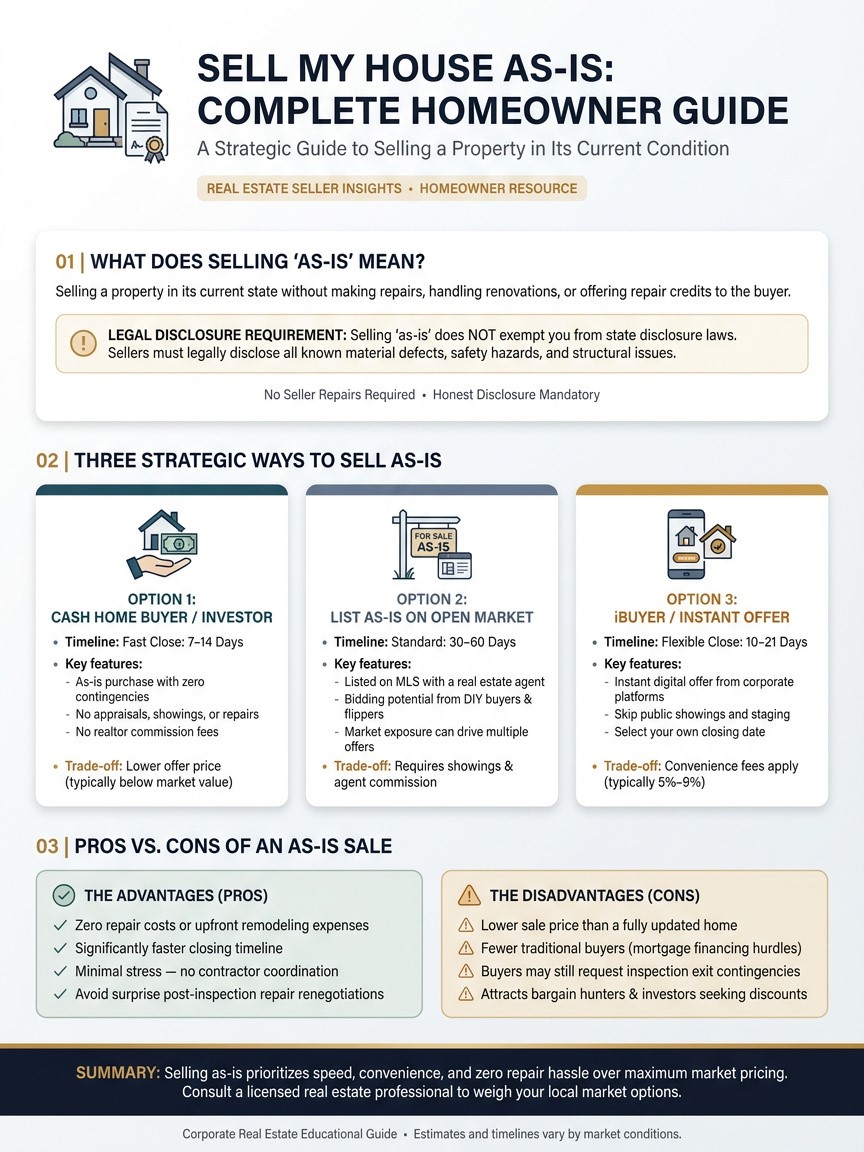 Rehabbers and “we buy houses” companies chase deeper projects, while owner-occupant buyers pay closer to market price when the damage stays minor. First-time buyers and other traditional buyers often hesitate because they lack repair budgets. That hesitation creates a limited pool of buyers, so expect fewer showings than a polished home draws.
What Are Your Options to Sell a House As-Is?
You have two main paths: take a cash offer or sell with an agent on the open market. HomeLight’s Simple Sale platform delivers a no-obligation cash offer within 24 hours, according to its website. An all-cash offer also removes lender approval from the timeline.
Marketplace Homes lists a guaranteed sale program that works as a backup cash offer when your home has not sold yet. Other sellers try for-sale-by-owner (FSBO), an off-market sale, or a sale leaseback, which helps them avoid moving twice. Opendoor lists a sell to buy your next home option, and HomeLight lists buy before you sell.
What Must You Disclose When You Sell a House As-Is?
You must tell buyers about known material defects, even when the contract says as-is. Chase and Rocket Mortgage both state that the as-is label does not erase your seller’s disclosure duty. Mandatory disclosures vary, so check your state-specific disclosure laws first, since each state sets its own forms and deadlines.
Skipping this step creates legal liability, and HomeLight notes that sellers can answer for hidden problems after close of escrow. Alabama works as a buyer-beware state under caveat emptor, yet sellers there still disclose health and safety issues such as black mold and lead-based paint. A real estate attorney can review your forms, and full transparency protects the deal.
Is a Pre-Listing Inspection Worth It?
A pre-listing inspection usually pays off because it shows what buyers will find anyway. A home inspector documents the flaws in an inspection report, and you can price the house around them. Rocket Mortgage lists this step among its tips for as-is sellers and says it helps you set a realistic price.
Collect repair estimates next, because known repair costs give you leverage once a buyer orders a home inspection. The report also shows whether the house meets minimum property requirements (MPRs), the safety baseline behind many lender standards. Failing those standards can sink a buyer’s loan, so you want that answer before you list.
Which Defects Scare Buyers Away Most?
Buyers fear deal killers most, and structural issues lead the pack. Foundation repairs can run roughly $2,225 to $8,133, according to Angi figures that HomeLight cites. That range explains why many buyers walk away or slash their offers.
Termite damage and pest infestation worry buyers because the harm hides behind walls, and mold remediation runs about $1,223 to $3,757 in the same data. An old worn roof or active roof leaks invite water intrusion, which feeds mold. Outdated wiring, an outdated electrical panel, and systems in disrepair also shrink your buyer pool.
How Do You Price a House in As-Is Condition?
Start with fair market value, then subtract what repairs would cost. A home value estimator gives a rough number, and a comparative market analysis (CMA) built on similar home sales sharpens it. Opendoor says its offers rest on home details, recent sales, and market data.
Investors often apply the 70% rule: they pay 70 percent of after-repair value (ARV) minus repair costs, as HomeLight’s example shows. A $440,000 ARV with $30,000 of repairs produces an offer near $278,000 in that example. Opendoor adds a condition adjustment to cover its preparation and resale costs.
Realistic pricing protects you from price cuts, lowball offers, and large price concessions later. A discounted price still beats a stale list price that sits for months. Compare market value with your assessed value and a home appraisal, because tax and lender numbers differ.
How Much Will You Net From an As-Is Sale?
Your net proceeds equal the sale price minus every cost on the closing statement. HomeLight’s net proceeds calculator and Opendoor’s home sale calculator both help you estimate that figure. Run both before you accept anything, because closing costs shift with the buyer type.
Opendoor’s breakdown lists closing costs such as title insurance and appraisal fees, and it may charge extra for a closing date beyond 30 days. An agent sale adds agent commissions and listing fees, while a cash sale usually skips them. Watch for seller credits, because buyers sometimes request them after an inspection.
Cash deals close fast: HomeLight says its Simple Sale can close in as few as 7 days, and Rocket Mortgage says cash buyers often close in 7 to 10 days. A flexible closing date and a short closing timeline also cut carrying costs, meaning the insurance, utilities, and loan payments you pay while you wait. Ask your lender for a payoff quote so your mortgage payoff matches the escrow figures, and pick a move date that fits.
Can Buyers Still Negotiate an As-Is Deal?
Yes, buyers still negotiate, even when the as-is clause limits repairs. Many request an inspection contingency, then use the findings as buyer leverage on price. Chase confirms that an as-is sale does not always mean zero negotiation, so plan your response before offers arrive.
You decide whether to reopen repair negotiations or hold firm after accepting an offer. Sellers who disclose everything up front often attract non-contingent offers, and HomeLight links that result to pre-listing inspections. A buyer’s home sale contingency slows the deal, whereas multiple offers and bidding wars in a hot area speed it up.
How Do You Prepare a House for an As-Is Sale?
Spend small and show the house honestly. Curb appeal, a deep clean, and a chance to declutter cost little and photograph well. Chase and HomeLight both recommend these basics for as-is sellers, and they take a weekend rather than a month.
A fresh coat of neutral paint helps you depersonalize the space, and professional photography shows the layout clearly. Write a listing description that names the flaws and highlight the positives, such as location and yard. Light staging and flexible showings give nervous buyers more confidence.
Avoid cosmetic upgrades that return little: HomeLight puts a mid-range kitchen remodel at about 51 percent return on investment (ROI). Pick high-return projects instead, and market through the MLS and investor networks. A listing agent with as-is experience, ideally a top agent in your market, handles both channels.
How Do Financing and Local Market Conditions Affect an As-Is Sale?
Financing shapes your buyer pool, and local market conditions shape your leverage. A buyer using an FHA loan must clear stricter property rules, according to Rocket Mortgage. Strong demand helps you, so check days on market in your area.
In a seller’s market, buyers overlook flaws to win the house, while a buyer’s market stretches timelines and discounts. Many buyers secure pre-approval first, and lenders weigh their debt-to-income ratio before approving a loan. Self’s blog explains pre-approval versus pre-qualification for readers who want to understand that step.
You also have money options as a seller. Chase and Rocket Mortgage both describe tapping home equity through a HELOC or cash-out refinance, and Rocket Mortgage lists a bridge loan. These tools can raise cash for home improvements or a next purchase, though each option adds a new loan payment to your budget.
What Should You Look for in a Service Provider?
Look for a provider that explains its offer in writing, states its fees, and lets you choose the closing date. Compare the written offer against your net proceeds estimate before you sign. Each company below offers the services listed on its own website, so confirm details there.
Opendoor says each of its selling options includes a built-in cash offer, and HomeLight lists agent matching, Simple Sale, and a home value estimator. Marketplace Homes lists listing agents and a guaranteed sale program. Chase and Rocket Mortgage publish as-is guides alongside mortgage tools, and Self offers credit-building products that may help a buyer reach pre-approval.
In my experience, sellers who gather three written offers understand the trade-off between speed and price much faster. Ask each provider who pays closing costs, how it treats repairs, and how long its offer stays open. Then compare the answers line by line before you choose.
FAQs
Is it a good idea to sell a house as-is?
It makes sense when time or money blocks repairs. You trade a higher price for speed and certainty. Weigh your current condition, your market, and your goals before you decide.
How much less will an as-is house sell for?
Rocket Mortgage estimates that as-is homes often sell 5 to 20 percent below market value, depending on condition. HomeLight puts typical results at 75 to 95 percent of ARV. Minor cosmetic flaws land near the top of that range.
Do you need a real estate agent to sell a house as-is?
Not always, according to Chase, but an experienced agent helps with pricing and disclosures. HomeLight cites an NAR report showing FSBO homes sold at a median of $360,000 versus $425,000 for agent-assisted homes. A listing agent also fields buyer questions for you.
Can you sell an as-is house that still has a mortgage?
Yes, the sale proceeds pay off the loan at closing. Request a payoff quote from your lender so you know the exact mortgage payoff. Your net proceeds equal what remains afterward.
Where Can You Find the Right Place to Sell My House As Is?
This website collects the questions, comparisons, and checklists you need to find the right provider for sell my house as is, so you can compare options in one place. Read the details on each company’s own website, then return here to weigh price, speed, and disclosure duties side by side. Start with the cash offer and sell with an agent routes, and choose the one that fits your timeline.