

Rent to own with bad credit lets you live in a home now and buy it later while your score recovers. The arrangement works only when you understand the contract, the fees, and the mortgage you still must win. This guide explains the mechanics, costs, risks, and starting points.
What does rent to own with bad credit actually mean?
A rent-to-own home is a rental that carries a right, or a duty, to buy the property later. Buyers with bad credit use it to gain time before a lender reviews their credit history. You sign a lease agreement and purchase agreement together, and the seller agrees to sell at a set price.
Zillow’s learn page describes these leases as including an option or requirement to buy, usually within three years. People also call the deal rent-to-buy or lease to own, and the tenant-buyer pays rent every month. The seller keeps title until the closing date, so you earn equity in the home only after the sale closes.
How does a rent-to-own agreement work step by step?
You negotiate the price and lease terms, pay an option fee, rent the home, and then decide whether to buy. SuperMoney’s rent-to-own guide lists five steps and puts price negotiation first. Every step lives in writing, so the contract matters more than the house.
The purchase price locked at signing stays fixed for the whole lease term. That helps when home values climb, because you capture the appreciation, and it hurts when home values drop. Your monthly rent payments also run higher than normal, since part of each payment buys the option to purchase.
What is a lease-option agreement?
A lease-option agreement gives you the right to buy but no duty to do so. At the end of the lease, you can walk away from the deal. You forfeit option fee money and lose rent credits when you leave, but you usually owe nothing more.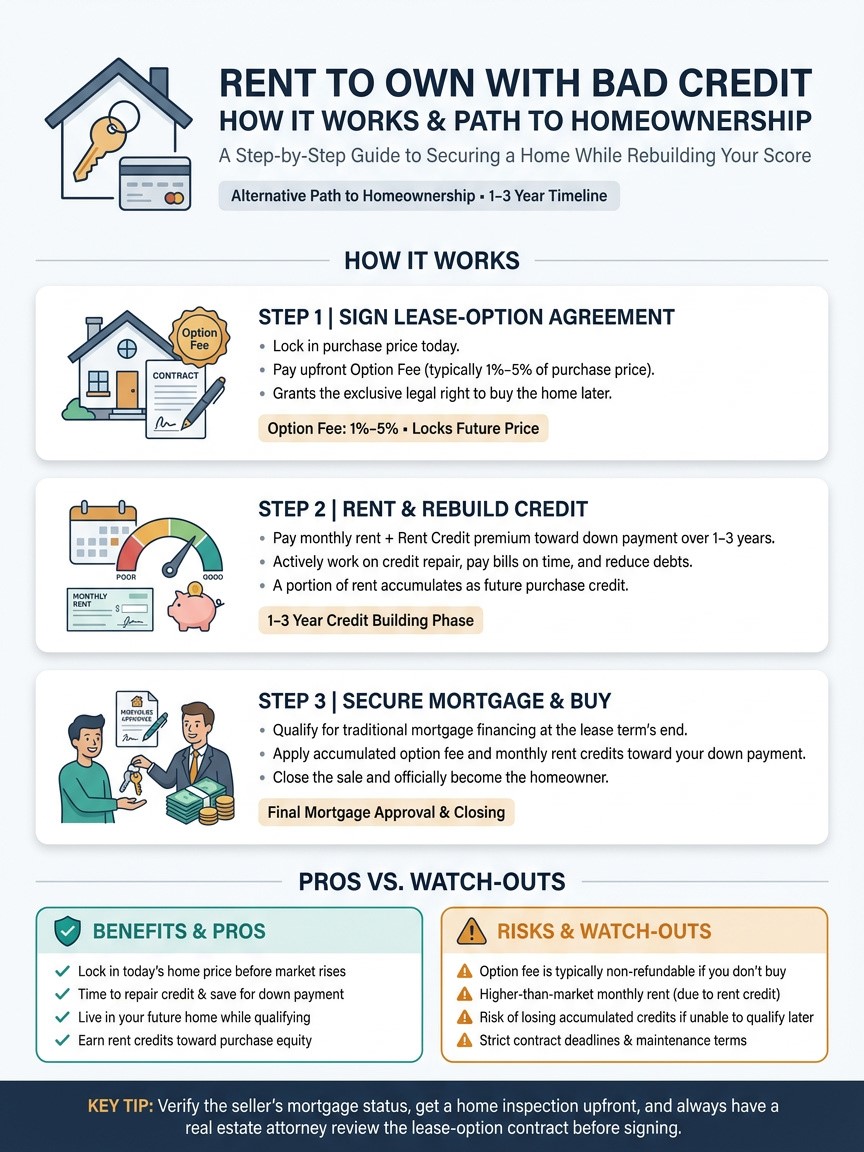 Super Money’s rent-to-own page tells most buyers to seek this structure because walking away carries no legal consequences. Clever’s guide agrees that the fee and credits are your risk. A lease-option costs more than a plain lease, but it adds flexibility and limits your downside.
What is a lease-purchase agreement?
A lease-purchase agreement binds you to buy when the lease ends, whether or not your finances have improved. If you cannot qualify, you face legal and financial penalties. Treat the obligation to buy as the most serious clause in the document.
Clever’s guide recommends hiring a real estate attorney to review this kind of contract. Request a contract review that checks for hidden clauses, the exact closing date, and who pays for repairs. Pay for that review before you sign, because you cannot renegotiate after the option fee leaves your account.
How much does rent to own cost upfront and each month?
Expect a non-refundable option fee of 1% to 5% of the price, plus above-market rent every month throughout the lease. On a $300,000 home, that fee runs from $3,000 to $15,000 upfront. Clever’s guide gives that 1–5% range as typical.
Part of your rent may count as rent credits, but only if the contract says so in writing. Run a market rent comparison for the same neighborhood, and check the total rent vs market rent over the full lease. If the gap exceeds the credits you earn, you pay extra for the option and build no savings.
Can you qualify for rent to own with bad credit?
Many sellers accept bad credit, but they still ask for income verification and a background check. Rent-to-own companies often set a minimum credit score as well. Clever’s guide lists these rules and notes that service areas and eligible homes vary by program.
Stable income matters more than a flawless file, so collect pay records early. Show savings growth month by month, because sellers want proof that you can fund the fee and keep paying rent. Keep that money in a separate savings account so you can document it quickly.
How does your credit score affect the mortgage at the end?
Your credit score decides whether a lender approves or denies your mortgage when the lease ends. A credit score under 600 often means higher costs or a denial for borrowers. Kikoff’s blog explains what a subprime mortgage is and what it costs.
Focus on on-time payments, because payment history carries the most weight, and lower your credit utilization. Kikoff’s blog covers hard inquiries and the debt-to-credit ratio, so avoid unnecessary applications and let your account age grow. Each gain in credit score points improves your credit approval odds, so track progress every month.
How can you improve your credit score during the lease?
Pay every bill on time, keep balances low, and dispute errors on your credit report. Rent reporting and bill reporting add your regular payments to your credit history over time. Kikoff and Self both list these services on their own websites.
Kikoff states that its rent reporting sends payments to Equifax and TransUnion monthly, and Self says it reports rent to all three credit bureaus. Credit repair takes months, so start on day one of the lease. Many people build credit from scratch with a credit builder product and aim for a good credit score before applying.
Which brands help with credit building and home buying?
Several brands cover parts of the journey, and each offers the services listed on its own website. Self lists a Credit Builder Account, a Credit Builder Loan, and a Self Visa Credit Card, which is a secured credit card. Kikoff lists a credit account, credit monitoring, credit disputes, debt negotiation, and free credit scores.
SuperMoney lists budgeting, net worth tracking, and a financial plan with financial goals inside its app. Kikoff’s Fynn tool offers personalized insights, and Self presents its products as a credit-building toolkit. Clever lists a concierge team, home buyer rebates, and cash back after closing in eligible states, while Century 21 Advantage Gold lists a mortgage calculator and property search for Pennsylvania and New Jersey.
Where can you find rent-to-own homes near me?
Search rent-to-own listings on Zillow and Redfin first, then add specialist sites and an agent. Clever’s guide names Rent to Own Labs, HomeFinder, and ZeroDown as rent-to-own websites worth checking. These homes appear rarely, because they make up less than 2% of housing arrangements.
Use the Zillow rent-to-own filter to narrow results, and ask a real estate agent experienced with rent-to-own to approach sellers. Many deals start through direct negotiation with sellers, so message owners of rental properties and post in Facebook groups. A buyer’s agent can also compare single-family homes and flag rent-to-own homes near me that skip the portals.
What do rent-to-own companies like Divvy Homes offer?
Rent-to-own companies buy a home and lease it to you while you prepare for a mortgage. Divvy Homes uses a three-year term, and Home Partners of America uses one-to-five-year terms, according to Clever’s guide. That guide cites research showing that only 38–50% of participants buy the home.
Compare rent credits, the lease term, and what happens if you cannot buy. Check service areas and eligible homes first, since programs cover select cities. Read Trustpilot reviews before you apply.
What risks come with rent to own with bad credit?
The biggest risks are fees you cannot recover, a price you cannot change, and a mortgage you cannot win. Many tenants pay above-market rent for years and then fail to qualify. Clever’s guide warns that unfavorable terms and high upfront fees appear often.
Maintenance responsibilities often shift to the renter, so ask who handles repairs and upkeep before you sign. A locked-in purchase price hurts if the neighborhood cools. If you are unable to qualify for a mortgage, you leave with no home and no refund.
How should you negotiate a rent-to-own contract?
Negotiate the price, the option fee, the rent credits, and the exit terms before you sign anything. Ask for a lease-option, a fair rent, and written repair duties from the seller. Every figure you settle now removes one more surprise later.
When I compared guides for this article, the strongest advice always told buyers to write the exit plan into the contract. Ask what happens if you lose your job, if the home needs a major repair, or if the lender denies you. Keep copies of every payment, because those records protect you if the seller disputes credits.
How do you spot rent-to-own scams?
Verify the seller is the owner, compare the price with nearby sales, and read every clause. Warning signs include an overpriced property and a vague contract. Clever’s guide advises you to report fraud to the police and the Federal Trade Commission.
Pull ownership information from county tax records to confirm the seller holds title. Search for BBB complaints, then check whether the company resolved customer complaints. Judge the price against fair-market value, because a price far above or below it signals trouble.
Is rent to own worth it compared to other options?
For many buyers, a short credit repair plan and a small down payment beat a long lease on the road to homeownership. Clever’s guide says six months to a year of focused repair can unlock traditional financing. It also puts the low down payment range for an FHA loan or conventional loan at a 3% to 3.5% down payment.
Rent to own still suits buyers who want to avoid moving twice, lock in a price, and try the home and neighborhood first. Zillow lists benefits such as the chance to build credit history while renting, and it warns about a limited pool of homes. Experian’s guide says the lease period can add buffer savings and leverage for a mortgage application, making rent to own an alternative path to homeownership for some tenants.
How do you choose the right service provider?
Choose a provider that explains fees in writing, lists its service areas, and shows verifiable reviews. Ask whether the contract is a lease-option or a lease-purchase, and request a home buying checklist. Compare two or three providers before you sign anything.
Use state-by-state guides for local rules, ask a mortgage advisor how close you stand to mortgage pre-approval. Run a mortgage calculator to test your monthly mortgage payment, and check home affordability, closing costs, and the home appraisal. Kikoff’s rent vs buy calculator and its posts on mortgage pre-qualification and how long it takes to buy a house help each first-time home buyer build financial literacy.
FAQs
Can I rent to own with a credit score under 600?
Yes, some sellers and programs accept it, but expect questions about income and savings. A lender still decides your loan approval at the end. Use the lease to raise your score, and compare interest rates from more than one mortgage lender.
Do I lose my money if I cannot buy?
Usually you lose the option fee and rent credits, and a lease-purchase can add penalties on top of that. A lease-option limits the loss to those amounts alone. Ask a real estate attorney to confirm the numbers in your specific contract.
How can I buy a house with bad credit without rent to own?
Many buyers save for a down payment, repair their credit, and apply for a low-cost loan. Saving for a down payment of 3% to 3.5% can take less time than a long lease. Kikoff’s blog also publishes a guide on how to buy a house with bad credit.
Where should you start with rent to own with bad credit?
Read the contract type, the fees, and the exit terms, then match each to your income and credit plan. This website helps you compare providers, spot red flags, and find rent to own with bad credit options that fit your situation. Visit this site, review the points above, and contact each brand to confirm its listed services.