
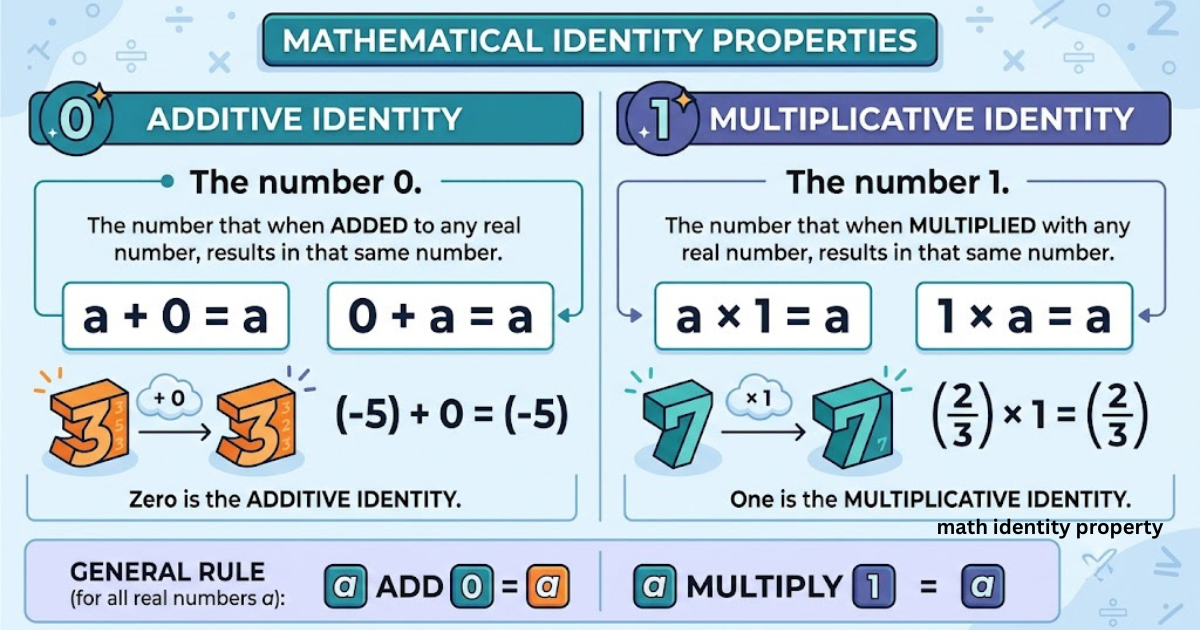
I used to tutor a neighbor’s kid who hated algebra, until one rainy afternoon we found the foundation hiding under all the confusion the math identity property.
It sounds fancy, but really it’s just one of the main types of rules that govern arithmetic, sitting quietly beside other number properties while numbers and variables move through every operation we throw at them.
This guide takes you through the first steps of the topic, showing how special numbers keep values unchanged, why the identity property shows up while solving equations, and how simplifying expressions gets faster once these number properties click in your head during everyday situations.
What Is the Identity Property in Math?
Here’s the trick I tell every student: imagine a number walking straight through an arithmetic operation and coming out untouched on the other side that’s the whole story behind the identity property.
You can add a value, try to remove it, watch it grow, or wonder if it will shrink, yet the result stays unchanged because one special value, the identity element, protects the original number from any change.
This general rule stretches across every group among the types of numbers we study natural numbers, whole numbers, integers, rational numbers, and real numbers which means any number matched with its correct identity element for operation remains completely invisible to that operation.
Additive Identity Property
My students always memorize this rule fast: the additive identity property simply says that adding 0 to any number hands you back the same number, an unchanged value every single time.
Test it yourself with plain addition plus equals negative plus 0 still equals tricky decimal like 12.5 plus 0 keeps its exact value. These easy examples are why 0 carries the nickname additive identity in classrooms everywhere.
Multiplicative Identity Property
The same logic flips over into multiplication, guided by one steady rule known as the multiplicative identity property. Multiply any number by 1, and you land right back on. The same number after multiplying by keeps its decimal shape without shifting. These examples explain why 1 wears the crown of multiplicative identity in every math notebook.
Does Identity Property Apply to Subtraction and Division?
A question I get a lot: do subtraction and division copy the pattern set by addition and multiplication? Not quite, because the identity property doesn’t hold true in both directions for these two.
A checks out perfectly, yet reverse the order and falls apart right away. Division hits the same wall works, but collapses unless confirming this property truly belongs only to addition and multiplication.
Identity Property vs Other Number Properties
Line up the number properties together and the comparison turns genuinely interesting. The commutative property plays with position, easily seen in while the associative property cares about grouping, visible in.
Meanwhile, the distributive property spreads a number over a sum yet the identity property stays unique because it depends on a single special number doubled down again with.
Real-Life Examples of Identity Property
Math doesn’t stay locked inside a textbook, and real-life examples of this concept pop up constantly during everyday situations.
Add ₹0 to your money, and the total sits right at exactly the sort of thing that happens while shopping for a product priced at its listed price.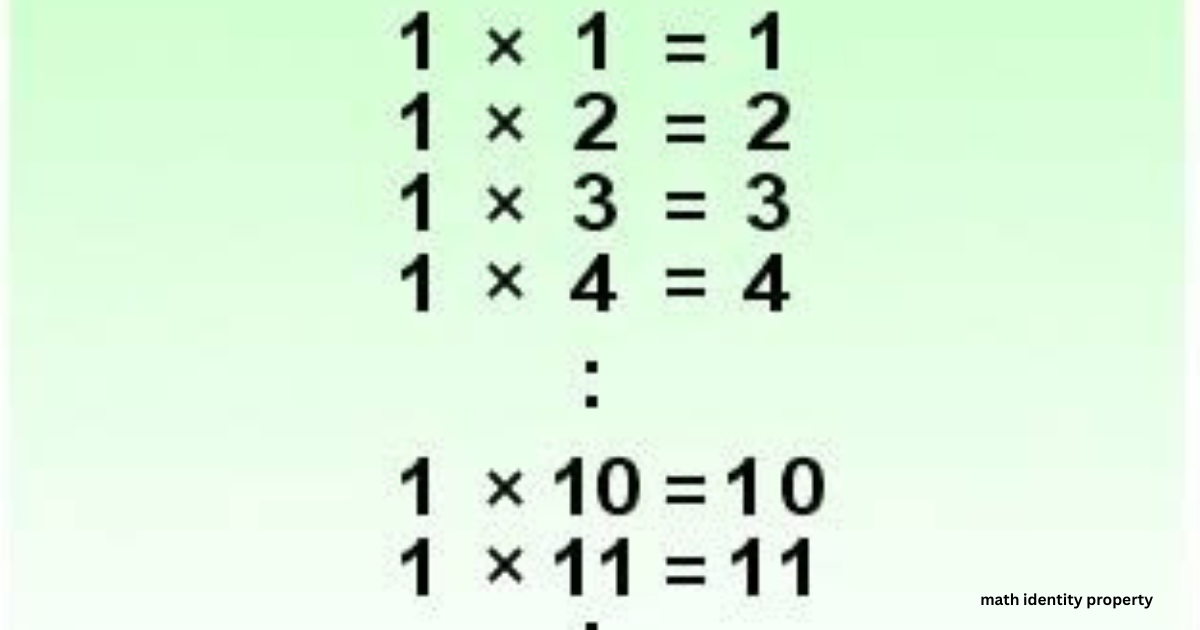
Grab just 1 unit, and the price never budges, while sharing a bag of candies with only 1 person means that person walks away with the whole bag even glancing at the temperature and adding 0 degrees leaves the number frozen right where it began.
Solved Examples
Nothing beats working through solved examples to make this stick. Example 1 takes 24+0 and lands on 24 thanks to the additive identity property.
Example multiplies returns through the multiplicative identity property. Example 3 solves revealing that e=0. And example blends both rules becomes staying even after zero joins in.
Why Is Identity Property Important?
This concept reaches far beyond one homework page. It sharpens number sense for early learners, supports isolating variables inside algebraicmath identity property simplifying expressions at every grade.
Step into advanced math, and identity elements turn into a foundational concept behind entire mathematical structures explored in group theory a small childhood rule that never really disappears.
FAQs About math identity property
What is the identity property in math?
It’s the rule where a number passes through an arithmetic operation and stays completely unchanged. The identity element for addition is 0, and for multiplication, it’s 1 that’s really the whole heart of the identity property.
What are the two types of identity property?
The identity property splits into two types: the additive identity property, anchored by 0, and the multiplicative identity property, anchored by 1.
What is the identity element for addition?
For addition, the identity element is 0, since a+0=a never fails.
What is the identity element for multiplication?
For multiplication, the identity element is 1, because a×1=a holds every time.
Does identity property apply to subtraction and division?
Only partly. The identity property works smoothly for addition and multiplication, while subtraction and division only hold in one direction — a-0=a and a÷1=a are true, but the reverse, 0-a=a and 1÷a=a, isn’t.
Is identity property the same as commutative property?
Not at all. The commutative property deals with the order of numbers, shown through a+b=b+a, while the identity property leans on a single special number — 0 or 1 — that leaves another number entirely unchanged.
Can identity property apply to negative numbers and decimals?
Yes, without question. The identity property holds true across all real numbers, covering negative numbers, decimals, and fractions too.