

I still remember struggling with geometry homework as a student, especially when quadrilaterals like the trapezium showed up on every exam paper.
This article breaks down the full definition, types, and properties of a trapezium, covering everything from its angles and diagonals to its area and perimeter.
You will also find simple formulas and solved examples with parallel sides explained clearly, so nothing feels confusing again.
What is a Trapezium?
A trapezium is simply a two-dimensional quadrilateral with exactly one pair of opposite sides running parallel to each other, and this pair is called the bases, while the other two sides are known as legs or non-parallel sides.
The height of the shape is the perpendicular distance between those bases, and depending on which region you are learning from, the terminology can shift.
In the UK and Indian convention it stays a trapezium, but in the US, the same shape is called a trapezoid in American English.
I always tell my students not to panic over the name change, because the shape and its rules stay exactly the same no matter where you study.
Properties of Trapezium
Every quadrilateral carries interior angles that add up to 360 degrees, and a trapezium follows this rule too, with its adjacent angles turning out supplementary and equalling 180 degrees along each leg.
Inside the shape, two diagonals cross and always intersect, while a median, also called a mid-segment, joins the midpoints of the legs and runs parallel to both bases, its length equal to half the sum of the parallel sides. 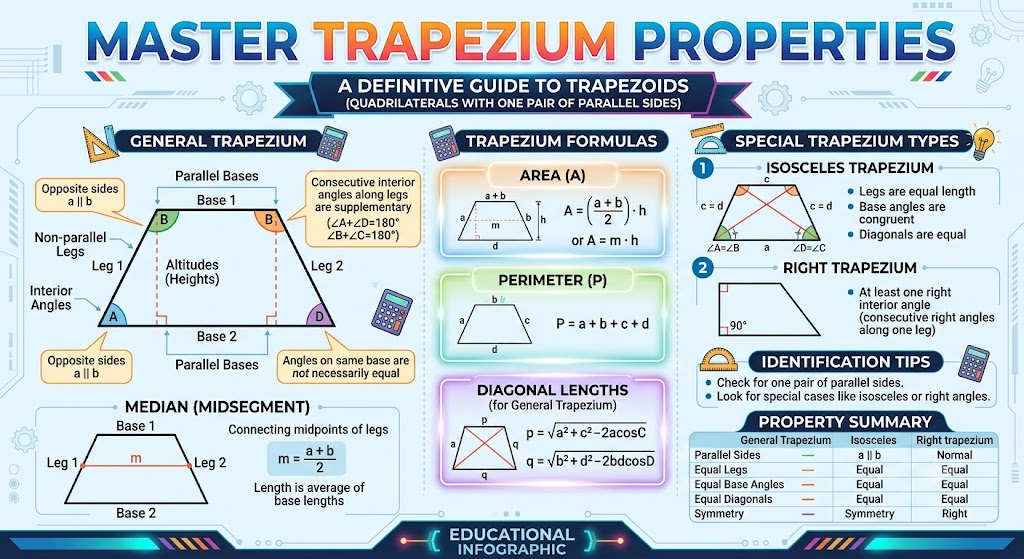 Most trapeziums carry four sides of different measure, so we call them unequal sides, unless the shape happens to be isosceles, where the non-parallel sides match each other exactly.
Types of Trapezium
An isosceles trapezium carries legs of equal length, which makes its base angles match perfectly and its diagonals come out equal too.
A scalene trapezium, on the other hand, has four sides of different lengths, so none of its non-parallel sides or bases line up in any special way.
Then comes the right trapezium, where one leg stands perpendicular to both bases, creating right angles of 90 degrees on that side alone.
Area of a Trapezium
The area of a trapezium is the space enclosed within its four sides, and we find it using a simple formula times the sum of the parallel sides, multiplied by the height.
Which is really just the perpendicular distance between the two bases. Let me walk you through a quick example to make this stick: if the two bases measure the working part looks like.
That gives us a final area of 40 cm², and honestly, once you plug in real numbers like this, the whole formula clicks instantly.
Perimeter of a Trapezium
Finding the perimeter of a trapezium is refreshingly simple you just add up the lengths of all four sides. That means the sum of the two bases plus the two legs gives you the total distance around the shape. No tricky formula here, just plain addition that even beginners handle with ease.
Trapezium vs Parallelogram
Students often confuse a trapezium with a parallelogram, but the distinction is actually easy once you see it clearly. A trapezium keeps only one pair of parallel sides, while a parallelogram keeps both pairs of opposite sides running parallel, with its diagonals managing to bisect each other and stay equal in every case. Most textbooks stick to this exclusive definition, meaning a parallelogram never technically counts as a trapezium.
Common Mistakes to Avoid
Master Trapezium Properties constantly is students assuming a shape with two pairs of parallel sides is a trapeziumWhen that shape is actually a parallelogram. Another slip-up happens when learners believe diagonals stay equal in every trapezium, though this only holds true for isosceles trapeziums.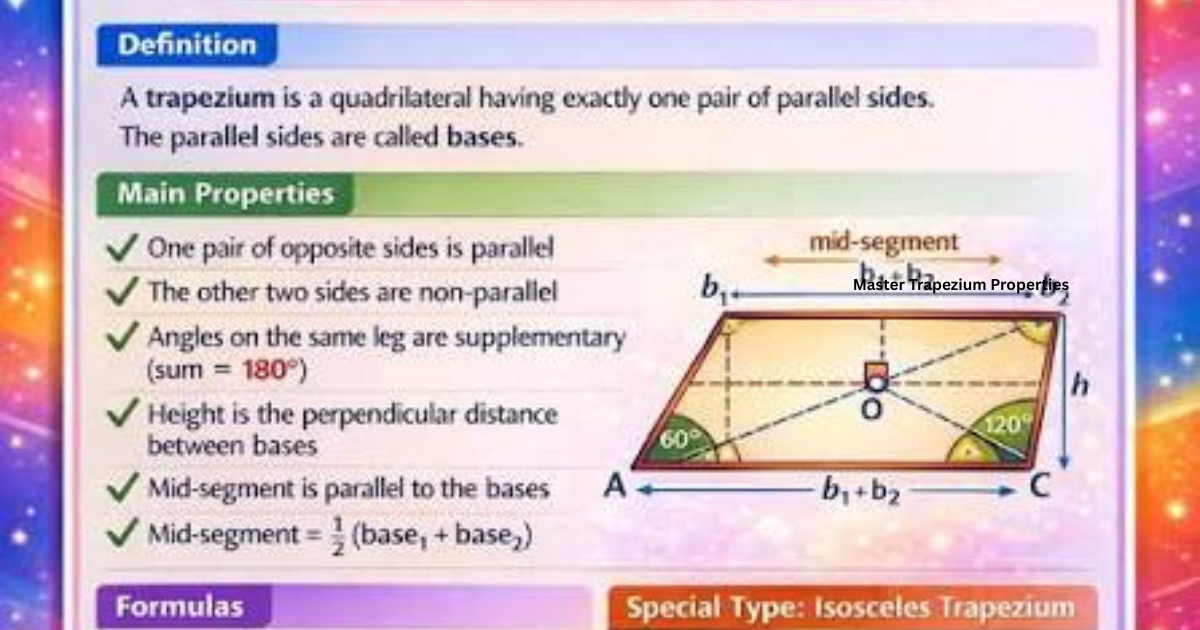 Lastly, many forget to add both bases together before multiplying by the height in the area formula, which throws off the entire answer.
Real-World Applications
Beyond the classroom, trapezium shapes show up everywhere in real life, especially in architecture and carpentry, where roof designs, bridges, and even furniture often rely on this exact shape.
In computer graphics, mesh modeling and rendering use trapezium-based calculations to build realistic 3D surfaces. And in physics, the trapezium’s area helps engineers work out the center of mass problems with surprising accuracy.
Conclusion
By now, you have a full grip on trapezium properties, from its angle relationships and parallel sides to its area and perimeter formulas.
Whether you are working with an isosceles, scalene, or right trapezium, these core properties stay consistent every single time.
This little quadrilateral proves that geometry does not have to feel intimidating once you understand the shape from the inside out.
FAQs About Master Trapezium Properties
What are the basic properties of a trapezium?
A trapezium always keeps one pair of parallel sides, called bases, along with two non-parallel sides known as legs. Its interior angles add up to 360 degrees, and its diagonals always intersect somewhere inside the shape.
What is the formula for the area of a trapezium?
The formula for area is straightforward: multiply the height by the sum of the parallel sides, then take half of that result.
Is a parallelogram a trapezium?
No, a parallelogram has two pairs of parallel sides, while a trapezium keeps only one pair, so under the exclusive definition most textbooks follow, a parallelogram is never classified as a trapezium.
What is an isosceles trapezium?
An isosceles trapezium has non-parallel sides, or legs, of equal length, which makes its base angles and diagonals come out equal as well.
Do the diagonals of a trapezium bisect each other?
Not quite the diagonals of a trapezium simply intersect, but they only bisect each other inside a parallelogram.
What is the difference between a trapezium and a trapezoid?
It really just comes down to region the same shape is called a trapezium in British English and Indian English, while it becomes a trapezoid in American English.