
Every buyer researching under-construction property wants a clear answer on one thing: how much GST actually adds to the final bill.
The GST rate structure treats affordable housing and regular flats differently, and the GST Council has kept this two-tier system in place since the last major overhaul.
Under the current rules, affordable housing projects attract just 1%, while non-affordable residential units are taxed at 5%, and both come without Input Tax Credit.
The qualifying criteria matter as much as the rate itself, because a flat only counts as affordable when its carpet area stays within 60 sqm in metro cities or 90 sqm in non-metro cities, alongside a property value capped near lakh.
Builders working across metropolitan towns and non-metropolitan towns must track this carefully, since crossing the threshold shifts the entire effective tax picture for the buyer.
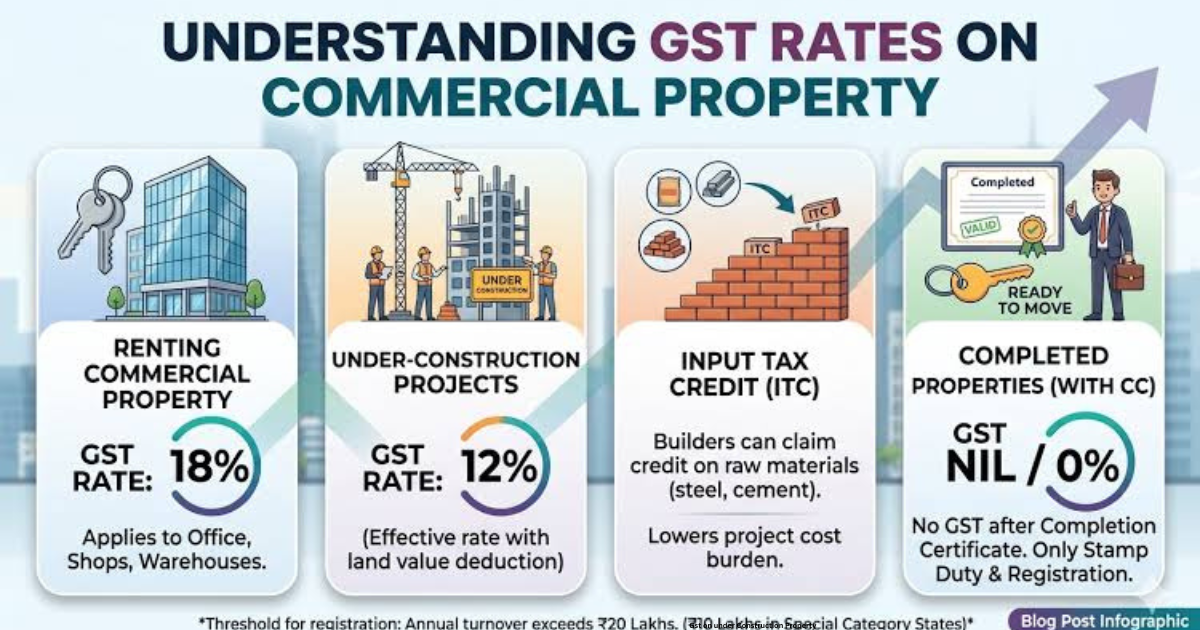
Commercial space follows its own path entirely, with commercial properties and commercial under-construction units taxed at 12%, and here ITC is actually allowed.
These numbers replaced the older regime that charged 8% on finished properties meant for affordable buyers and 12% on everything else, a switch that took effect from April.
The GST 2.0 rate revision, rolled out around September left residential property taxation untouched even though it reshaped several other categories.
Land itself stays outside this net, since only one-third of a package deal is treated as the cost of land and the rest falls under works contract services.
While any project holding an occupancy certificate before sale remains exempt entirely, a distinction the real estate industry and non-affordable housing projects developers watch closely under every GST rate cycle.
GST Overview: Why GST Applies to Under-Construction Property
Many buyers ask why ready-to-move-in homes skip GST while unfinished flats don’t, and the answer sits inside basic tax law.
Constructing a building counts as a construction service under the supply of goods and services framework, so anyone paying for an ongoing construction service is technically buying a service, not a finished asset.
Once a municipal authority or development authority issues the Completion Certificate or Occupancy Certificate the property gets reclassified and stops being a service in progress.
It becomes immovable property, and under Schedule III of the CGST Act, the definition of supply simply excludes such completed assets from GST’s reach. That’s the moment a flat effectively turns GST-free. This distinction carries real tax implications for anyone weighing a purchase decision between an under-construction unit and a ready one.
The sale of property after the completion certificate stage involves no service component at all, so the government has nothing left to tax. Buyers who understand this timing rarely get caught off guard by a builder’s GST invoice.
How to Calculate GST on Under-Construction Property
Working out the exact GST computation on a flat is easier than most buyers expect once you know the base price. Take an affordable housing flat priced at in a non-metro city with an 85 sqm carpet area the GST amount here comes to just taking the total cost to.
Compare that with a non-affordable flat, say a 2 BHK in a metro city listed at lakh, which equals where a sqm carpet area pushes the GST amount to bring the total cost to.
Commercial buyers do the math differently, since a commercial property or office space worth Rs.1 crore attracts a flat lakh in GST at the rate.
A Rs.50 lakh residential purchase, meanwhile, would add roughly ₹2.5 lakh more under standard rules though remember that stamp duty and registration charges sit completely outside this calculation.
Extra charges like a clubhouse fee or a preferential location premium can also carry their own GST component, so it pays to check every line item on the builder’s cost sheet before signing.
Impact of GST on
For most homebuyers, GST shows up as an upfront cost addition layered directly on the base price, and this single line item shapes the overall tax burden they carry through the purchase.
On the plus side, transparency has genuinely improved since one visible GST line replaced a maze of hidden charges buried across old-style taxes, making financial obligations easier to plan for.
That said, the pros and cons of this system aren’t evenly split for everyone.Anyone shopping in non-affordable residential zones feels the pinch more sharply, because the financial pressure rises.
When there’s no ITC pass-through to soften construction costs for developers. Since developers can’t claim input tax credit on the input costs they pay for materials, they often pass that gap straight into property prices, adding to the buyer’s financial burden. Even the cement GST rate, despite recent cuts, still filters into pricing decisions somewhere along the chain.
Here’s where the comparison incentive kicks in weighing an under-construction flat against ready properties almost always comes down to total outlay, not sticker price alone.
A ready flat with zero GST can turn out more cost-effective than a slightly cheaper unit still carrying tax, especially under today’s competitive market pressure between builders.
This is exactly why simplified taxation hasn’t erased every upfront costs concern; it just made the numbers easier to compare side by side.
Is GST Applicable After Possession?
A lot of confusion comes from mixing up physical possession with the actual tax trigger, but the real marker is the CC/OC issuance date compared with your purchase agreement timeline.
If the competent authority hasn’t issued the Completion Certificate or Occupancy Certificate by the time you sign, the deal counts as an under-construction property transaction, full stop.
Every rupee you pay before that certificate lands falls squarely within GST scope, whether it’s a single payment or a series of installments.
Payments made after the certificate is issued, though, sit completely outside taxation, even if you haven’t moved in yet.
This matters most for anyone booking a flat during construction, since early instalments almost always attract GST while the final ones might not, depending on timing.
Knowing this sequence in advance helps you budget the full journey rather than getting surprised by a late-stage tax bill.
GST Effect on Construction Materials
Buyers aren’t the only ones paying GST; builders shoulder their own share on every construction input purchase that goes into a project.
Cement and steel or iron products both sit at while bricks, sand, and aggregates are taxed at and paint along with other finishing materials rounds out the list as well.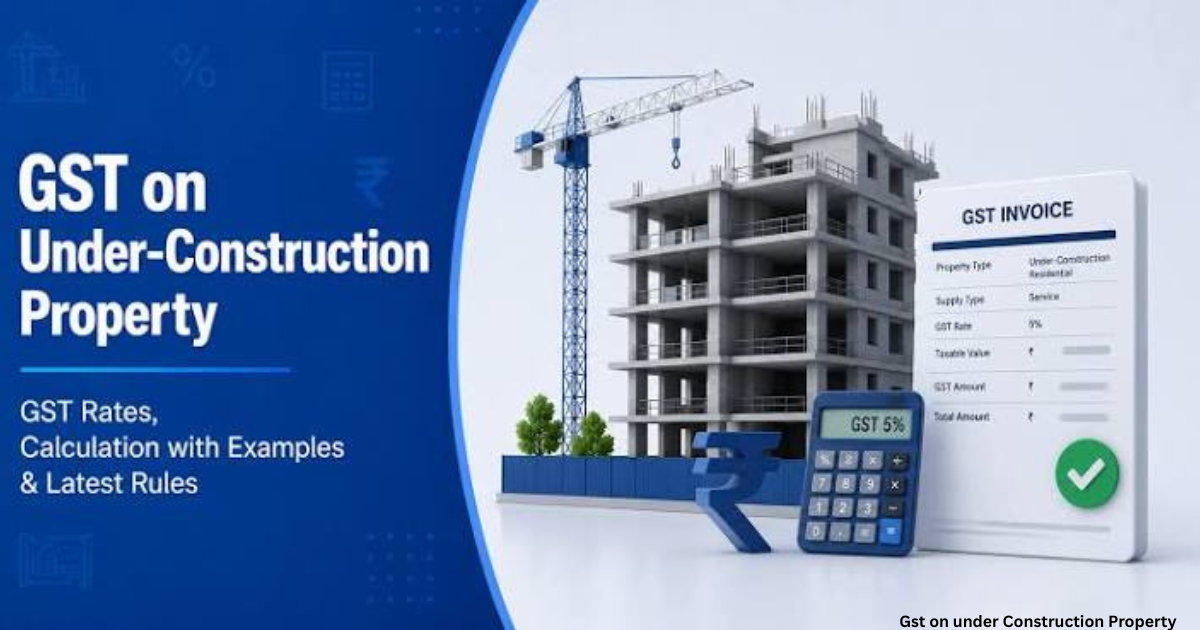 The GST 2.0 revision, effective from September 2025, brought welcome cost relief by cutting cement from down to easing project costs for many residential projects.
Unfortunately, this saving doesn’t automatically flow to buyers, because there’s no ITC offset available against the GST liability builders owe on residential sales.
So while cheaper materials can improve developers’ margins and overall project viability, the benefit stays largely on the builder’s side of the ledger. It’s a reminder that lower input costs don’t always translate into a lower flat price for the end buyer.
What is the Difference Between GST and Stamp Duty?
People often lump GST and stamp duty together, but they’re levied by entirely different bodies. GST comes from the Central Government through the GST Council underwhile stamp duty is a State Government matter governed by each state’s own State Stamp Act.
The stamp duty rate typically runs between 5–8% and applies to property registration on every deal, whether it’s a fresh booking or one of many resale properties changing hands.
GST, by contrast, only touches under-construction purchases and skips registration charges entirely.Knowing the governing law behind each tax helps buyers avoid confusing the two when budgeting a purchase.
One is a service tax tied to construction status, and the other is a fixed state levy tied purely to the paperwork of ownership transfer.
Does GST Apply to Land Value?
A plain sale of land, with nothing else bundled in, sits completely outside GST’s reach. The Central Board of Indirect Taxes and Customs has repeatedly since Schedule III excludes standalone land value from the definition of a taxable supply.
Things get murkier with composite contracts, where a buyer purchases land and signs a separate construction agreement with the same developer for building on it.
Tax officers may treat this as a composite supply, which can pull the construction value portion back into GST’s scope.
Joint development arrangements raise similar disputes, especially when the land and construction values aren’t clearly split in the paperwork. Getting that separation right in writing avoids unnecessary tax friction down the line.
Are Under-Construction Properties More Expensive Because of GST?
GST alone doesn’t tell the whole cost story, because under-construction units usually start with a lower base price per square foot than gst on under construction property.
Builders price this way to account for construction-stage risks and the time value of money tied to early bookings, which often balances out the extra tax.
Construction-linked payment plans also offer real payment flexibility, spreading both cost and GST across the build timeline instead of demanding one lump-sum payment upfront, a huge relief for cash flow planning.
Early buyers frequently get more say in customisation options too, from interior specifications and fittings to layout adjustments that a finished flat won’t allow.
Add it all up, and an under-construction unit can end up genuinely cost-competitive, sometimes even cheaper than the ready-made alternative once you calculate the full total outlay. The smart move is always comparing complete costs, not just the tax percentage sitting on top.
How is GST Going to Affect the Real Estate Sector?
Zoom out, and GST has genuinely reshaped the real estate sector in a handful of measurable ways. The concessional rate on affordable homes has driven real encouraging builders to launch more projects that fit within the qualifying limits.
On the compliance side, folding VAT, service tax, excise duty, and entry tax into one single number brought genuine transparency improvement, making it far easier to compare builders and projects.
Input cost adjustments, like the recent cement cut, also support builder cost management and, in turn, some price stability across the market.
The structural advantage enjoyed by ready flats continues to influence demand contributing to a slow buyer preference shift towardparticularly in cities sitting on heavy unsold ready inventory.worth watching if you’re timing a purchase around resale value.
How Does GST on Under-Construction Property Affect Home Loans?
Financing an under-construction flat with a home loan means GST becomes part of your total funding requirement, not a separate side expense.
Most lenders calculate both loan eligibility and the disbursement schedule against the GST-inclusive cost of each stage, rather than the bare base price.
Every tranche typically gets released in step with the construction-linked payment plan, matching the amount you owe at each construction milestone.
Skipping GST from your calculations early on is a common mistake, so it’s worth padding your requested loan amount to cover it from day one rather than scrambling for extra funds midway through construction.
Impact on Builders
GST compliance sits high on every builder’s checklist, and the rules hit commercial developers and residential ones differently.
Commercial players can deduct GST paid on inputs, which effectively means lower taxes for them, but builders working on non-affordable housing units don’t get that same relief.
That gap usually shows up downstream as expensive houses, since the extra cost has to land somewhere in the pricing.  On the paperwork side, staying compliant means filing GSTR 1 and GSTR 3B returns along with monthly invoices that follow proper GST format for every buyer.
Skipping this regulation isn’t a small risk. Either poor compliance can trigger a penalty or worse, drag a builder into legal problems that delay project handovers entirely. Buyers should honestly check a builder’s compliance history before signing anything major.
How to Avoid GST on Under Construction Property
Nobody should confuse smart tax planning with tax evasion. The two are worlds apart, and only one of them is legal.
Genuine legal strategies exist for trimming your GST bill, starting with simply buying finished properties that already carry a completion certificate and owe zero tax.
Joint development agreements offer another route, where you own the land yourself and only the construction services taxable portion attracts GST, typically 18% residential or 12% commercial depending on the build type. Opting for blended housing projects can also mean landing in the low 1% bracket instead of the standard rate.
Builders sometimes use a composite scheme with an advance deduction of 1% GST on residential sales, which can translate into lower buyer costs when structured properly. None of these routes involve hiding income or dodging tax; they simply use the law as it’s written.
Compliance Requirements
Compliance isn’t only a builder problem; buyers who ignore it risk their own legal complications down the road. Builders are expected to maintain comprehensive records and issue proper invoicing for every payment collected.
Before signing anything, confirm the builder actually holds valid GST registration and that the sale agreement clearly states the GST amount included in your price.
Skipping this check invites unforeseen tax exposure later, exactly the kind of surprise nobody wants after handing over lakhs in booking money.
GST on Construction of Residential House
Building your own house works differently from buying one, since self-constructed residential units don’t attract GST on the amalgamated cost of the finished structure.
Instead, tax applies separately to materials and contractor services or labor services used along the way.
Self-construction carries no ITC entitlement either, meaning every rupee spent on cement, steel, or labor stays fully taxed with no credit to claim back.
Anyone planning this route should build these separate material and service taxes into their overall budget right from the design stage.
FAQs About Gst on under Construction Property
How to calculate GST on under-construction property with examples?
Multiply the base price by the applicable rate for affordable housing for regular residential units. A lakh affordable flat adds just taking the total to. lakh, while a same-priced non-affordable flat adds lakh, landing at lakh.
What is the GST rate on under-construction property?
It’s 1% for affordable housing flats with carpet area up to sqm in metros or sqm in non-metros, priced under and for other residential units, both without Input Tax Credit.
Why is GST applicable only on under-construction properties?
Because law treats an unfinished flat as a supply of construction service, not a sale of finished property. Once the Completion Certificate arrives, the unit becomes immovable property, and Schedule III of the CGST Act takes it entirely out of GST’s scope.
Is GST applicable after possession?
GST depends on CC/OC issuance timing relative to your payments, not on physical possession. Any amount paid before the Completion Certificate is issued attracts GST; anything paid after does not.
Does GST apply to land value?
No, a standalone land sale carries no GST at all. It only enters the picture through composite arrangements, where a construction agreement bundles land with construction services, pulling the construction portion back under tax.
What is the difference between GST and stamp duty?
GST is a central tax of essentially a service charge on under-construction purchases. Stamp duty, on the other hand, is a state-level levy running applied to all property registrations regardless of construction status.