
Smart buyers who study a denver co mountain parcel begin with due diligence, and a flat in Madipakkam deserves the same care. This guide walks you through the checks, the costs and flat in Madipakkam, Chennai the common traps in plain words. Read it before you pay.
What should I know before buying a flat in Madipakkam?
Madipakkam is a residential suburb in south Chennai, a few kilometres from Velachery, with a steady real estate market of mid-sized apartment buildings. Expect to verify the title, study the flood history and keep about 11 percent of the price aside for government charges. Settle these three before you tour a show flat.
Many buildings here stand on older plots that builders redeveloped, so you usually buy a share of the land along with your flat. That makes ownership details more important than the paint colour or the modular kitchen. A good rule is to read the papers first and tour the flat second.
Why do buyers choose Madipakkam?
Buyers choose Madipakkam for its quiet streets, its nearness to the IT corridor on Old Mahabalipuram Road and its easy links to Velachery and Medavakkam. Families also like the schools, hospitals and daily shops within a short drive. Prices stay lower than in prime south Chennai areas such as Adyar.
A cheaper tag does not mean a weaker locality, but it does mean you must compare carefully. Run a quick market analysis by checking recent sale prices in the same lane, not just the broker’s average. Streets only two blocks apart can differ by several lakhs.
Who should think twice about buying here?
If you hate traffic, you may struggle, because Medavakkam Main Road and the Velachery junctions jam up during office hours. Buyers who want a secondary residence for occasional stays may find the area too busy. Buyers who plan a permanent residence usually adapt well.
Test the commute yourself before you commit. Drive the route at 9 am and again at 6 pm on a weekday. Five minutes on a map can turn into forty on the road.
How do I check that the flat has clean papers?
Ask the seller for the sale deed, the patta, the chitta, the approved plan and a fresh Encumbrance Certificate before you pay an advance. Each paper answers a different question about who owns the land, who built the flat and whether any loan or dispute hangs over it. Never skip one because the broker sounds sure.
Think of this step as reading the property records of your future home. Your advocate should trace every earlier sale in the chain, which is why resale flats need the parent deeds too. The recorded documents at the Sub-Registrar Office show whether the seller truly holds the title.
What are patta, chitta and the Encumbrance Certificate?
Patta and chitta are Tamil Nadu land records that show the registered holder and the type of land. The Encumbrance Certificate lists registered transactions and charges on the property for a chosen period. You can search these records online through the state’s land and registration portals.
Ask for an Encumbrance Certificate that covers at least the last thirty years. A clean certificate shows no mortgage and no registered claim. If it lists a loan, demand proof that the seller cleared it.
Does the legal description really matter?
Yes, because the legal description names the exact land, survey numbers and boundaries that your flat shares with other owners. A mistake there can cause trouble years later during a resale or a loan. Your advocate should match it against the deed line by line.
Check the undivided share of land, called UDS, as well. A flat with a tiny UDS gives you little claim on the plot if the building ever gets redeveloped. Ask the builder to state your share in square feet.
How much does it cost to buy a flat in Madipakkam?
Tamil Nadu charges 7 percent stamp duty and 4 percent registration fee on a standard sale deed, so government charges alone come to about 11 percent. The charge applies to the higher of your sale price or the state guideline value. On a Rs 70 lakh flat, that means about Rs 7.7 lakh.
Add these charges to the purchase price and your real budget looks very different. Banks generally do not lend for stamp duty and registration, so keep that money ready in your own account. Add a cushion for legal fees and the corpus fund.
How does stamp duty work on a flat?
The Registration Department takes the higher of your agreed price or the guideline value for that street. If the guideline figure beats your price, you pay duty on the guideline figure. Quoting a lower value in the deed does not save money and can bring a penalty.
You can pay online through the TNREGINET portal and then book your slot at the Sub-Registrar Office. The deed must reach registration within four months of signing. Bring both parties, two witnesses and the original papers.
What other property costs should I expect?
The list is longer than most buyers guess. A new flat bought from a builder before completion carries GST of 5 percent for non-affordable housing, while a resale or ready flat carries none. You also pay for parking, power connection charges and a corpus fund.
Keep a line in your plan for maintenance expenses as well. Monthly society dues, lift repairs, water tank cleaning and security all come out of your pocket. Ask the owners’ association for last year’s accounts before you buy.
Do I pay real estate taxes after I buy?
You do. Greater Chennai Corporation collects property tax twice a year, so your annual tax bill arrives in two parts. Ask the seller for receipts showing nothing is pending.
The assessed value of your flat sets the tax. It splits into land value and improvement value, the latter covering the building itself. Unpaid dues from the previous owner can follow the flat, so confirm the zero balance in writing.
Is Madipakkam safe from flooding?
Parts of Madipakkam flood during heavy rain, and several streets stood under water in December 2015 and again during Cyclone Michaung in December 2023. The suburb sits low and close to the Pallikaranai marsh, so drainage and elevation deserve a close look. Check the exact street, not just the area name.
Never trust a verbal promise that a building stays dry. Visit after a heavy shower and see where water collects. Ask residents which lanes flooded.
How do I check the flood zone risk of a flat?
Start with the ground floor level compared with the road, because a plinth below street level invites water. Look at the stormwater drains outside, and ask whether the builder raised the plinth. Upper floors reduce risk but do not remove it.
Residents’ groups often keep photos and dates from past floods. A building with a motor-operated sump, a raised car park and a backup generator copes far better. Treat these features as part of the price.
Should I worry about emergency preparedness and insurance?
Yes, because a flood can damage the ground-floor parking and the lift pit more than the flats. Ask whether the society keeps backup power and a working sump pump. Good emergency preparedness is cheaper than repairing a drowned lift.
Talk to insurance providers before you buy and compare cover for water damage and contents. Policies differ on what they pay after floods. Read the exclusions line by line.
What approvals should a builder have in Madipakkam?
A legal building needs a planning permission from the Chennai Metropolitan Development Authority or the local planning body, a building permit and, for larger projects, registration with the Tamil Nadu Real Estate Regulatory Authority. Ask for the approval numbers and check them yourself. A builder who hesitates deserves your suspicion.
Rules about zoning decide what a plot can hold, and the land-use rules for each locality cap the height and the share of land a building may cover. These local regulations exist to protect you as much as the neighbours. Ask the planning department and the building department to confirm the sanctioned plan matches what the builder constructs.
What are setbacks and why do they matter to a flat owner?
Setbacks are the open gaps a building must leave from the plot boundary and the road. A builder who ignores them may face demolition orders or fines, and the flat owners then suffer. Measure the gaps yourself when you visit.
Study the building footprints in the approved plan and compare them with the real structure. Extra balconies or an added floor often signal a violation. Ask for the completion and occupancy certificate on a ready flat.
Do permits and construction quality really need a separate check?
Yes, because a permit proves legality but not quality. Hire an engineer for a few thousand rupees to inspect the construction before you pay the final instalment. Cracks, damp patches and weak plaster show up quickly to a trained eye.
Check the structure year built on a resale flat, because older buildings need more repair. Ask for the number of stories the building has and whether the lift matches that height. A tall building with one slow lift makes daily life hard.
How should I inspect a flat before I buy?
Visit twice, once in daylight and once in the evening, and bring a checklist. Test every tap, switch and window, then stand on the balcony and look around. A calm inspection saves you from expensive surprises after possession.
Plan an in-person visit with a family member who sees what you miss. Slowly walk the property floor by floor, including the stairwell, terrace and parking. Photos can hide noise, damp and neighbours, but your senses cannot.
What should I look at inside the flat?
Check the number of bedrooms and number of baths against the sale agreement, and measure the carpet area with a tape. Confirm the usable space by walking through the layout and imagining your furniture. Look at the views and the light, because a window that faces a wall costs you every morning.
Open the electric panel and ask about electricity backup, then run water in every bathroom for a few minutes. Check for leaks under sinks. Confirm other utilities such as piped drinking water and the sewage connection.
How can technology help me check the neighbourhood?
Use mapping tools on your phone to study the aerial view of the plot and the lanes around it. Note the latitude and longitude of the building and compare them with the deed. Your phone camera and GPS also record where you took each photo.
A land survey by a survey professional costs more but settles doubts about boundaries. It confirms the property lines and shows whether neighbours built over any easements. Order one when the deed and the ground do not match.
What does the neighbourhood tell me?
Check the road access to the building, because a narrow lane makes fire engines and ambulances slow. See whether the driveway fits two cars and whether the parking has a sensible turn. Stand outside at night and listen to the traffic.
Look for the school district and nearby hospitals, which matter if you have children or parents. A park or lake offers outdoor recreation after work. Walk the lanes on a Sunday to feel the community.
How do I plan my loan and monthly budget?
Most buyers borrow part of the price, so compare at least three lenders and ask for the full fee sheet. Banks look at your income, existing loans and the property papers. Keep your EMI below about 40 percent of your monthly take-home pay.
Good financing starts with a clear picture of your price range. Check the last sale price of similar flats, and ask each bank for a valuation before you sign. Tax law lets you claim up to Rs 1.5 lakh on stamp duty and registration under Section 80C, but only on the old regime.
What if I buy for rent or resale?
Treat the flat as an investment property only after you check rents in the same lane. Gross yield in Chennai usually stays modest, so appreciation drives most returns. Compare the rent with your EMI and your maintenance expenses.
Look at listings in the building to see how fast flats sell. Slow sales hint at a hidden problem. Ask two local brokers about rental demand.
What numbers tell me the area will grow?
Look at population growth, population density and housing units growth from census-style data, plus the median household income around the building. Rising income and new homes usually support prices. Do not rely on one figure.
A housing affordability index helps you judge whether local families can keep buying. Compare it with a similar suburb and with your own budget. Plan for the downside as carefully as the upside.
What should I plan after I move in?
Keep a small fund for future improvements such as better lighting, a water purifier or a balcony grill. Check your society’s bye-laws before you drill or change anything on the outside. Small upgrades add up quickly.
Register yourself as the owner name with the society, the electricity board and the corporation so bills reach you. Update your mailing address for tax and bank letters. Keep a folder, paper and digital, with every receipt.
Closure Property of Multiplication
Multiplication follows almost the same pattern as addition, since natural numbers, whole numbers, integers, rational numbers, and real numbers all stay closed whenever you’re multiplying values from within them.
Take two integers, call them a and b; their product always turns out to be an integer, no surprises there.
But there’s one interesting exception: closure property of rational numbers irrational numbers are not closed under this operation, and here’s an example that proves which simplifies down to 4, a plain rational number rather than something irrational.
This single result shows that multiplying two irrational values doesn’t guarantee an irrational answer at all.
Closure Property of Division
Division is where closure most often breaks down, since natural numbers, whole numbers, and integers are all not closed under it.
Here’s a simple example and that decimal really just a fraction in disguise refuses to fit back inside the original set of whole numbers, even though both two numbers we started with belonged there.
What Is Closure Property for rational numbers and real numbers, which stay closed across most sets, apart from one big exception: division by zero.
Whenever the divisor turns out to be zero, the result becomes undefined, so dividing by it breaks every rule we’ve discussed so far.
Why is the Closure Property Important?
This isn’t just a textbook rule memorized for exams; the closure property plays a genuinely practical role across many fields.
In education, it helps students move past rote procedures and build real understanding of how a number system actually works, rather than just following steps blindly.
Beyond the classroom, this same logic supports computer science, where consistent data types rely on predictable number behavior so that algorithms and data structures deliver predictable results every single time.
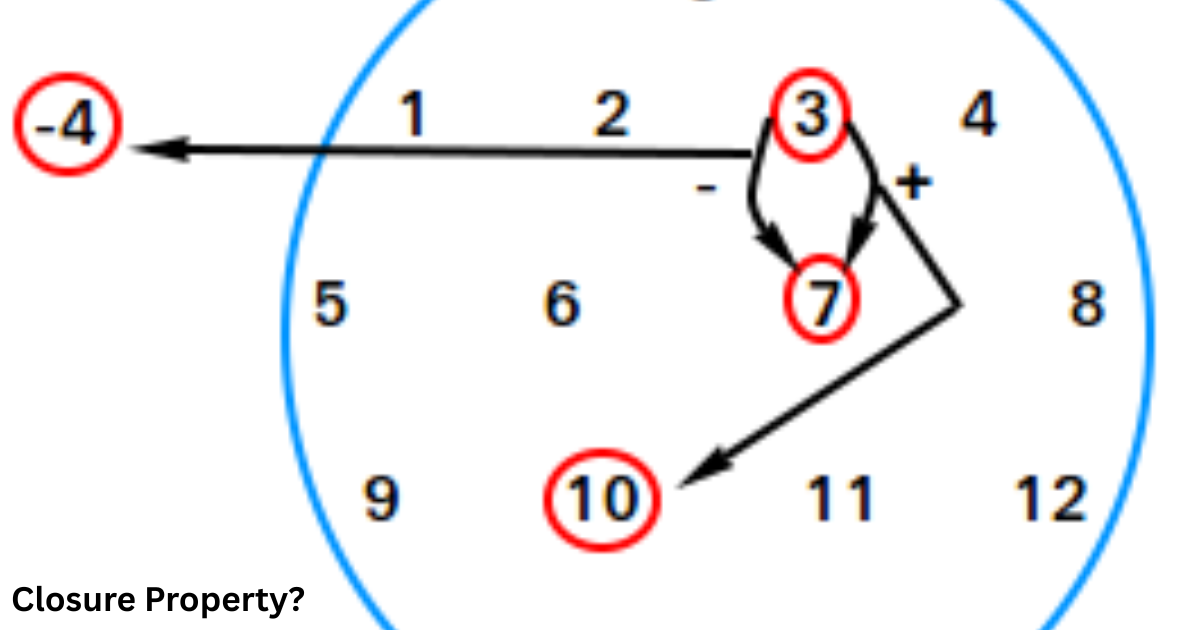
It also forms the foundation for algebraic structures like groups, rings, and fields inside abstract algebra, and even shows up in cryptography and coding theory, where reliable operations matter enormously.
Without it, equations wouldn’t stay solvable, calculations across different number systems would grow chaotic, and entire mathematical systems would lose the consistent, dependable behavior we rely on daily.
Closure Property vs Other Properties
People often mix up the closure property with the commutative property and the associative property, but each one answers a completely different question closure property of rational numbers.
Closure property asks whether the answer stays inside the same set; commutative property checks whether you can swap the order of numbers.
Without changing the outcome, written simply as an associative property asks whether you can regroup values freely.
Shown as and c can be arranged in any sequence and the result stays the same, that’s a different story from closure altogether and these questions matter more than most students realize.
Quick Reference Table
To sum up quickly, Natural Numbers and Whole Numbers stay Closed under Addition and Multiplication, but turn Not Closed the moment you try Subtraction or Division.
Integers hold up a little better, staying Closed for Addition, Subtraction, and Multiplication, though Division still trips them up.
Rational Numbers and Real Numbers manage to stay Closed across nearly every operation, landing at Closed only for division, while Irrational Numbers end up Not Closed almost everywhere you test them.
Frequently Asked Questions
How much money do I need beyond the flat price?
Keep about 11 percent of the price for stamp duty and registration, plus GST of 5 percent if you buy an under-construction flat. Add legal fees, parking, a corpus fund and fit-out costs. A cushion of 15 to 18 percent of the price covers most buyers.
Is it worth it to buy a flat in Madipakkam?
It is worth it if you want a calm residential area near Velachery and the IT corridor and you accept the flood risk after checking the exact street. Buy only a building with clean papers, good drainage and a sensible price. Skip any deal that rushes you.
Which documents should I ask for first?
Ask for the sale deed, patta, chitta, Encumbrance Certificate, approved plan, RERA registration and recent tax receipts. Have an advocate read them before you pay an advance. Resale buyers also need the earlier deeds.
How long does registration take?
The deed must reach the Sub-Registrar within four months of signing, but the visit itself usually takes a morning once your slot is booked on TNREGINET. Bring both parties, two witnesses and the original papers. Missing documents delay the day.
Should I hire an engineer for a new flat?
Yes, because an engineer checks cracks, damp, wiring and plumbing that you cannot judge. The fee is small compared with a repair bill. Book the visit before you pay the final instalment.
Can I save money on registration?
Not on an ordinary sale, because the 11 percent is fixed. A family gift or settlement deed costs far less, but only among close relatives. Never undervalue the deed to cut the bill.