

Built-up roofing (BUR) is a flat roofing system that combines alternating layers of bitumen and fabric. Crews stack at least three of these ply layers on a low-slope roof and finish the top with gravel surfacing. Together they form a multi-ply roofing system instead of a single sheet.
The bitumen comes from asphalt or coal tar, and the reinforcing fabric usually takes the form of felt plies. Each layer bonds to the one below, so the stack forms a continuous sealant layer across the roof deck. Owners have trusted this method for about a century, which explains why the built-up roof still appears on commercial plans.
What Layers Make Up a Built-Up Roof?
A typical built-up roof rests on a roof deck, then a base sheet, several plies, and a cap sheet. Workers often add an insulation layer beneath the plies and cover everything with aggregate topping. Each layer has one job, from holding insulation to shielding the bitumen from sunlight.
Crews pour a flood coat of hot tar or bitumen just before the stone goes on. Manufacturers usually coat the surfacing with fire-retardant properties, so roofers call it fire-retardant surfacing. Some owners swap the stone for a reflective top coating when they want a lighter, cooler surface.
How Do Roofers Install Built-Up Roofing?
Installers choose among three main methods: hot BUR, cold-applied BUR, and peel-and-stick BUR. Hot BUR heats the bitumen until it liquefies, while the other two skip that heating step. Each method suits different roof shapes, building uses, and local fire-safety limits.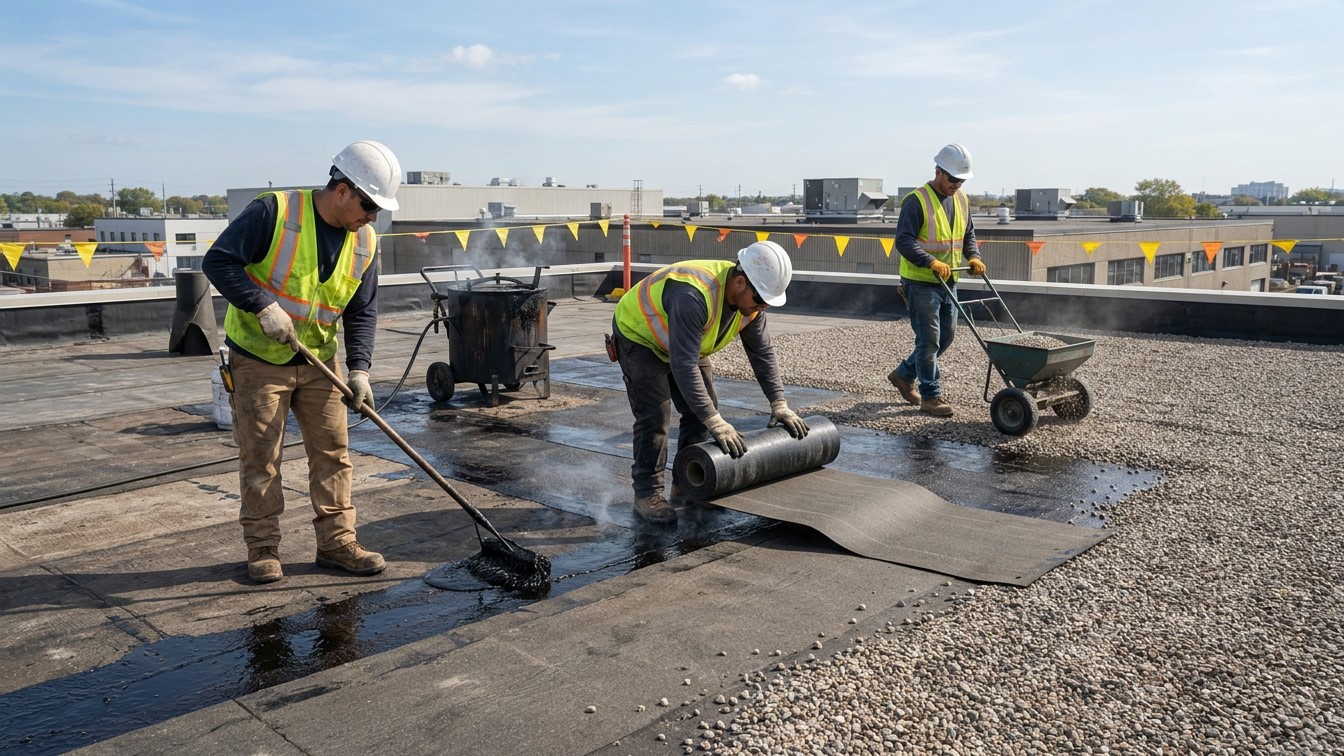 Crews perform a hot-mopped application by spreading heated bitumen with a mop between plies. Peel-and-stick BUR suits small areas such as crickets and patio covers, because the rolls carry their own adhesive. Before any layer goes down, a careful crew cleans the substrate and rolls on roof primer so the first ply grips.
How Does Built-Up Roofing Differ From Modified Bitumen and Single-Ply Roofs?
Modified bitumen uses modified asphalt in factory-made sheets, while built-up roofing builds its plies on the roof itself. A single-ply membrane such as EPDM rubber roofing, TPO, or PVC roofing relies on one sheet. The real differences come down to layer count, seam count, and attachment method.
Crews install modified bitumen using torch-applied, self-adhered, or hot-mopped methods, and the sheets carry polyester reinforcement or fiberglass reinforcement. TPO and PVC sheets rely on heat-welded seams, while crews hold single-ply sheets down with a mechanically attached pattern of screws and plates or weigh them down as ballasted roofing. You will also see spray polyurethane foam (SPF), which goes on as a seamless application, plus liquid-applied membrane and fluid-applied roofing options.
What Are the Benefits of Built-Up Roofing?
Owners choose built-up roofing for its waterproof protection, durability, and low maintenance. The thick stack blocks water intrusion, and service crews can walk the surface without damage, which shows strong foot-traffic tolerance. A well-built system reaches a long service life of up to 25 years, according to City Roofing & Maintenance.
Fire protection counts as another strength, since the fire-retardant surfacing slows flame spread. Repairs stay simple because crews can fix blisters, ripples, and cracks with basic patching. The system also offers solid wind resistance, which matters on exposed commercial rooftops.
Is Built-Up Roofing Energy Efficient?
Yes, a modern built-up roof can reach good energy efficiency when owners add roof insulation and a light surface. A reflective top coating raises solar reflectivity, which cuts heat gain below the deck. Many owners call this upgrade energy-efficient roofing, and it often turns the system into a cool roof.
Coating options include aluminum roof coating, silicone roof coating, elastomeric roof coating, and acrylic roof coating. Aluminum-pigmented asphalt products give old black surfaces a bright finish, and some carry Energy Star labeled coatings. Check each label first, because every coating bonds best to a specific roof type.
What Problems Can Built-Up Roofs Develop?
The most common problems include roof leaks, ponding water, blisters, and cracks. Leaks often announce themselves as ceiling stains, and unchecked moisture damage can invite mildew and mold. Catching these signs early stops a small patch from becoming serious roof deterioration.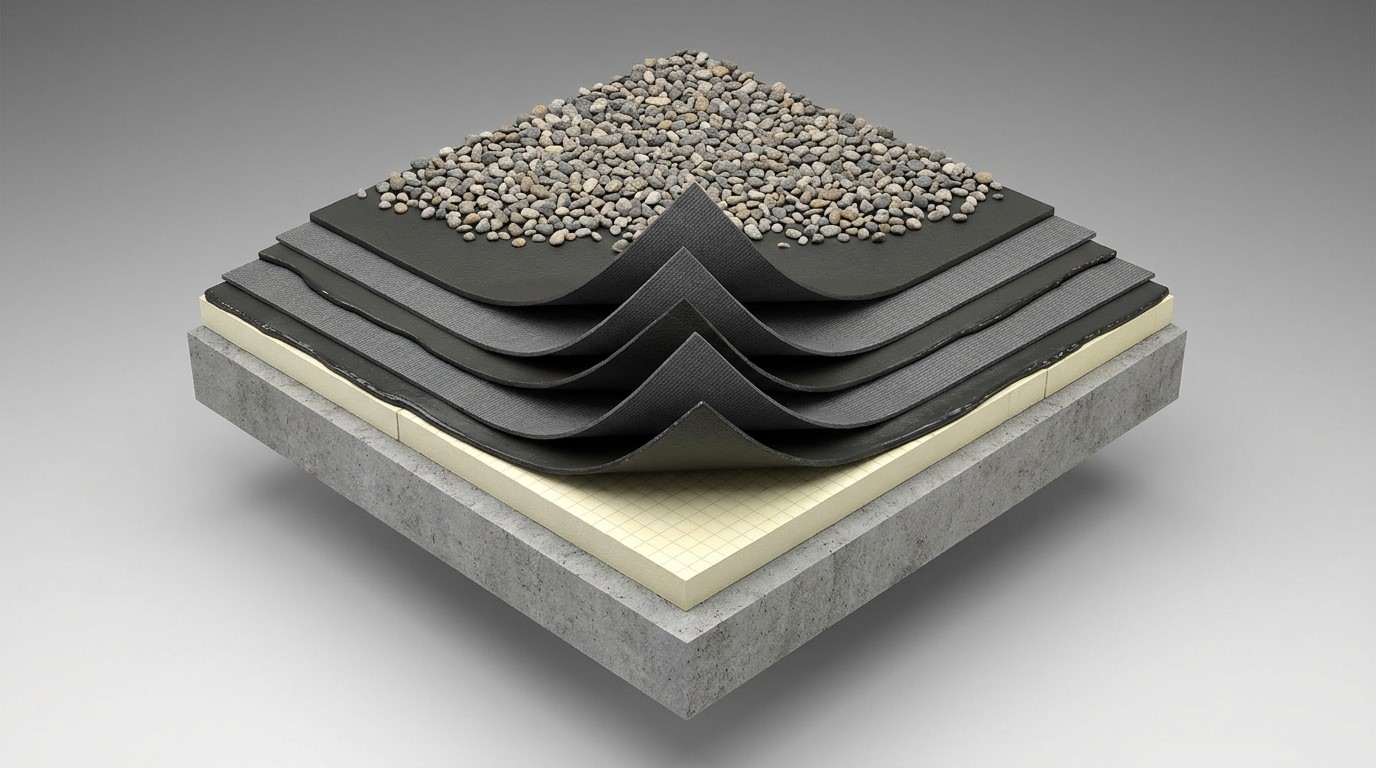 Weathering and UV exposure wear the surface down over the years, and wind uplift can peel edges loose. Hail and storm damage can open the surface, while coastal salt-water wear speeds up aging near the ocean. Once water reaches the deck, structural damage becomes possible, so act before that stage.
Where Do Built-Up Roof Leaks Usually Start?
Leaks usually start at small details such as corners and joints rather than across the open field of the roof. Flashing, penetrations, roof seams, and edges absorb the most stress. Inspectors check these spots first because water finds the weakest detail.
Clogged roof drains, a weak drainage system, and full gutters and downspouts also push water where it should not go. Roof vents and skylights add openings that need sound joint sealants. A vapor barrier, an air barrier, and vapor-retarding tape at seams protect the building envelope from moisture moving up from inside.
How Do You Repair a Built-Up Roof?
Minor roof repair starts with cleaning the area and locating the leak. Crews then patch blisters and cracks with flashing cement or roof cement and embed asphalt cotton fabric or fiberglass fabric. Bigger problems call for roof restoration or roof replacement.
Products such as rubberized asphalt cement and emulsified asphalt coatings belong to the cold-applied coatings and cements family, and crews spread them by brush or spray application. Look for ASTM D4586, the standard for asbestos-free asphalt roof cement, on the label. For hidden leaks, electronic leak detection pinpoints the entry point without tearing off sound material.
Should You Repair, Restore, or Replace a Built-Up Roof?
The repair versus replace decision depends on roof age, leak count, and deck condition. Isolated defects usually justify roof repair, while widespread roof deterioration points toward roof replacement or re-roofing. A written roof damage assessment gives you facts instead of guesses.
Roof restoration with a roof coating application can extend a sound roof, but it cannot fix a wet substrate or a failing sub-roof. City Roofing & Maintenance explains on its repair page that extensive leaks or structural damage often make full replacement the better answer. During a tear-off, crews fasten new insulation with mechanical fasteners before they lay fresh plies.
How Much Does Built-Up Roofing Cost?
Cost depends on roof size, ply count, insulation, surfacing, and deck condition, so no single number fits every building. Request itemized quotes that list each layer and material. Judge cost-effective choices by lifespan, not just the first line of the estimate.
Extras such as roof insulation, a reflective top coating, or additional ply layers change the total, so ask each contractor to price them separately. A system with a long service life spreads its price across as many as 25 years. Treat the roof as a building asset, because maintenance records and a roof warranty protect its value.
How Often Does a Built-Up Roof Need Maintenance?
Schedule a professional roof inspection every year and add another one after each major storm. City Roofing & Maintenance recommends yearly checks and a deeper review every five or six years. Regular roof maintenance keeps small defects from becoming roof leaks.
Inspectors use flat roof inspection techniques such as walking the field, probing blisters, and checking drains. Between visits, you can clear debris from drains and note any new ceiling stains. Keep every report in one file, because it supports a roof warranty claim later.
Which Safety Rules and Standards Apply to Built-Up Roofing?
Look for products with UL and FM testing for fire resistance and wind uplift. Architects often cite a built-up asphalt roofing specification, such as CSI section 07 51 13, in project documents. In hurricane zones, projects follow the Florida Building Code, and some products earn Miami-Dade product approval.
Hire licensed, bonded and insured contractors whose crews complete roofing safety training. ROOFCORP states on its website that its engineers train in the latest safety and roofing techniques. The Florida Roofing and Sheet Metal Contractors Association (FRSA) publishes articles on the 2026 ninth-edition Florida Building Code changes.
Can a Flat Roof Handle Foot Traffic or a Green Roof?
Yes, many flat roofs carry equipment, walkways, or planting, though each use adds requirements. A green roof or vegetated roof system needs strong waterproofing under the soil and plants. Walkway zones often receive a traffic coating for extra surface protection.
Good weather resistance and impact resistance matter more on roofs that see foot traffic and hail. Sloped sections of the same building may use asphalt shingles or metal roofing instead of plies. Your contractor should detail the transitions at each flashing so water cannot sneak behind them.
What Should You Look for in a Built-Up Roofing Provider?
Choose a provider that handles commercial roofing and installs built-up roofing regularly. Ask for photos of similar roof installation jobs and written details for every layer. A company that also does residential roofing can help owners with mixed properties, but BUR experience matters most.
Verify license, insurance, manufacturer approvals, and roof warranty terms before you sign. Ask how the crew handles flashing, drains, and penetrations, because those details decide whether the roof stays dry. Insist on a written scope that lists roof inspection and roof maintenance after the job.
Which Contractors Publish Built-Up Roofing Services?
City Roofing & Maintenance lists built-up roofing on its services page and describes hot BUR and peel-and-stick BUR. ROOFCORP lists built-up among the flat roof systems it services and installs, and it also lists roof maintenance, roof repair, roof restoration, and roof replacement. Champion Roofing lists maintenance, repairs, replacement, inspections, emergency roof repair, and storm damage repair on its website.
Champion’s systems page names EPDM rubber roofing, TPO, PVC roofing, modified bitumen, metal roofing, and asphalt shingles, but it does not name built-up roofing. Each of these companies offers the services listed on its own website, so confirm the details there before you call. Ask any contractor directly whether it installs BUR on your building type.
Which Manufacturers and Resources Support Built-Up Roofing Work?
Champion Roofing‘s website shows Johns Manville, GAF, TAMKO, and Owens Corning among its manufacturers. ROOFCORP’s site lists APOC, Carlisle SynTec, Fibrelite, Gaco Western, GAF, Firestone, Polyglass, and Versico. Karnak manufactures roof cement, coatings, and sealants that suit built-up roofing repairs.
WATERPROOF! Magazine publishes trade articles on built-up, single-ply, and ballasted roofing for contractors. FRSA runs a member search for licensed contractors and suppliers in Florida. Homedit covers home improvement and building materials, but it does not offer roofing services.
What Are the Most Common Questions About Built-Up Roofing?
How long does a built-up roof last?
A well-built built-up roof can last up to 25 years with proper care, according to City Roofing & Maintenance. Actual life depends on weathering, regular roof maintenance, and installation quality. Check your roof warranty for the manufacturer’s stated term and any maintenance conditions.
Can you walk on a built-up roof?
Yes, crews can walk on it for routine inspections and light service work. City Roofing & Maintenance notes that multi-ply systems tolerate heavy foot traffic better than single-ply sheets. Use walkway pads anyway, because repeated steps gradually wear the surface near doors and equipment.
Can you coat over an old built-up roof?
Often yes, if the deck stays dry and the plies still bond well together. A roof damage assessment and electronic leak detection show whether trapped water lurks below. If trapped moisture is present, roof replacement works better than a coating alone.
Why Should You Visit This Website to Find Built-Up Roofing Providers?
This website gathers the questions to ask, the standards to check, and the contractors that publish built-up services in one place. Use it to compare providers on commercial roofing experience, roof warranty terms, and roof inspection habits before you call anyone. Visit the built-up roofing pages on this site, shortlist two or three providers, and confirm each service on the company’s own website.