
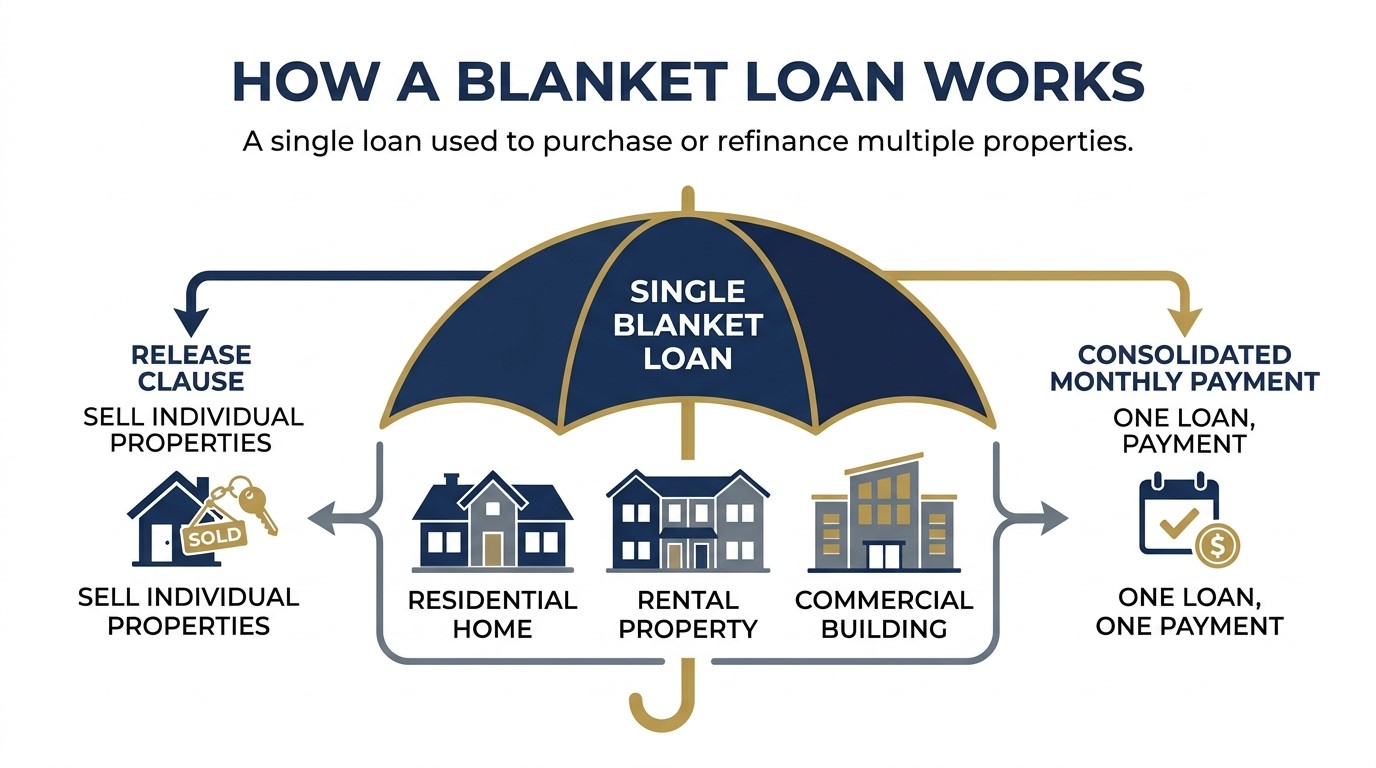
Many investors reach a point where a separate mortgage for every building stops making sense. A blanket loan solves that problem by folding several properties into one financing package. This guide explains the mechanics, the risks, and the checks that matter when you choose a provider.
What Is a Blanket Loan?
A blanket loan is a single mortgage for multiple properties, and it places two or more properties under a single loan agreement. Lenders also call it a blanket mortgage, a blanket mortgage loan, or a multi-property loan. Some borrowers use the phrase portfolio loan for the same idea, although that term carries other meanings too.
The borrower makes one monthly payment to one servicer and signs the paperwork at one closing. Every property in the package acts as collateral through a blanket lien, which lenders also describe as cross-collateralization or collective collateral. That structure explains both the convenience and the risk.
How Does a Blanket Loan Work?
Here is how a blanket loan works: the lender collects an appraisal package for the group, values the properties together, and issues one loan against the combined value. The borrower then repays that loan on a single schedule. When the borrower sells one property, the release terms in the contract decide what happens next.
The legal paperwork usually takes the form of a deed of trust or a mortgage that records a lien against every property. Lenders sometimes write a recourse loan, which lets them pursue the borrower personally, or a non-recourse loan, which limits them to the properties. Ask which structure your lender uses before you sign anything.
What Is a Release Clause in a Blanket Loan?
A release clause lets the borrower sell one property and keep the loan on the others. The borrower must pay down a portion of the loan, and the lender then lifts its lien on the sold property. Without that clause, a sale can force the borrower to repay the whole balance. Lenders word these provisions differently, so look for a partial release clause or partial release provisions that state the payoff amount for each property. A due-on-sale clause pushes in the opposite direction, because it demands full repayment when a secured property sells. Print each blanket loan with release clause offer and compare the payoff terms side by side, because you can sell individual properties without refinancing only when the contract allows it.
Who Should Use a Blanket Loan?
Real estate investors, developers, house flippers, and landlords use blanket loans most often. Builders also rely on them for projects with many properties. Lenders generally expect borrowers to already own several properties.
Rental property investors and buy-and-hold investors gain simpler bookkeeping, while commercial property owners and businesses with multiple locations use the same structure for offices and retail sites. Portfolio investors, self-employed investors, and LLC borrowers also fit the profile, because some lenders qualify them on property income instead of personal returns. A buyer of a first home or primary residence rarely qualifies.
Which Properties Can a Blanket Loan Cover?
Lenders apply a blanket loan to single-family rentals, duplexes, triplexes, and four-plexes, as well as condos and townhomes. Some programs also finance small multifamily properties and multifamily apartment buildings. Rental Home Financing and Lima One list many of these property types on their blanket loan pages.
Lenders also write loans for commercial real estate and residential real estate, and some accept mixed property types in one package. Rental Home Financing states that the properties can sit in different cities or states. Developers use the same structure for a subdivision, where individual lots sell off one by one.
What Can You Do With a Blanket Loan?
Investors use a blanket loan to purchase multiple properties at once, or to refinance multiple mortgages when several loans carry different rates. A common example is the landlord who wants to refinance multiple rental properties into one loan. Both paths replace many payments with a single one.
A borrower can also consolidate mortgages through portfolio consolidation, pull cash from a cash-out refinance, or pick a rate-and-term refinance to change the rate. Those moves help investors scale a real estate portfolio, fund a fix and flip, or pay for new construction, rehab financing, and land development. Union Savings Bank says investors can leverage equity or acquire additional collateral, and Rental Home Financing says a blanket loan can free trapped equity.
How Do You Qualify for a Blanket Loan?
To learn how to qualify for a blanket loan, start with the lender’s published blanket loan requirements. Expect a review of your credit score, down payment, net worth, and existing real estate portfolio. Lenders weigh these factors heavily because one loan carries the risk of several properties.
Rental Home Financing qualifies borrowers on DSCR (debt service coverage ratio) and sets a minimum of 1.0, which means rental income must cover the annual debt payments. It also lists a minimum credit score of 650 for most programs and says it does not require tax returns. Other lenders may examine loan-to-value ratio (LTV), equity in properties, income documentation, proof of experience, and an appraisal.
What Does Underwriting Look Like for a Blanket Loan?
Underwriting for a blanket loan examines both the borrower and the property group. The underwriter reviews cash flow, rental income, and the title policy that covers the group. Lenders apply strict qualification standards because a single mistake can affect the whole package.
Some lenders issue an asset-based loan or a business-purpose loan, which relies on what the properties earn rather than on your paycheck. Lima One describes its blanket financing as asset-based, and it says borrowers can close with less documentation than a typical bank mortgage requires. Ask for prequalification first, so you learn your likely terms before you pay for an appraisal.
What Are the Pros and Cons of a Blanket Loan?
The main blanket loan pros and cons come down to convenience versus concentrated risk. You gain simplified management, simplified accounting, and reduced paperwork. In return, you accept higher risk, because the lender holds every property as security.
Benefits include lower closing costs, one origination fee, one credit approval, improved cash flow, and time savings. Some lenders also offer a lower blended interest rate and synchronized loan terms across the package. SoFi notes that borrowers can sidestep caps on individual mortgages, and Rental Home Financing offers programs with no limit on number of financed properties.
What Risks Does a Blanket Loan Carry?
The biggest risk is risk pooled in one loan, because a default can lead to foreclosure on all properties the loan covers. SoFi warns that a lender may foreclose on every covered property if the borrower stops paying on one. That reality makes careful budgeting essential.
Lenders may ask for a large down payment, set stricter requirements than conventional lenders, and offer shorter loan terms or large loan amounts that raise each payment. SoFi says lenders typically require a down payment of up to 50%. Review the contract for a prepayment penalty and any complex loan structure.
How Does a Blanket Loan Compare With Other Loans?
A blanket loan differs from individual mortgages in structure, not just convenience. Individual mortgages carry separate payments, closings, and costs for each property. Blanket loan vs individual mortgages comes down to one package versus many.
Compared with a traditional mortgage or conventional investment loan, a blanket loan skips the per-property application. Conventional loans follow Fannie Mae and Freddie Mac guidelines, and Rental Home Financing says Fannie Mae allows up to 10 financed properties while many banks stop at four. Those financed property limits push growing investors elsewhere.
How Does a Blanket Loan Differ From a Portfolio Loan?
Blanket loan vs portfolio loan is a common comparison, because lenders use both terms loosely. A portfolio loan stays on the lender’s own books, while a blanket loan specifically places one lien across several properties. Some lenders also draw a line between a blanket loan and a package loan, so ask for their exact definition.
Other options include a HELOC, a home equity loan, a commercial real estate loan, or a small business loan. A hard money loan or bridge loan gives short-term funding, and Lima One, a private lending firm, lists Fix & Flip and Bridge Plus loans on its site. A DSCR loan, such as the programs at Rental Home Financing, qualifies the borrower on property income.
What Loan Terms and Structures Should You Expect?
Lenders price blanket loans with a fixed interest rate or an adjustable-rate mortgage (ARM), and the loan term sets how long you repay. Rental Home Financing lists 30-year fixed programs and fixed periods of 5 or 10 years with 30-year amortization. Always check amortization, because it controls how fast the balance shrinks.
Some structures offer interest-only payments or a balloon loan with a large balloon payment due at the end. Ask about the prepayment period, since early payoff can cost extra, and confirm who handles loan servicing after closing. Rental Home Financing, for instance, names one servicer for the whole package.
What Should You Look for in a Blanket Loan Provider?
Start by confirming the provider offers the product you need: a blanket loan for rental properties, a blanket loan for investment properties, or a blanket mortgage for real estate developers. Then compare blanket loan lenders on rates, fees, and release terms. Never assume every mortgage lender offers blanket financing.
A mortgage broker can shop several lenders, while a direct lender handles the loan in-house, and a portfolio lender keeps the loan on its books. A community bank or commercial bank may offer blanket financing to local borrowers, and SoFi suggests asking banks that make commercial loans. Meet the loan officer, review the loan application steps, and read all lender requirements before you pay any fee.
Which Brands Offer Blanket Loans or Related Services?
Each brand below offers only the services its own website lists, so confirm details with the provider. Rental Home Financing offers blanket loans for rental investors, including 30-year fixed and 5 or 10-year fixed programs. Union Savings Bank offers a basic blanket loan, a blanket loan for investors, and a blanket construction loan.
Lima One lists Fix & Flip, Bridge Plus, New Construction, Rental, and Multifamily loans, and its blanket mortgage guide describes asset-based financing for investors. SoFi publishes educational material on blanket mortgages but states that it does not offer them. Wikipedia explains the concept as a reference, while HAR.com, run by the Houston Association of Realtors, lists homes and rentals in Texas rather than blanket loans.
What Are the Most Common Questions About a Blanket Loan?
Is a Blanket Loan Worth It?
A blanket loan can be worth it when you own several properties and value one payment over flexibility. It rarely suits a buyer of a single property. Compare closing costs, rates, and release terms before you decide.
How Much Equity Do You Need for a Blanket Loan?
Equity needs vary by lender, so check each program. Rental Home Financing lists up to 80% loan-to-value on purchases and rate-and-term refinances, and up to 75% on cash-out deals. More equity usually widens your options.
Can You Sell One Property Later?
Yes, when the contract includes a release clause. You pay a set amount toward the balance, and the lender removes its lien from that property. Without the clause, you may need to refinance the whole loan.
Can an LLC Apply for a Blanket Loan?
Rental Home Financing says it lends to LLCs, LPs, corporations, and trusts. Other lenders set their own rules for entity borrowers. Check the borrower requirements before you apply.
Where Can You Find the Right Blanket Loan Provider?
A blanket loan rewards borrowers who read the contract, compare providers, and ask direct questions. Residencyin.com exists to help readers find the right provider for a keyword like blanket loan, so you can start there instead of searching lender by lender. Visit residencyin.com to compare options for your properties and your plan.