
I still remember the first time I picked up scissors in geometry class to prove that a triangle always holds 180 degrees inside it, and that memory stuck with me far more than any dusty theorems ever did. The Angle Sum Property sounds like a strict rule from a textbook, yet it becomes something students can actually touch once you turn to the paper cutting method instead of relying only on formulas.
This hands-on approach turns a page of fundamental rules into a hands-on activity, where you cut apart the interior angles of any shape built from three sides and watch them settle quietly along a straight line.
In this article, I want to walk you through a simple step-by-step guide that explains how to verify this idea using real geometric construction, covering every concept you need and listing the materials needed before we even pick up a pencil.
By the end, we will look at frequently asked questions on this topic, because the goal here is to help you grasp the sum of three angles so completely that you could explain it physically to a friend using nothing but basic shapes cut from paper.
What is the Angle Sum Property of a Triangle?
Whether you draw a lean scalene triangle, a balanced isosceles one, or a perfectly even equilateral shape, the same rule quietly governs every triangle you sketch: the Angle Sum Property.
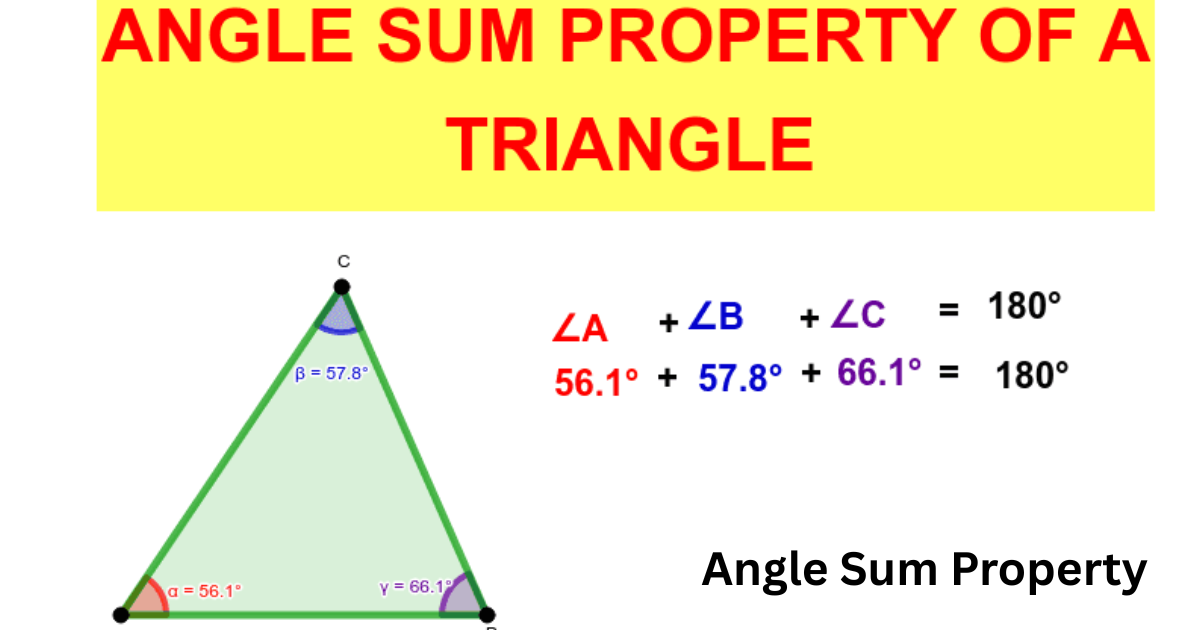
This property simply states that if you label the corners ∠A, ∠B, and ∠C, their sum will always equal 180°, no matter the size or shape of the figure in front of you.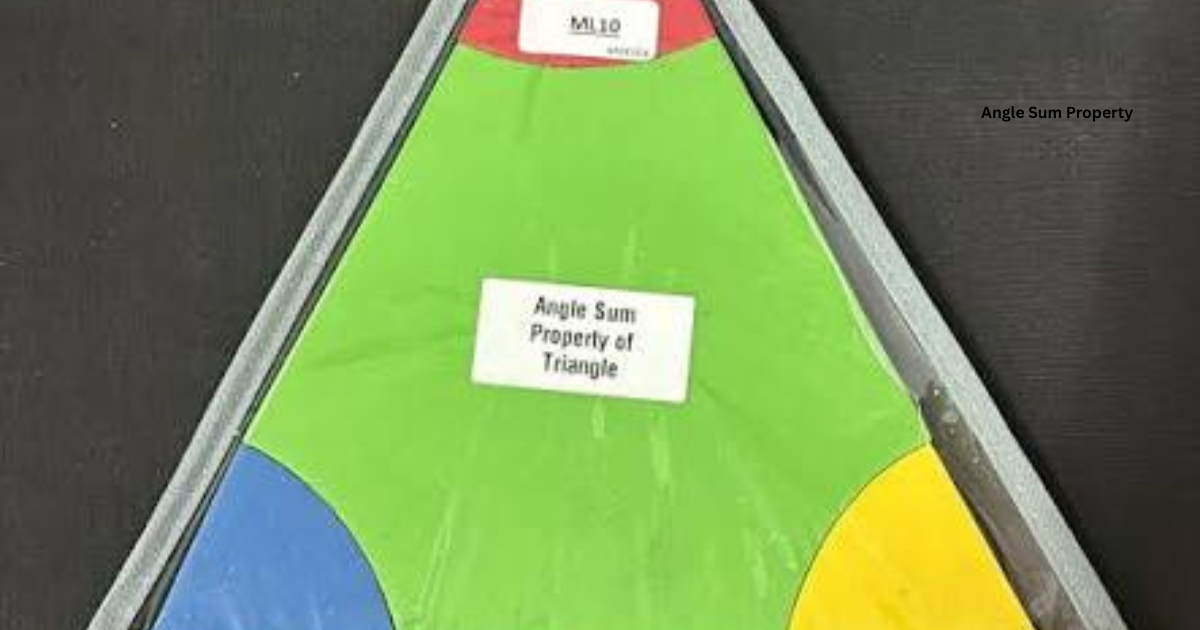 It does not matter whether the triangle looks acute, obtuse, or right-angled, because the angles inside always add up the same way, and this consistency forms the foundation for later concepts in geometry and trigonometry.
Once you accept that the three interior angles of any triangle behave this predictably, a whole world of geometric problem-solving opens up in front of you.
Materials Required for the Paper Cutting Activity
Before you cut a single angle, gather a sheet of plain white paper or some coloured paper, along with a sharp pencil, a steady ruler, and a pair of scissors that cut cleanly.
You will also want to mark each corner clearly, and this is where sketch pens or colours come in handy for telling the three corners apart at a glance.
None of this is complicated or expensive, and the only truly optional item on the list is colour itself, since a plain pencil outline works just as well for the activity.
If you enjoy exploring other number and geometry properties this way, you can also check out this guide on the distributive property of rational numbers for a similar hands-on explanation.
Step-by-Step Method to Verify Angle Sum Property by Paper Cutting
Start by taking your pencil and ruler to draw any triangle you like, whether it turns out scalene, isosceles, or equilateral, and label its three corners A, B, and C. Next, mark the three angles as ∠1, ∠2, and ∠3, and give each one a different colour such as red, blue, or green so you can track every vertex once the cutting begins.
Pick up your scissors and carefully cut out the whole shape first, trimming along the outer edges so nothing extra remains attached.
Then slice the triangle into three pieces, making sure each angle piece among the three angle pieces still carries its own vertices intact.
Now arrange the pieces along a fresh line, pushing every one of the edges together at a single common point so there are no gaps or overlaps between them, and align each piece so its sides sit flush against the next.
Watch carefully as the shapes fit together to form one continuous straight line, which is really just a straight angle measuring exactly 180°.
Observe this outcome closely, because the sum of the three original angles has just settled quietly into a single flat line right in front of your eyes.
Why Does This Method Work?
This trick works because a straight line is nothing more than a flat angle of 180°, and once you place the three angles of a triangle adjacent to one another, their vertices meeting at one shared point, the sides naturally line up into a single continuous stretch.
There is no need for an abstract theorem or a formal algebraic proof here, because you can see, touch, and hold the proof in your own hands.
This is exactly why teachers reach for it as an effective teaching tool, since it takes something that feels distant and turns it into a tangible, physically real experience for students.
The paper cutting method genuinely demonstrates how three separate angles add up to form one straight angle, and few explanations of a triangle’s geometry feel this direct or this effective.
Paper Folding Technique
If scissors are not your preferred tool, you can still draw and cut out a triangle ABC and try a folding version instead. Fold vertex B inward along a crease that runs parallel to side AC, so that it touches the midpoint at point D sitting on that side.
Angle Sum Property for corners A and C, until all three vertices meet neatly at that single point D, and the once-separate three angles have now folded together into one shared spot.
Observe the line they create, because as their edges meet, the sides settle into one unbroken straight line, giving you the exact same visual conclusion as before.
Both the cutting methods and the folding methods reach an identical sum of 180°, so you can use them interchangeably depending on which one suits your convenience at the time.
Real-Life Applications of the Angle Sum Property
This simple idea about triangles does not stay confined to a classroom activity, because engineers rely on it for real construction projects and calculating structural angles on-site.
Surveyors depend on the same logic for surveying land and for navigation across long distances, and both fields use it as a working basis for their daily calculations.
In architecture, professionals use the property when dividing larger geometric figures into smaller triangles, which then makes solving problems involving polygons and unknown angles far more manageable, and this same foundation carries straight through into higher trigonometry as well.
FAQS About Angle Sum Property
What is the angle sum property of a triangle?
The angle sum property simply tells us that the three interior angles of any triangle always equal a sum of exactly 180°, no matter how the shape is drawn.
How do you prove the angle sum property using the paper cutting method?
By drawing a triangle, cutting out its three angles, and arranging them adjacent to each other so their edges align into one straight line, the paper cutting method clearly verifies that the angles sum up to 180°.
Does the angle sum property apply to all types of triangles?
Yes, the angle sum property holds true for every kind of triangle you can draw, including scalene, isosceles, equilateral, acute-angled, obtuse-angled, and right-angled triangles alike.
What materials are needed for the paper cutting activity?
You only need a plain sheet of paper, a pencil, a ruler, a pair of scissors, and some coloured pens to mark each angle distinctly before you start cutting.
If two angles of a triangle are known, how do you find the third angle?
Since the sum of the three angles always reaches 180°, you simply subtract the two known angles from that total to find the third angle; for example, if the angles are 108° and 32°, the missing angle works out to 40°.
Is there another way to demonstrate the angle sum property besides cutting?
Yes, the paper folding method offers a handy alternative, where you fold each vertex of the triangle inward along one side until all three angles have folded and meet at a single point, forming the same straight line as before.
Why is the angle sum property important in geometry?
This rule acts as a foundational concept that supports further learning in trigonometry, mensuration, and coordinate geometry, and it helps students solve for unknown angles in polygons built from several triangles.