
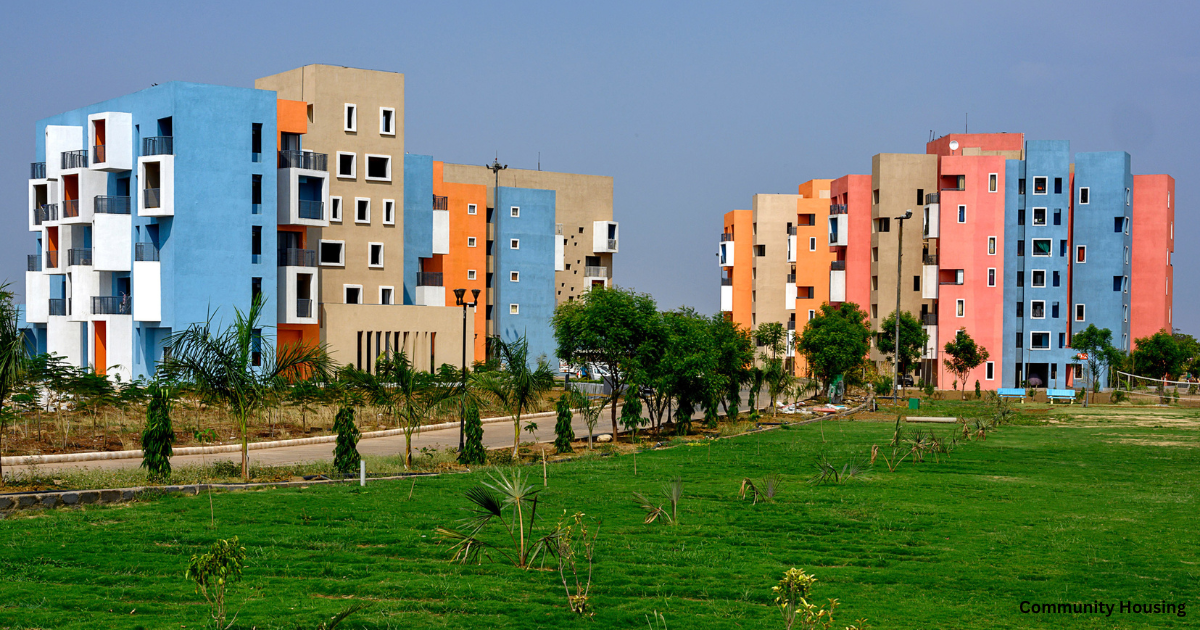
Walk through any Indian city today and you’ll notice how much daily life has shifted from traditional villages, where group living once felt automatic, toward busy residential complexes, all shaped by fast-moving urbanisation.
Family structures keep changing, and that shift is exactly why community housing keeps coming up in conversations with both a buyer and a renter I meet. India’s housing landscape now revolves around one idea: how people manage shared space and resources without sacrificing comfort.
Behind this shift sit three forces working together economic pressures, social pressures, and environmental pressures all quietly reshaping how Indian cities grow.
Rows of vacant housing sit empty in our urban housing units even as entire families crowd into slums nearby, simply because well-planned housing and affordable housing still don’t reach everyone. I’ve seen this contrast firsthand on site visits, and it never gets any less jarring.
What Does Community Housing Mean?
Ask ten people what community housing really means, and you’ll likely get ten similar answers built around one word: cooperation.
Families and people don’t just end up co-existing under a shared roof they take on shared property, shared amenities, and everyday decision-making as a team.
Homeowners here work toward mutual well-being, turning an ordinary residential property into something closer to shared living.
Once this arrangement becomes legally registered, it usually takes the form of a Cooperative Housing Society, or CHS for short, backed by a proper legal structure and administrative structure.
Each member gets a share certificate representing their stake, and the whole group follows a democratic principle built on one member one vote. Collective resources hold the entire model together, spreading both the cost and the responsibility fairly.
Day to day, the society quietly manages legal compliance, financial planning, common-area maintenance, and security so residents rarely have to think about the paperwork.
Having sat through a few society meetings myself, I can say this behind-the-scenes work is what actually keeps a building running smoothly. Good housing, in the end, depends as much on this quiet structure as it does on bricks and walls.
Types of Community Housing in India
Gated communities usually top the list for upper-income buyers and middle-income buyers chasing privacy, security, and an exclusive lifestyle behind access-controlled entrances.
Senior citizen communities take a gentler approach for older residents, built around dignity, healthcare access, and assisted-living support.
Multi-generational housing sits somewhere in between, letting families raised in a joint-family system stay close within one fenced compound.
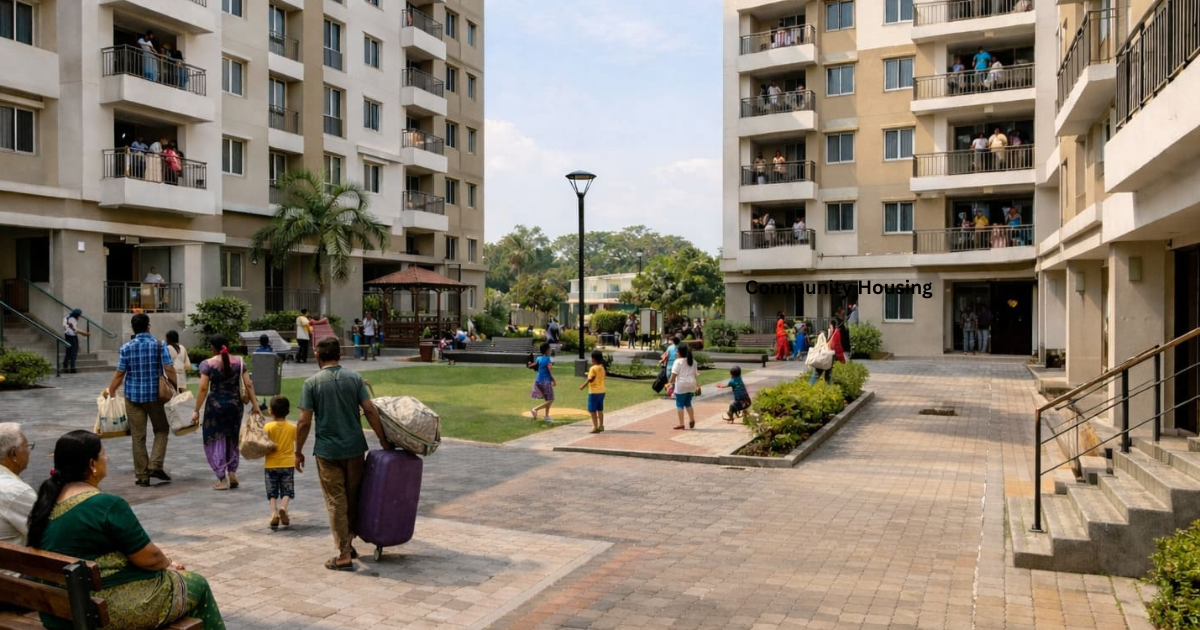 Students and young professionals, meanwhile, lean toward co-living spaces packed with private rooms, common lounges, and reliable Wi-Fi, especially across busy metro cities.
Renting this way often works out lighter on the wallet, and bundled housekeeping adds a layer of independence and connection that a solo flat rarely offers. It’s the kind of setup I’d have loved during my own early working years.
Sustainability drives eco-friendly townships, which lean on green energy, water conservation, and waste management to serve environmentally conscious and health-conscious residents.
Gyms, pools, parks, and clubhouses round out the shared amenities on offer, and some individual units even rest on collectively owned land to keep costs down. It’s a model that quietly rewards anyone thinking long-term about their footprint.
Before you purchase into any of these, it’s worth knowing how cooperative housing societies are structured on paper. A Tenant Ownership Society keeps units individually owned while the land stays common, whereas a Tenant Co-partnership Society holds both under joint control.
Add in a Housing Construction Society funded through pooled funds to build at lower cost, a House Mortgage Society that arranges loans, and a Housing Maintenance Society that simply upkeeps an existing complex often with leisure facilities and shared construction costs built in.
Benefits of Community Housing
Money aside, the biggest win of community life might just be belonging regular interaction with neighbours chips away at isolation faster than most people expect.
Watchful neighbours, guarded entry points, and fenced premises add real protection and better safety on top of that, building a genuine layer of security most standalone living can’t offer. Stronger social support grows out of these small, daily exchanges more than any brochure promise.
Practically speaking, shared amenities such as gyms, pools, parks, and clubhouses raise the quality of life without piling on individual ownership costs, and shared maintenance keeps it all functioning.
A cooperative housing society usually runs on democratic governance, giving every resident an equal vote and keeping records as well-documented decisions. It’s a fair trade for anyone tired of managing everything solo.
Environmental efficiency also gets a quiet boost from common green spaces, collective utilities, and shared resources, which together trim the whole community’s environmental footprint.
Splitting utility expenses across more households naturally leads to a lower cost of living, something my own clients notice within the first billing cycle. Savings like these tend to convince even the biggest skeptics.
Drawbacks Worth Knowing
Community housing isn’t without its bumps, and slower decision-making tops the list since most changes wait on formal voting during scheduled meetings.
Delayed approvals can test anyone’s patience, and everyday things like renovations, rentals, or even pets often need committee sign-off first. Owners used to full autonomy in a standalone apartment sometimes find this adjustment period frustrating.
Poor management from a weak committee can chip away at living standards faster than most residents realise, and differing opinions among neighbours sometimes spiral into internal disagreements.
Add a heavy dependency on committee decisions and stricter rules, and you get the limited flexibility that occasionally frustrates long-term owners of a cooperative housing society. Knowing this upfront helps set realistic expectations.
Community Housing vs. Apartment Ownership
Look closely at Ownership, and the gap between an Apartment and a Cooperative Housing Society becomes obvious fast. An Apartment stays individual unit-based under an RWA or association, governed by RERA and the Apartment Act, which hands owners flexible owner-driven Control, quicker Decision-making, and genuine owner autonomy. Governance rarely gets in the way here.
A registered society flips that Aspect entirely, running on collective share-certificate based Ownership under the Cooperative Societies Act and a more democratic rule-bound Legal framework.
An elected committee steers daily matters, and nothing major moves forward without society approval. Which model suits you really depends on how much control you’re willing to trade for shared support.
How to Choose the Right Community Housing Option
Location decides more than people expect proximity to schools, hospitals, and workplaces shapes daily routines for families, young professionals, and seniors alike.
Public transport access matters just as much for anyone commuting daily. Amenities like a gym, park, or clubhouse should genuinely match your lifestyle needs, not just look good in a listing photo.
Beyond the obvious, check the resident mix and demographics of a project, since that quietly shapes community rules and shared activities you’ll live with daily.
A handful of tips for new residents go a long way too greet your neighbours early and take time to learn the unwritten norms. Small efforts here save a lot of friction later.
Common Misconceptions About Community Housing
A common myth says community housing costs you independence or privacy, yet most modern projects protect private units and encourage independent living right alongside shared spaces.
Another myth calls it expensive, when shared-cost models frequently make it more affordable than living solo. Diverse resident mix also brings far more support and variety than people assume going in.
The Bigger Picture: Housing Shortage and Government Schemes
Government interventions toward affordable community housing in India trace back towhen the National Housing and Habitat Policy became one of the country’s earliest serious efforts, aimed squarely at the urban poor, minority groups communities.
The Valmiki Ambedkar Awas Yojana followed in 2001, offering a low-cost housing scheme built for slum dwellers specifically.
Momentum kept building through the Rajiv Awas Yojana, chasing a slum-free India by 2022 through low-cost urban housing and basic amenities.
By 2015, the Pradhan Mantri Awas Yojana pushed things further still, promising pukka housing complete with water, power, and sanitation for families who needed it most.
Real weight went toward women’s ownership too, alongside dedicated support for differently-abled persons, seniors, minorities, and women more broadly across the country. Policy, at its best, tries to reach whoever gets left out first.
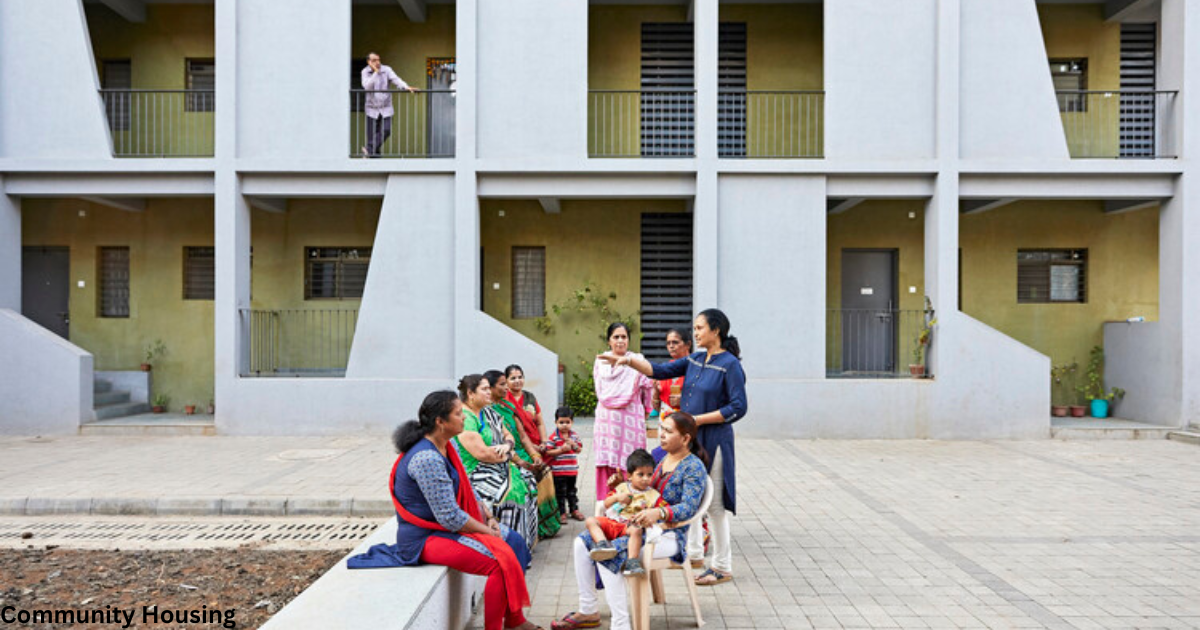 None of this erases the gap on the ground, though Indian cities still carry plenty of vacant homes even as a huge slice of the urban population crowds into slums.
Dharavi in Community Housing in Delhi, Nochikuppam in Chennai, and the Basanti slum in Kolkata remain among the largest slums anywhere in the country. Census figures from 2011 first put real numbers behind what many of us had already seen on the ground.
Notable Community Housing Projects in India
Charles Correa’s HUDCO Housing in Jodhpur remains one of the most cited examples, packing units into a courtyard-centric design and climate-responsive design built for EWS, LIG, and MIG buyers alike.
Kunchanjunga Apartments in Mumbai takes a completely different route, rising as a 32-storey tower with cantilevered terraces borrowed from vernacular verandas.
Both prove good design doesn’t need to look the same twice for more on how architecture shapes community living, take a look at our housing architecture secrets.
B.V. Doshi left his own mark twice over first with Aranya Community Housing in Indore, an EWS project known for its open layout and socially responsive design, and again with LIC Housing in Ahmedabad, where duplex units were built around genuine resident customisation.
Yamuna Housing in Delhi took cues from traditional Indian village lanes, wrapped inside a traffic-free interior layout that keeps the whole complex calm.
CIDCO Housing in Belapur rounds out the list, offering low-cost LIG housing shaped by Raj Rewal around pedestrian-friendly clusters that still hold up decades later.
Seeing these projects in person, even briefly, changes how you think about affordable design. They’re proof that thoughtful planning outlives any passing trend.
FAQS About Community Housing
What is the concept of community housing?
Living in community housing means more than just residing under one roof — it asks for active participation through sharing spaces, taking on shared responsibilities, and building genuine social life with your neighbours.
What are the main benefits of community housing?
People choose community housing for real companionship, stronger security, and a dependable support system, along with easy access to amenities and shared costs that lighten the monthly load.
Is community housing good for the environment?
Community housing genuinely helps the environment — shared utilities and common green spaces drive collective resource use, cutting the environmental footprint far below what standalone living typically produces.
What is the difference between an apartment and a cooperative housing society?
An apartment refers only to the physical property, while a cooperative housing society provides the legal framework and administrative framework that keeps that same property collectively managed.
What are the different types of cooperative housing societies?
Cooperative housing generally falls into five categories: tenant ownership societies, tenant co-partnership societies, construction societies, mortgage societies, and maintenance societies, each built for a different homeownership need.
Why do senior citizens prefer community housing?
Senior living communities ease isolation through steady daily interaction with neighbours and staff, backed further by organised social events and on-site care support that residents can lean on.
What are the disadvantages of community housing?
The real trade-offs come down to slower decision-making, stricter rules, dependency on committee management, and reduced flexibility, all compared against the freer pace of independent apartment ownership.