

A studio apartment offers something rare in a crowded city: an efficient, luxurious, and convenient space that still respects your privacy, all without stretching your wallet.
Many people call it their own inner sanctum, a true private space, and in India this often takes the shape of a 1RK one room with a kitchenette and an attached bathroom.
As career-focused young professionals move into growing urban real estate markets, studios have become the go-to option in India’s biggest metros and even in fast-rising tier-2 towns.
At its core, a studio is a self-contained unit built around one open-plan room, where the sleeping area, living area, and kitchen share space, leaving only the bathroom enclosed.
In 2026, most Indian studios measure between sq ft and ft of carpet area, and they attract two very different kinds of buyers: single urban professionals aged 24 to 35 wanting city life without the price tag of a bigger flat.
Investors chasing rental yields of 4 percent to 6 percent near IT parks, universities, and co-living hubs.
That beats the 2.5 percent to 3.5 percent yields typical of 2 BHK and 3 BHK homes, and it proves that layout, not just size, is the real decision factor for anyone comparing options.perfect choice for modern professionals. If you are comparing compact properties in other major locations, read our Find Your Dream Apartment in Lucknow guide for top investment tips.
For renters trying to choose between features, price, and amenities, the whole decision can feel confusing, especially in a fast-moving metro city like Bangalore.This guide breaks it all down so you can match a studio to your actual budget and lifestyle, not just a listing photo.
What is a Studio Apartment?
I always tell first-time buyers to picture a single-room unit where the kitchen and bathroom sit inside one efficiently zoned layout: a work corner on one side, a sleeping nook on the other, sometimes separated by partial walls.
It’s no longer just an artist’s space; today it stands for cost-effective, minimalist living that fits a busy schedule.
Think of it as one self-contained unit built around a single open-plan room, where the sleeping area and living area flow together and only the bathroom stays fully enclosed, with no bedroom partition walls cutting the space up.
Here’s where buyers get tricked, though. A 1BHK with a small hall is still a 1BHK if the bedroom has a walled bedroom, and a kitchen alcove behind even a half-wall is not a true studioit’s a fake studio dressed up for marketing.
This distinction matters because cooking odor behaves very differently in an open kitchen compared to a semi-enclosed kitchen, and that single detail affects daily livability far more than square footage does.
In simple terms, it’s one large room, merging the living room, bedroom, and kitchen behind a single wall and door, built for a flexible layout that uses every square foot. Sized around this format suits singles, students, and budget renters who want simplicity over size.
Size & Configuration
Studios in India generally range from and I like explaining it this way is roughly the size of someone’s master bedroom, while sq ft edges close to a squash court.
Instead of walls, most studios rely on room dividers and smart zone separation to keep the living area, bed space, kitchen, and bathroom feeling distinct, and keeping minimized furniture is what makes this effective space use actually work.
Builders now break sizing into clear bands. Anything below 280 sq ft counts as extremely compact, common in student housing and co-living developments, and best suited to a single occupant rather than anyone planning a long-term residence.
The mark is the most common size in India, comfortable enough for a sofa bed, wall-mounted TV, and pull-out dining table.
With a semi-enclosed kitchenette making daily cooking realistic; this is the investor-grade sweet spot near Bengaluru, Pune, and Hyderabad.
At the top end, 450 sq ft studios can fit IKEA India Studio Furniture a proper loft bed or partition screen, plus a working desk, which makes them better for extended stays and part-time work from home routines.
Still, anyone planning life with a partner should know that couples and family living usually run into real privacy limitations within about six months, which is why a 1BHK often makes more sense for only a marginally higher cost.
Studio Apartment vs 1 BHK
Every table comparison I’ve seen boils down to the same point: a studio is a single integrated room, while a 1BHK keeps the separate bedroom, living room, and kitchen apart.
That difference shapes everything else: an open floor plan versus defined rooms, less privacy versus more privacy, and typically lower rent against higher rent.
Studios also win on convenience, since they’re easier to clean, though they offer less customization compared to the more customization a 1BHK allows.
For individuals and working professionals, a studio usually fits better, while couples and small families lean toward a 1BHK, and the minimal furniture a studio needs contrasts sharply.
With the more furniture a bigger flat demands which is exactly why studios stay cheaper while 1BHKs run expensive.
The real dividing line, as most agents will tell you, comes down to the bedroom wall itself.
Whether you’re comparing 250 sq ft to 450 sq ft studios against 400 sq ft to 650 sq ft 1BHKs, that single walled bedroom with its own door is what buys you real functional privacy.
Price-wise, studios typically cost percent less in the same micro-market, and investors see it in the numbers too: percent to percent gross yield on studios against percent on 1BHKs.
That’s why singles and investors chase short-stay studio options, while long-stay tenants and families still prefer the private bedroom.
The full three rooms, and the extra hall space, along with better furnishing needs, utility bills, and storage that a 1BHK provides.
Price Rent
Location swings studio prices wildly. In strategic locations within a developed city, prices can touch 1 crore, while developing areas offer the same format from around 25 lakh.
All depending on size and location. Monthly rent tells a similar story city by city.On top of rent, budget and extra utilities like power and water, though studios still keep maintenance fees and cheaper power costs on your side.
Benefits Pros of a Studio Apartment
What I love recommending studios for is how genuinely space-saving and cheaper they are compared to other real estate formats.
You’ll notice lower electricity, lower utility costs, and lower maintenance costs almost immediately, and faster cleaning often means your home is always ready for impromptu gatherings and get-togethers.
There’s also a lifestyle upside nobody talks about enough: a confined space naturally pushes you toward stepping out more often, which keeps life balanced.
And because everything sits within reach, multitasking becomes effortless you can handle cooking while joining a meeting without missing a beat.
Add in affordable rent, a space that’s easy to clean and easy to maintain, and a strong pull toward singles who value central locations, and it’s easy to see why studios keep winning over first-time renters.
Drawbacks Cons of a Studio Apartment
No format is perfect, and studios do come with real trade-offs. Some people genuinely feel claustrophobic in a single room, and studios simply don’t work for families who need their own personal space.
If you own a lot of furniture, hosting guests becomes tricky fast, since less storage leaves little room for visitors to feel comfortable. 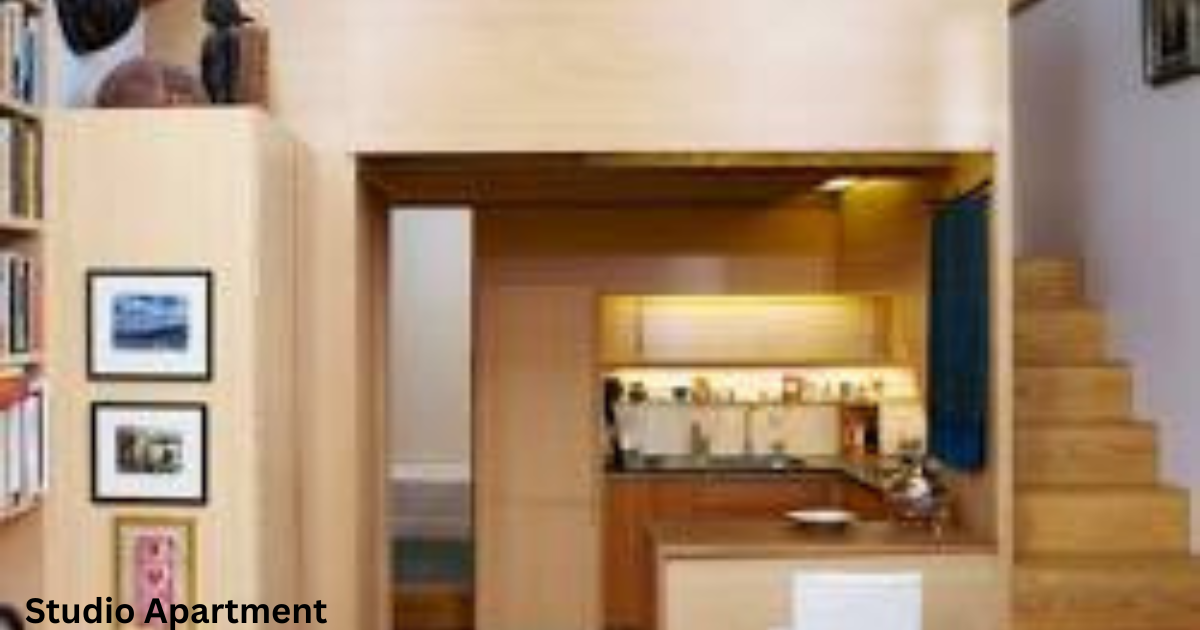 Minimal privacy between the sleeping area and cooking area means every activity happens in one shared space.This is exactly why couples thinking about family planning or raising children should look elsewhere; a studio simply isn’t built for that stage of life.
Studio Apartment Features & Price Range
Most studios use wall partitions cleverly instead of building full separate rooms, keeping the living zone, bed zone, and kitchen zone visually distinct.
Built-in shelving with open blocks works double duty as a divider and storage for books and daily items.
Mirrored doors and mirrored walls are another favorite trick, creating an illusion of space while bouncing extra natural light around the room for a polished aesthetic.
Meanwhile, split-level architecture adds real depth, putting unused vertical space to work for wardrobes and even a shelf for plants.
Studio Apartment Interior Inspirations
If you love a raw look, go industrial style: think exposed brick, bare concrete, and high ceilings paired with neutral tones for that signature chic-raw look.
Prefer something more personal? Use spare wall space for hanging art, or lean into cosy and comfortable styling with soft colors, sentimental decor, inspirational art, and warm lighting.
Minimalism is another strong direction, built around symmetrical patterns, geometrical patterns, and deliberately sparse furniture.
For genuinely intelligent use of space, add corner storage and functional elements that double as an artistic view.
Finally, an alcove studio with its L-shaped layout gives you a naturally divided kitchen and divided bed zone, without needing a single extra wall.
Are Studio Apartments Environment-Friendly?
Yes, genuinely so. An environment-friendly footprint comes naturally with less space to condition, which means real electricity savings and water savings on top of lower overall utilities.
Because studios sit within a compact city location, they don’t strain the surrounding ecosystem, and less air-conditioning, less heating, and lower transportation savings all add up.
Combine that with less furniture production, and you get a genuinely smaller carbon footprint overall.
Studio Apartment Meaning in India Investment Case
The numbers make the investment case clean and simple: a lakh studio renting at delivers a gross rental yield of percent, while a lakh 1BHK renting at only manages 3.5 percent.
That gap comes down to better per-square-foot rental realization, giving studios a real yield advantage in high-demand micro-markets.
Smart investors are watching Bengaluru neighborhoods like Devanahalli, ORR, and Whitefield, along with Pune’s Hinjewadi and Baner co-living hubs, student zones in.
Hyderabad and Chennai near universities, plus Noida Sector 150 and Sector 62 close to tech parks in Delhi NCR.
The one caution I always add: studios have a smaller resale buyer pool, since developers and co-living conversion buyers dominate demand more than end-use buyers do.
Which can soften resale price and stretch your resale timeline anywhere from 6 months to 18 months, compared with just 2 months so plan your investment horizon accordingly.
Investor Case Study
Arjun, 28 years old and working as a software developer at a Pune firm, came in with a 40 lakh budget for his first investment property.
He originally wanted a 1BHK in Hinjewadi because his colleagues swore by its resale value, but a simple yield comparison changed his mind.
Both properties were expected to see similar appreciation, but the studio didn’t even require a home loan.
Which kept his budget simple and stress-free. He found a tenant within possession in Bengaluru, signed on a 12-month contract.
And locked in a gross yield of nearly 5 percent in a year, one proof that smaller numbers can still add up to a smarter deal.
Five Things to Check Before Buying/Renting
Start with kitchen ventilation, daily cooking odours need a proper exhaust fan vented to the exterior wall, or ideally a chimney provision, or you’ll face a constant livability problem.
Next, confirm RERA registration on the official state portal before you hand over any booking amount, especially if co-living operators are involved in the deal.
Look closely at the maintenance charge structure too, since high-amenity buildings sometimes carry disproportionate Studio Apartment charge against rent eats percent of your rental income.
So always check the maintenance rate per sq ft before committing. Also review the tenant profile and any occupancy restrictions, since some housing societies ban short-term rentals under 11 months.
Restrict short-stay guests, or disallow co-living arrangements entirely, read the society bye-laws and the RERA project terms carefully.
Finally, vet the builder’s track record in co-living ecosystems, especially around managed services and any guaranteed rental schemes, and clarify what happens to your rental guarantee if the developer’s business model ever changes.
What is a 1-Bedroom Apartment?
A 1BHK gives you a private bedroom, living area, kitchen, and bathroom genuinely three rooms built around one bedroom plus a separate hall and living room.
Sized around 300 sq ft to 600 sq ft, this format suits couples and small families who want real privacy and proper storage.In a city like Bangalore, this is exactly why so many renters search for verified rentals before signing anything.
Best Choice for Couples and Remote Workers
A 1-bedroom almost always beats a studio for couples who want genuine private space, since studios can feel cramped once both individuals are working or relaxing at home together.
Remote workers especially benefit from that extra room to spread out.That said, some couples still choose studios for a limited stay or simply out of cost preference, and that’s a perfectly valid trade-off if it fits your season of life.
Demand for Studios and 1-BHK in Bangalore
In Bengaluru, and especially in Whitefield, single bachelors, students, and young professionals keep fueling steady demand for both formats. This kind of sustained popularity shows no signs of slowing down anytime soon.
Studio or 1BHK How to Choose
Start with your budget, then list your real must-haves: privacy, a proper workspace or study space, and security matter more than most people expect. Location should factor in early too.
If you regularly host guests, a 1-bedroom simply works better. If you want lower rent, easy cleaning, and a central address, a studio is the smarter pick.
Conclusion
At the end of the day, a studio wins on its lowest price point, its minimalist layout, and being the easiest to maintain, perfect for singles who want a genuinely compact space that combines living and sleeping areas in one smart footprint.
A 1BHK, with its separate rooms, offers better privacy and more space, making it the stronger pick for couples, teleworkers, and anyone who enjoys entertaining.
Ultimately, the right choice comes down to your budget, your way of life, and how much privacy actually matters to you day to day.
FAQS About Studio Apartment
Can I have a roommate in a studio apartment?
Yes, but a roommate in a studio means sharing the entire one-room living space and its functional areas, since there’s no way to divide the shared space privately.
What is the difference between a studio and a one-bedroom apartment?
A one-bedroom has a separate enclosed bedroom and feels like a genuinely bigger space that’s more private, while a studio stays smaller and less expensive.
Studio vs one-bedroom apartment which is better?
Studios suit budget-friendly renters and minimalists, while one-bedrooms win on privacy, storage, and having a genuinely separate living area.
Which is cheaper: studio or one-bedroom apartment?
A studio wins almost every time lower rent, lower utilities, cheaper heating, cooling costs, and lighter furnishing needs all point to the studio’s cheaper option.
Is a studio apartment good for couples?
If you both embrace minimalism and accept less privacy, it can feel perfectly comfortable though most couples eventually move to a one-bedroom for long-term living.
When should you move from a studio to a one-bedroom?
The right time is usually when you need more privacy, start working from home, begin moving in with a partner, or simply outgrow storage and general living space.
Which is better for investment: studio vs 1 bedroom flats?
One-bedroom apartments carry better resale value and stronger long-term appreciation, while studios attract more short-term tenants but come with lesser resale value.