
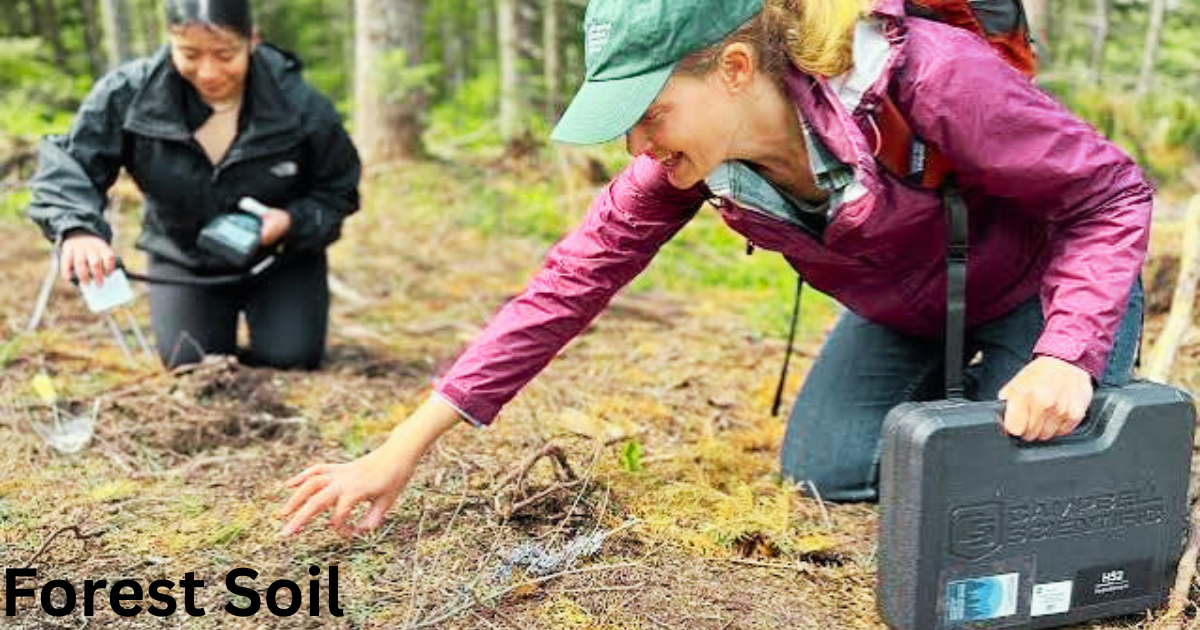
Walking through a dense woodland, you rarely think about what lies beneath your feet but forest soils hold the entire system together.
The process of soil formation begins with forest vegetation taking root, and over centuries, deeply rooted trees push through layers of earth.
Creating those iconic litter layers known as O horizons. These layers trap and recycle organic matter, nutrients, and even wood fragments.
Feeding a hidden world of soil-dwelling organisms that most of us never see.Every forest soil tells a story written by geological parent materials.
Shaped by topographic positions, and rewritten constantly by shifting climates and living organisms. Some soils began as raw talus fields or fresh glacial till and alluvium.
While others have matured quietly in stable landscapes over thousands of years. Depending on where you stand, the ground beneath a forest can be sandy, clayey, wet, arid, frigid, or warm.
Researchers studying the Douglas fir regions of North America discovered staggering variability in nitrogen levels within forest floors, and the US soil classification system now recognizes.
Forest soils across all its major soil orders. The productive potential of any forest depends on a daily exchange between the sun, the climate, stored water, carbon, and cycling nutrients.
Healthy ground supports water filtration, controls wind erosion and water erosion, boosts plant biodiversity and soil biodiversity, and reduces outbreaks of insects and diseases all while feeding clean water supplies downstream.
In the mountains, forest soils belong to almost all soil types found on Earth, shaped by mechanical weathering from snow, rain, and wild Field Measurement Book.
 These soils carry humus but often run short on potash, phosphorus, and lime, yet they still support tea, coffee, spices, and tropical fruits across many regions.
The ground turns loamy and silty along valley floors, grows coarse on upper slopes, stays acidic in snowy country, and reaches peak fertility at the fertile bottom of a valley.
From a broader scientific view, forest soils are generally acidic and organic, with chemical fertility that stays naturally limited.
Threats like acidification, physical degradation, loss of soil carbon, collapse of biological activity, and creeping pollution all chip away at their health.
Meanwhile, ecosystem management plays a growing role in protecting soil sustainability, because organic matter in the topsoil breaks down faster than mineral phases can replace it.
The entire forest ecosystem begins to suffer especially under the pressures of climate change, shifting rainfall, rising temperature.
And cascading interactions and feedback that scientists are still working to fully understand.Beyond the trees themselves, plantations introduce new microbes.
And fauna communities into previously non-forested ground. Generations of soil scientists have studied the ecologic characteristics of these systems, from the famous surface.
Organic layers in Denmark that gave us the terms mor and mull, to cutting-edge research on mycorrhiza-forming fungi and the effects of fertilizer applications on forest.
Today, research spans boreal forests, temperate forests, and truly global ecosystems, all united by the fact that forest floors and their soils store more organic carbon.
Than any other part of any terrestrial biome, a fact that places them at the heart of climate science.
Features of Forest Soils
Generations of soil scientists have devoted careers to understanding forest soils, starting with ecologic characteristics like the famous surface organic layers studied in Denmark.
Which gave the scientific world the terms mor and mull. From there, research expanded into nutrients, water supplies, soil organisms, especially mycorrhiza-forming fungi.
And the effects of fertilizer inputs on forest management decisions across the globe. These early investigations laid the foundation for how we now classify.
Protect, and productively manage forest ground worldwide.Primary forest soils those with intact native tree cover and minimal disturbance .
Display well-developed soil profiles and clear horizonation that reflect the full history of soil formation factors and the processes that shaped them.
This sets them apart from cultivated soils and cropped soils, where human activity has heavily disrupted the natural soil properties and changed .
Conditions for microorganisms across different soil horizons. The critical divide runs between the surface organic layer, known as the O horizon, and the mineral soil layers beneath.
A boundary that microbiologists study intensely, especially in boreal forests where the O horizon grows several centimeters thick and teems with roots and microscopic life.
Some forest soils carry a thin layer of peat at the surface, forming a historic organic horizon or H horizon, marking the transition point toward full histosols or peat soil lower in the landscape.
Where soil fauna activity is high, the clear line between the O horizon and the mineral soil blurs through bioturbation, mixing organic and mineral materials together.
Across the boreal zone, soils often develop in coarse-textured, glaciofluvial deposits with minimal clay content or in stony glacial till ground that resists cultivation and crop production but sustains vast forest ecosystems.
The loamy and silty soils along valley floors contrast sharply with the coarse soils of upper slopes and the acidic, low-humus soils of snowy country.
Even the nutrient-rich soils of tropical rain forests stay surprisingly poor in nutrients overall, because their parent material is old and deeply weathered.
Stripped of primary minerals long ago, forests there survive through rapid microbial decomposition of litterfall and extraordinarily tight nutrient cycling.
Meanwhile, deficiencies in potash, phosphorus, and lime limit productivity across many mountain forest soils, even where humus accumulates.
And the land remains fertile enough to support tea, coffee, spices, and tropical fruits at lower elevations.
Acidification, physical degradation, loss of soil carbon, declining biological activity, and industrial pollution represent the major environmental threats pressing down on forest soils today.
Their generally acidic and organic nature means their chemical fertility sits at a natural disadvantage compared to agricultural land, and ecosystem management.
Must compensate for a topsoil that loses organic matter faster than mineral phases can replenish it.
Soil classification systems, including mineral soils, organic soils, and upland forest soils categories, help managers track these pressures .
Alongside measurements of groundwater influence, forest cover extent, and placement within the world’s major soil groups, including podzols and podzolized soils.
Developed in sorted glaciofluvial deposits, treed mires, and ditched peatlands.Field data from Finland reveals the full range.
Bulk density, pH, organic carbon, nitrogen, phosphorus, potassium, and calcium all vary dramatically between the humus layer, mineral soil, and surface peat layers.
These variations directly control the edaphic factors temperature, moisture, aeration, nutrients, and acidity that determine which microorganisms survive.
Nature and Definition of Forest Soils
Soil functions as the primary medium where plant roots grow, built from unconsolidated mineral material and organic material that hold shifting amounts of water.
And air while sheltering soil fauna and an extraordinary diversity of microorganisms. Scientists broadly split soils into mineral soils and organic soils based on their organic.
Matter content, and both types support tree growth across the world’s forests. Most forest soils form within weathered mineral deposits, carrying varying amounts of organic matter.
That fuels the biological processes above and below ground.Upland forest soils stay freely draining and remain largely unaffected by groundwater.
Separating them functionally from lowland mineral soils where water tables dominate. Today, forest cover stretches across 4.06 billion ha of the Earth’s surface .
A fraction of the land area that forests once blanketed in prehistoric times, when they covered nearly half the planet. Because forests spread across every major climate zone.
Forest soils appear in most of the world’s major soil groups, reflecting the sheer range of conditions under which trees take root and thrive.
In the cold boreal zone, soils typically develop in coarse-textured, glaciofluvial deposits with low clay content or in stony glacial till neither ideal for cultivation or crop production.
But perfectly suited for boreal tree species. Podzols and podzolized soils dominate these northern landscapes, while lower-lying areas transition into treed mires.
And ditched peatlands managed for forestry. Soil classification systems including the FAO framework organize these types using measurements of bulk density, pH, organic carbon.
Nitrogen, phosphorus, potassium, calcium, and the key edaphic factors temperature, moisture, aeration, and acidity that govern microbial life and tree growth alike.
Important Forest Soil Groups
New Hampshire sits on some of the most complex soils in the northeastern United States, a complexity driven directly by their glacial origins.
And the layered legacy left by retreating ice sheets. The Natural Resource Conservation Service, or NRCS, built its soil mapping program around these patterns.
And developed the Important Forest Soil Groups framework to give natural resource professionals and landowners a practical planning tool.
These groupings help managers evaluate soil productivity, anticipate plant succession patterns, and understand how soil and site interactions shape every management decision on the ground.
Group IA soils run deeper and loamy, staying moderately well-drained and well-drained with reliably fertile ground and favorable soil-moisture conditions year-round.
Succession on these soils pushes naturally toward climax communities of shade-tolerant hardwoods: sugar maple, beech, red maple, yellow birch, gray birch.
White birch, aspen, white ash, and northern red oak mixing with red spruce, white spruce, balsam fir, hemlock, and white pine in early stages.
These are premier sites for high-quality hardwood veneer and sawtimber production, especially sugar maple, white ash, yellow birch, and northern red oak.
Though softwoods remain a minor presence and keeping them productive within hardwood stands demands intensive management and careful natural regeneration work.
Group IB soils share many characteristics with Group IA but run sandy and loamy-over-sandy, offering slightly less soil moisture and nutrients while still supporting solid trees.
Beech tends to dominate climax stands here, and hardwood competition from white birch and northern red oak runs moderate to severe.
Making softwood production and establishment of softwood plantations dependent on disciplined intensive management.
The deeper, coarser soils within this group also carry real potential for conversion to dedicated softwood systems given the right investment in chemicals.
Group IC soils trace back to glacial outwash deposits of sand and gravel, producing a coarse textured profile that drains quickly.
Ranging from moderately well-drained to excessively drained and creates conditions that favor softwood growth while limiting hardwoods significantly.
Succession trends point toward red spruce and hemlock, with early stands carrying white pine, northern red oak, red maple, aspen, gray birch.
And paper birch competing for space. These soils shine for high-quality softwood sawtimber, especially white pine, which can thrive in near-pure stands.
Modest soil moisture management and without the heavy chemical control required on richer sites.
Group IIA draws from the same productive soil base as Groups IA and IB but adds complicating factors: steep slopes, exposed bedrock outcrops, high erodibility.
Scattered surface boulders, and intense stoniness that push up the cost and difficulty of tree planting, thinning, and harvesting without dramatically reducing overall productivity.
Group IIB takes a different limiting path through poor drainage, with a seasonal high water table sitting at 12 inches or less below the surface, cutting productivity.
And restricting hardwoods while leaving room for softwoods like red spruce, hemlock, balsam fir, and white pine to dominate stands suited for spruce and balsam fir pulpwood.
And sawtimber production. Where advanced regeneration naturally fills gaps, hardwood competition stays manageable.
Though intensive management through chemical control of competing woody and herbaceous vegetation can still improve outcomes on the tougher Group IIB sites.
Soils marked Not Rated fall outside these categories entirely either too variable to classify reliably or too limited in their potential for commercial use.
Production of forest products to justify placement in a formal group, including very poorly drained soils and those found at the highest elevations across the state.
Forest Soil Biology
Life in forest soils splits at the most fundamental level between prokaryotes and eukaryotes, with the prokaryote domain housing bacteria and archaea.
A and the eukaryote domain covering protoctista, plantae, fungi, and animalia four kingdoms teeming with representatives in every layer of forest ground.
Viruses, though present, contribute negligibly to microbial biomass and broader ecology, but every other group plays an active role in the extraordinary.
Biodiversity that forest soils harbor. Scientists widely believe that soil provides habitat for the majority of all life on Earth.
Yet the full scale of microbial diversity hiding in that ground remains largely unmapped.The challenge lies partly in morphology.
These organisms are simply too small and structurally similar to distinguish through traditional observation alone and partly in fact.
That standard cultivation methods in laboratory media capture only a fraction of what actually lives there.
Advances in rRNA sequence analyses have begun unraveling the phylogenetic relationships between microbial groups, leading to significant reclassification.
Across the tree of life in recent decades. Techniques including 16S rRNA gene sequencing, polymerase chain reaction amplification, in situ hybridization to identify.
Metabolically active microorganisms, substrate utilization assays for metabolic diversity, flow cytometry for enumeration, terminal restriction fragment length.
Polymorphisms for comparative analysis, and RNA slot blot methods for tracking active community members have all transformed how researchers map the living world beneath the trees.
Among the known numbers vascular plants at roughly 220,000 known species out of an estimated 270,000, bryophytes at 17,000 of a projected 25,000, algae at 40,000 of 60,000.
Fungi at 69,000 of a staggering estimated 1,500,000, bacteria at 3,000 of 30,000, and viruses at 5,000 of 130,000 the percentage known drops sharply as organisms shrink in size.
The overwhelming estimated species counts for fungi and bacteria alone signal just how far soil microbial community research still has to go.
What scientists do know is that the extreme heterogeneity of the forest soil environment drives an unusually high diversity of decomposer species.
And that this diversity directly maintains critical matter fluxes and energy fluxes while building resistance against disturbances to decomposition including.
The key process of nitrification is carried out by both heterotrophic bacteria and fungi in acid forest soils.
Understanding microbial ecology and biogeography at this scale remains one of the great unsolved challenges in soil biology.
Forest Soils and Carbon
Forest soils function as one of the planet’s most critical carbon reservoirs, holding more than 40% of all organic carbon stored across terrestrial ecosystems .
A figure that places them at the center of every serious conversation about atmospheric CO2, sequestration, and global climate change mitigation.
Scientists from IPCC, researchers like Lal, Wei et al., and teams led by Cotrufo, Prescott, Satchell, and Schmidt have all contributed to understanding.
How soil organic matter accumulates, stabilizes, and cycles through forest systems. The pressing scientific challenge is no longer simply measuring carbon fluxes.
But understanding the complete continuum of transformation from fresh litter to deeply stabilized SOM, a nexus that Satchell famously lamented had been neglected for too long.
At the surface, fresh litter enters the L layer, partially breaks down into the F layer, and eventually transforms into the deeply processed H layer.
The true humus that defines healthy forest floor chemistry. Through bioturbation, soil fauna physically move this organic matter downward.
Mixing aboveground litter into the mineral soil where it can bind to aggregates and clay minerals as mineral-associated organic matter, or MAOM the slow-cycling.
Dynamically stable pool that locks carbon away most effectively. Faster-cycling pools in the mineral soil particulate organic matter (POM) and dissolved organic matter (DOM) .
Keep the system dynamic, with losses and inputs constantly balancing in what Dynarski and Lavallee describe as a stable but never static equilibrium.
Prescott outlined three major pathways driving this system: transformation of litter into complex compounds within the forest floor.
Physical transfer of litter and humus downward into the mineral soil transfer zone, and the decomposition of belowground litters including root litter and mycorrhizal fungal residues.
Rates of litter transformations vary dramatically across forests depending on site conditions, making every forest’s decomposition pathways, carbon fluxes.
And SOM pools and fluxes are highly context-dependent. Adding another dimension to this picture, forest soils also act as the largest atmospheric methane (CH4).
Sinks in all terrestrial ecosystems, and research shows that soil organic matter driven by aboveground vegetation NPP net primary productivity.
Significantly controls CH4 uptake, pushing scientists toward incorporating NPP variables directly into global CH4 models to sharpen model predictions and better capture.
What these extraordinary worldwide forest floors contribute to the planet’s largest terrestrial biome.
Forest Soils and Climate Change
Forest soils have shaped human civilization for millennia, yet for most of history they lived in the shadow of agricultural soils in terms of scientific attention.
A gap that researchers studying temperate forests and boreal forests spent decades closing as forest soils became a truly global research priority.
That shift matters enormously now, because forest soils sit at the intersection of two of the biggest challenges facing the modern world:
Controlling air pollution and managing the deepening crisis of anthropogenic emissions across regions like China and beyond.
As policy has driven down human-caused pollution, biogenic sources of natural emissions from living forests and their soils have stepped forward.
A landmark multinational study led by Fudan University, in collaboration with Duke University and the University of California Irvine, published in Environmental Science.
Ecotechnology uses ground-based observations, satellite data, and chemical transport modeling to reveal exactly how dangerous the interaction between forests.
And soil emissions become during extreme heat. During China’s record-breaking 2022 heatwave, average summer temperature climbed from 23.0°C to 25.0°C, with peaks hitting 46.4°C .
Across the Yangtze River Basin, triggering explosive increases in both biogenic terpenoid emissions from vegetation and soil nitric oxide (NO) release from the ground below.
Isoprene, the dominant terpenoid species, surged more than 130% above the 2020–2021 average in emission rates, a spike independently.
Confirmed through satellite data tracking formaldehyde (HCHO) column densities across the affected region.
The study’s most striking finding was a previously unknown synergistic mechanism: elevated biogenic terpenoids generate peroxy radicals (RO2) that dramatically amplify atmospheric.
Oxidation capacity, accelerating the conversion of soil-emitted NO into nitrogen dioxide (NO2)
In NOₓ-limited regions the precise zones where this biogenic-soil synergy operates at full power researchers documented a 21% surge in regional ozone levels and SOA.
Concentrations rising by up to 4 μg m⁻³, compounding the secondary pollution burden across the basin. Projections under the Shared Socioeconomic.
Pathway 5-8.5 scenarios warn that a 5°C temperature increase could nearly double these effects, turning what already looks alarming into a serious structural threat to regional air quality targets across a warming world.
The implications reach directly into forest management and large-scale afforestation programs. While planting trees drives vital carbon sequestration.
The study warns that poorly planned greening efforts can worsen local air quality if ecological feedbacks and atmospheric feedbacks go unaccounted for in planning frameworks.
Researchers now call urgently for biogenic emission baselines to be built into climate adaptation strategies and pollution control frameworks, ensuring that as NOₓ emissions from human.
Sources continue declining and geographic extent of sensitive regions expands, the growing relative importance of natural emissions from forests Forest Soil Management.
Forest Soil Management
Forest soils form the irreplaceable foundation of both forest productivity and grassland productivity, and every decision about how to manage land begins.
With understanding the soil conditions underfoot. The Forest Service recognized this early, building a nationwide program of long-term soil productivity research across.
Dozens of sites to track the soil properties that drive forest growth and grassland growth season after season, year after year.
Through systematic soil monitoring, scientists map the impact of every major management action from harvesting to prescribed fire on the ground’s capacity to support life.
While also developing targeted strategies to reverse the damage on degraded soils and accelerate restoration.
The underlying science starts with a simple but profound truth: forest soils and forest vegetation evolved together as coupled ecosystems over timescales.
That dwarfs human land use histories, and understanding the effects of management actions on that bond is the only way to build management policies that genuinely optimize.
Ecosystem health at scale. Climate change, invasive species, rising wildfire severity, and increasing wildfire frequency now stress that bond in ways that are only partially understoo
Making the Forest Service’s long-term programs for tracking soil health, biophysical processes, and vegetation support more critical than ever.
Land managers working across this landscape increasingly rely on tools like the Soil Monitoring Toolkit and the Long-Term Soil Productivity Network to assess soil condition.
Monitor soil disturbance, and evaluate how management choices affect forest productivity and soil quality over time.
The USDA Forest Service science synthesis on forest management and rangeland soils under changing conditions pulls together the best current knowledge on soil carbon.
Hydrology, biogeochemistry, biological diversity, and the compounding effects of both natural disturbances and human-caused disturbances across the nation’s forest.
This comprehensive science synthesis reinforces what field researchers have known for decades:
The same soils that support water filtration, buffer wind erosion and water erosion, drive plant biodiversity and soil biodiversity, suppress outbreaks of insects and diseases.
And delivering clean water and abundant water to downstream communities also depend on receiving the sun’s energy through a thriving forest canopy, sustained by a stable climate.
Peat soils
Peat soils hold almost no mineral matter they build entirely from accumulated vegetation residues, specifically the remains of mire vegetation caught in various stages of decomposition.
Compressed by time and waterlogging into a dense organic archive of past ecosystems. Scientists classify peat as an organogenic, hydromorphic soil.
Formed specifically under conditions of persistent water saturation, and placed within the major soil group of histosols .
A category that covers roughly 325–375 million ha globally, concentrated overwhelmingly in the boreal zone. Microbial decomposition of the accumulated organic matter.
Slows dramatically under the anaerobic conditions created by high water tables, which is precisely why peat builds up rather than breaking down.
The broader context around peat reaches beyond the soil itself into the concept of the peatland, a landscape where peat has accumulated but which may have shifted away.
From its original pristine mire state through disturbance or changes in land use. Mire ecosystems function as the true birthplaces of peat.
Operating as a subset of the wider category of wetlands that includes other hydromorphic soils with higher mineral matter content but without the characteristic mire vegetation.
Where drainage has been applied through ditching and active management of ditched peatlands and treed mires.
These systems can support commercial forestry and transition toward conditions more similar to upland forest soils.
In the boreal zone, the contrast between upland podzols and podzolized soils developed in glacial till and glaciofluvial deposits and the waterlogged world.
Peat soils create dramatically different growing environments for both trees and microorganisms. Measurements of bulk density, pH.
Organic carbon, nitrogen, phosphorus, potassium, and calcium reveal the sharp chemical divide between these two soil worlds.
With the edaphic factors of temperature, moisture, aeration, and acidity shifting radically between them.
The distinction between forest mineral soils and organic soils and the full range of conditions each creates ultimately determines which species of trees.
Fungi, and microorganisms can establish, survive, and shape the ecosystems we recognize as forests.
Decomposition and Soil Organic Matter
Decomposition in forest soils is not a single event but a long, layered journey that begins the moment litter hits the ground and ends .
If it ends at all with organic molecules locked into the deep mineral soil as stable soil organic matter or SOM.
Fresh material enters the system as fresh litter in the L layer, transitions through the F layer as partial breakdown proceeds, and ultimately transforms.
True humus within the H layer is a sequence that the Canadian System of Soil Classification formalizes and that researchers increasingly prefer to de
Transformation rather than the older term humification, following shifts in scientific understanding driven by work from Schmidt and colleagues.
The forest floor acts as the primary theater for this early-stage work, where litter materials convert into complex compounds that either accumulate at the surface or begin moving downward.
Transfer to the mineral soil happens through two main routes: physical movement driven by bioturbation from soil fauna, and chemical transport as dissolved organic matter (DOM).
Percolates through the profile. Once in the mineral zone, organic inputs can stabilize within aggregates and bind to clay minerals as mineral-associated organic matter (MAOM) .
The slow-cycling, dynamically stable end of the spectrum or persistence in faster-cycling forms as particulate organic matter (POM).
The stable SOM pool, as redefined by Dynarski and further explored by Lavallee, represents not permanent chemical resistance but a dynamic balance where losses occur.
And inputs cancel each other out, maintaining what researchers now call a slow-cycling pool distinct from the more active faster-cycling pools cycling through the mineral soil continuously.
Below ground, the system adds another layer of complexity through belowground litters root litter decomposing in place and mycorrhizal fungal residues releasing carbon.
At the soil-root interface pathways that Prescott identified as the third major route of litter transformations feeding the SOM system alongside surface transformation.
And physical mineral soil transfer. The rates at which these decomposition pathways move carbon through fluxes and into stable pools depend heavily on site conditions.
Soil organisms, and the local ecology of the decomposer community, making every forest’s SOM story unique. Researchers track this progression through repeated mass measurements of litter enclosed in mesh bags, moving
Beyond simple mass loss numbers to capture the full decay process along the entire continuum from surface organic layers through the complex chemistry.
The nexus zone where litter becomes soil, building a clearer picture of how forests sequester carbon and what threatens that capacity under changing conditions.
Since no FAQs were present in any of the three competitor content pieces, I will generate relevant and commonly searched FAQs for the keyword forest soil based on the content we have already worked with.
FAQS About Forest soil
What is forest soil?
Forest soil is a living, layered medium shaped by forest vegetation, climate, and geological parent materials over thousands of years. It supports deeply rooted trees.
What are the main characteristics of forest soil?
Forest soil is typically acidic, organic, and rich in humus while remaining naturally low in chemical fertility. It carries distinct soil horizons including.
Why is forest soil important?
Forest soil drives water filtration, controls wind erosion and water erosion, supports plant biodiversity and soil biodiversity, and stores more organic carbon than any other part of any terrestrial biome.
What are the different types of forest soil?
Forest soils range from loamy, well-drained soils perfect for hardwood species like sugar maple and northern red oak, to coarse-textured, glaciofluvial soils suited for softwood species like white pine and red spruce.
How does forest soil store carbon?
Forest soils capture atmospheric CO2 through a continuous process of litter breakdown, humus formation, and stabilization of organic matter within aggregates and clay minerals as mineral-associated organic matter (MAOM).
How does climate change affect forest soil?
Climate change disrupts forest soil through rising temperature, shifting rainfall patterns, and intensifying heatwaves that spike biogenic terpenoid emissions and soil nitric oxide (NO) release simultaneously.