
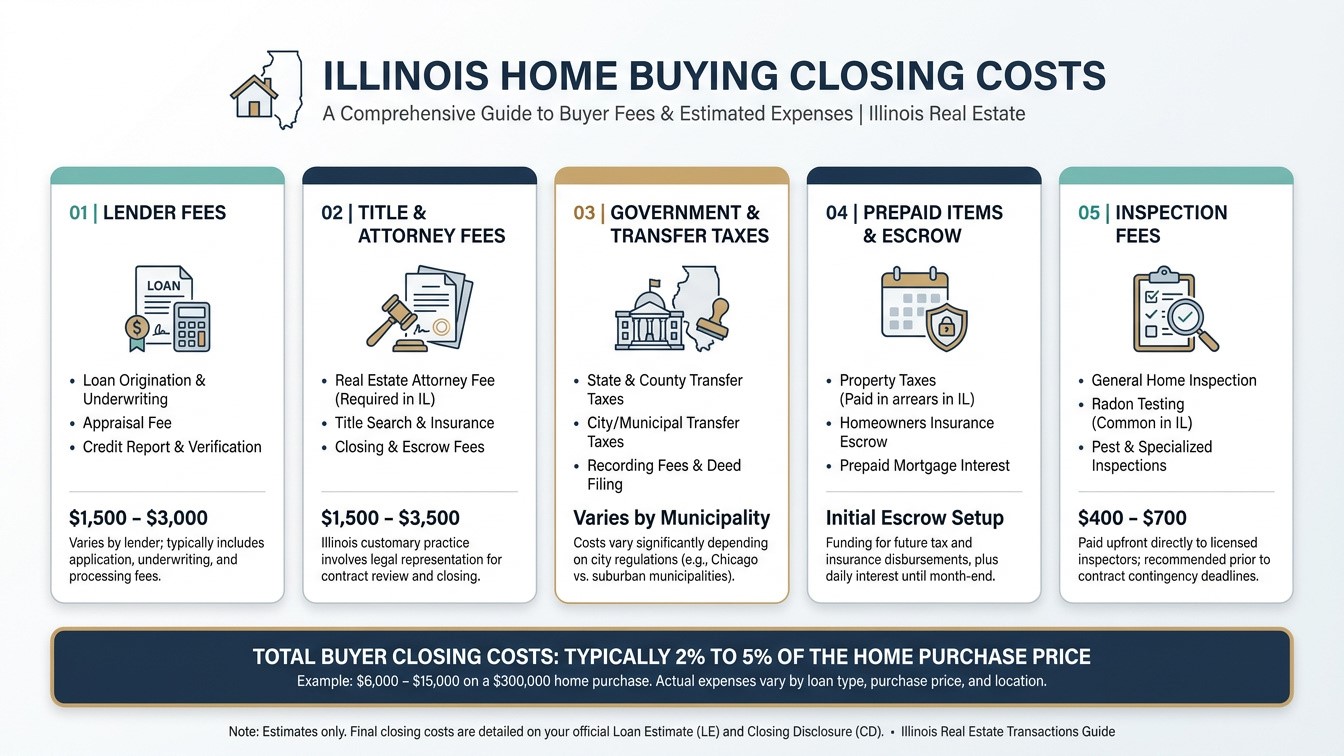
Buying your first home in Illinois costs more than the number on the listing. This guide walks through each fee, shows where the totals appear on your paperwork, and explains how to judge a provider. It draws on public pages from six brands, and it adds no figure those sources fail to support.
What Are Closing Costs on a First-Time Home Purchase in Illinois?
Closing costs are the fees you pay to finalize a home purchase on top of your down payment. NerdWallet puts them at roughly 2% to 6% of the loan amount. Your lender, title company, attorney, and local governments each collect a share.
AED Realty, a brokerage serving Chicago and Northern Illinois, lists earnest money, inspections, attorney fees, prepaid expenses, and lender costs as separate cash needs. It also publishes an Illinois home buying guide and a download on the costs of buying a home in Illinois, and both help a first-time home buyer plan. Keep your funds to bring to closing in a separate account.
Which Lender Fees Will Appear on My Loan?
Lenders charge for processing and risk, and those charges appear as loan origination charges, discount points, and other lender fees. Nerd Wallet’s list also names an appraisal fee, a flood determination fee, and tax monitoring and research fees. The list includes a pest inspection fee.
Nerd Wallet’s closing costs calculator tags each line as fixed or shop, which separates fixed vs. shop-for services. You can compare lender charges between two lenders, while taxes and government fees stay outside your control. Your lender also collects prepaid interest and initial escrow payments at closing.
What Title, Attorney, and Government Fees Should I Expect?
Expect a title search fee, lender’s title insurance, owner’s title insurance, a settlement fee, and a government recording fee. AED Realty groups these under title and closing-related charges. Many Illinois transactions also include attorney review, so budget for a real estate attorney.
Attorney review usually starts right after contract acceptance, and your attorney checks deadlines, disclosures, and ownership questions. AED Realty notes that many Illinois residential contracts allow only a short review window, so select your attorney early. NerdWallet says you cannot control government fees, so spend your comparison effort on lender and title services instead.
How Do the Loan Estimate and Closing Disclosure Show My Costs?
Your lender must send a Loan Estimate within three business days after your loan application, and it projects your monthly payment and closing costs. The Closing Disclosure carries the final numbers and arrives three days before closing. Compare the two documents line by line.
Your closing statement lists every credit and charge, so check its totals against the Closing Disclosure and your funds to bring to closing. Lender documentation requests continue through underwriting, final loan approval, and clear to close. Ask about lowering your closing costs early, because a no-closing-cost mortgage swaps upfront cash for a higher rate or larger loan, and seller-paid closing costs depend on the seller’s motivation.
How Do Earnest Money and Escrow Work?
Earnest money is a deposit you make after the seller accepts your offer, and it counts toward the price at closing. An escrow account holds it until the sale closes. It does not add a fee on top of the purchase price.
AED Realty’s example shows $5,000 of earnest money becoming a credit toward closing funds on your closing statement. Your purchase contract sets the initial and additional deposit and the contract deadlines, and an escrow holder cannot settle an earnest money dispute alone. Wire fraud poses a real risk, so confirm verified wire instructions by phone, and Robin Chessick’s website lists a secure ACH payment platform for earnest money deposits.
How Much Cash Do I Need Beyond the Down Payment?
Plan cash for the down payment, closing costs, earnest money, inspections, and prepaid expenses. AED Realty stresses that the down payment is not the only cash a buyer needs. Treat down payment vs. closing costs as two separate savings goals.
Ask a mortgage lender for a monthly mortgage payment at three price points, then run the same prices through NerdWallet’s how much house can I afford calculator. Count the total monthly payment, then widen it into a budget beyond the mortgage that covers housing costs. A larger down payment lowers your loan-to-value ratio and, depending on the loan, can affect mortgage insurance, so compare home affordability at two down payment sizes.
What Help Exists for First-Time Home Buyers?
State and local programs offer down payment assistance, grants, and forgivable loans to eligible buyers. NerdWallet’s first-time homebuyer hub covers first-time home buyer programs and first-time home buyer loans. Eligibility rules vary, so confirm each program’s terms with its administrator.
NerdWallet says a first-time home buyer class can open the door to grants and down payment assistance, and it lists first-time home buyer mistakes alongside 15 homebuying process steps. Print that homebuying checklist and mark each deadline. Flanagan State Bank also publishes homebuyer resources on the home loan process, loan programs, and pre-qualification.
Which Mortgage Types and Rates Should a First-Timer Compare?
Compare conventional loans, FHA loans, VA loans, and USDA loans, because each uses different qualification rules. Flanagan State Bank lists all four, plus a reverse mortgage and refinancing, on its mortgage pages. Your loan officer can show which options fit your credit score and income.
AED Realty adds that jumbo loans and renovation financing exist for other situations. Your lender sets your interest rate from your credit profile, loan type, and loan term, so a 30-year fixed mortgage, a 15-year fixed mortgage, and an adjustable-rate mortgage carry different pricing. Ask about a rate lock too, because lock length, cost, and terms vary by lender.
What Do Inspections Add to My Costs?
A home inspection checks the property’s condition, while a home appraisal estimates its value for your lender. You usually pay for both services, and neither one replaces the other. AED Realty draws that line clearly on its buying resources page.
A home inspector reviews the roof, foundation, plumbing, and electrical systems, and you can add radon testing, a sewer scope, mold testing, a chimney inspection, or a structural evaluation. Homes with a well and septic system call for extra checks. If the inspection report finds problems, you and your attorney can request repairs or a repair credit.
What Happens If My Appraisal Comes In Low?
A low appraisal means the appraiser’s opinion of value falls below your contract price, and your lender may finance less. AED Realty’s example shows a $400,000 contract with a $385,000 appraisal, which leaves a $15,000 gap. You can negotiate with the seller, bring more cash, or ask for a reconsideration of value.
The appraiser compares recent comparable sales and adjusts toward market value, so the report stays an opinion of value. Read your appraisal contingency carefully, since it does not always give you an automatic exit. AED Realty also notes that UAD 3.6 appraisal changes reshape how appraisers report property data in 2026.
How Do Property Taxes and Insurance Change My Monthly Budget?
Property taxes and homeowners insurance join your mortgage payment, and many lenders collect them through tax and insurance escrows. ConsumerAffairs reports that Cook County applies a 10% assessment ratio, so your assessed value differs from your sale price. Expect property tax notices and a property tax bill.
Ask your county assessor’s office about a homeowner exemption, because AED Realty warns that an exemption on the seller’s records may not carry over. ConsumerAffairs adds that you can file a property tax appeal, and that senior and veteran exemptions exist but require applications. Price flood insurance where it applies, compare insurance deductibles, count homeowners association assessments and utilities, and read your escrow statements.
What Does the Illinois Home Buying Process Look Like From Offer to Keys?
Start with mortgage preapproval, then search, make an offer, clear attorney review and inspection, finish the appraisal, and close. AED Realty’s appraisal page sketches this home buying timeline from offer accepted to final walkthrough. A prequalification gives only a rough estimate, so lean on preapproval.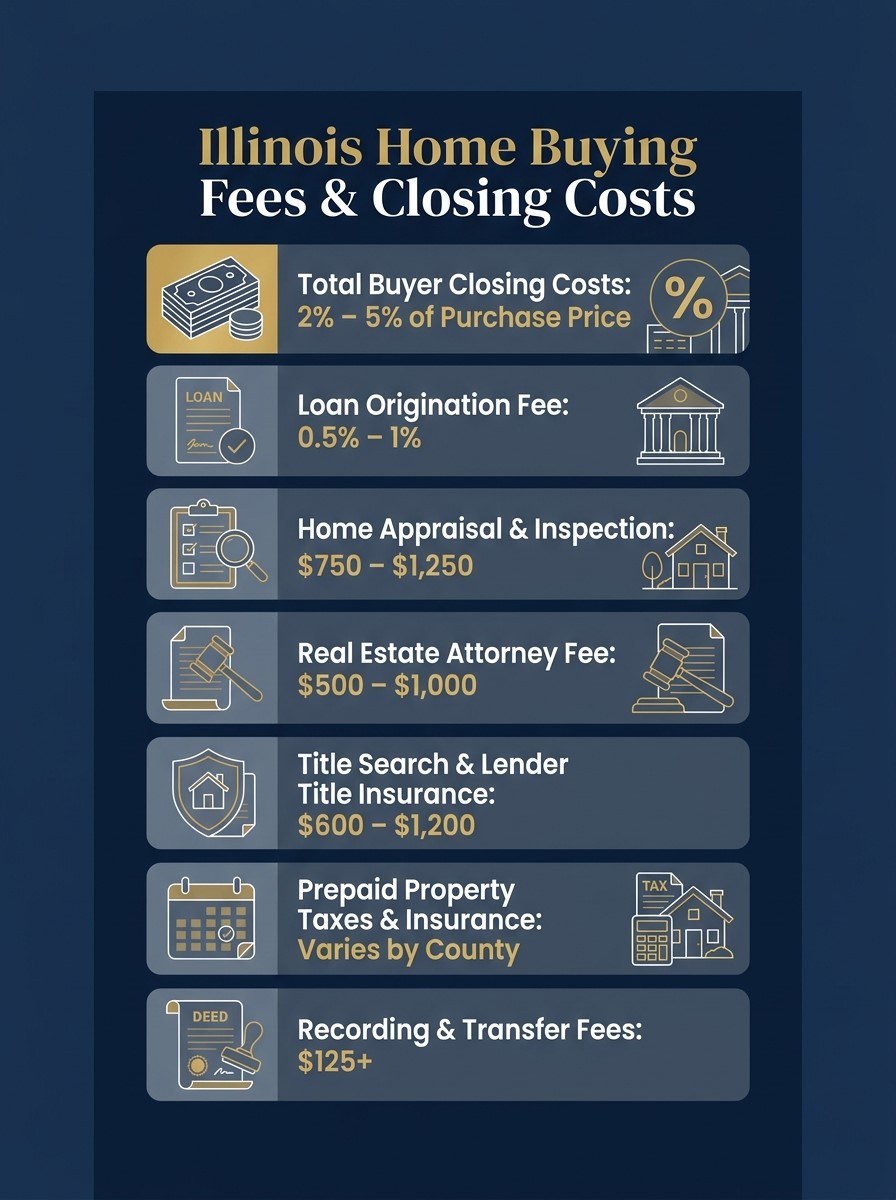 Your Illinois real estate contract carries contingencies and contract deadlines, so keep a calendar for each date. Buyer representation matters here, because your buyer’s agent shapes your offer strategy, negotiation, and read of market conditions. Robin Chessick’s site and AED Realty both describe buyer services.
How Do I Narrow My Property Search in Illinois?
Match your property search to your approved budget, your commute, and the home type you want. AED Realty covers homes, condos and townhomes across the region, and Robin Chessick describes the Chicagoland housing market on its homepage. Choose a neighborhood before you tour, not after.
If you want a condo with FHA financing, Robin Chessick’s resources page links to an FHA-approved condo database. NerdWallet publishes a guide to fixer-upper houses, which helps you weigh repair work against the price. Budget repair money before you bid.
What Should I Do After Closing?
After closing, take possession, change your locks, and learn where your water shutoff and electrical panel sit. AED Realty publishes a first-year homeowner checklist that covers these tasks. Treat a post-closing checklist as part of the purchase, not an afterthought.
Store your closing documents, inspection report, and warranties in one set of home records, and build a maintenance plan around the equipment you own. Start setting money aside for repairs, and add a moving budget if you have not paid for the move yet. A home warranty is optional, and ConsumerAffairs publishes a buyers guide on home warranties.
What Should I Look for in a Home Buying Service Provider?
Look for a provider that publishes clear fee information, states its loan or service options, and explains your next step. Compare at least two lenders and one buyer’s agent before you commit. This website exists to make that comparison easier.
NerdWallet compares lenders and offers a mortgage calculator, Flanagan State Bank lists USDA, FHA, VA, and conventional loans, and AED Realty offers buyer, seller, and investment services. Robin Chessick serves buyers and sellers through Baird & Warner, ConsumerAffairs publishes reviews and buyers guides, and Frontflip shows auction deals and investment reports. Each brand offers the services that its own website lists, so confirm details there, and note that ConsumerAffairs states it acts as a mortgage broker rather than a lender.
FAQs
How Much Are Closing Costs for a First-Time Buyer in Illinois?
NerdWallet puts closing costs at 2% to 6% of the loan amount. Your exact total depends on your loan, lender, and title services. Your Loan Estimate gives you the first real number.
Can the Seller Pay My Closing Costs?
Sometimes, yes. Motivated sellers occasionally contribute, but they do so less often when buyers outnumber homes for sale. Ask your agent to request a contribution in your offer.
Do I Get My Earnest Money Back If the Deal Falls Apart?
Sometimes, but not automatically. Your contract’s contingencies, such as attorney review, inspection, financing, or appraisal, decide your rights. Ask your attorney before you terminate.
Is a No-Closing-Cost Mortgage Worth It?
It can help when cash runs tight, but it costs more over time. Your lender recovers the fees through a higher rate, a larger loan, or both. Compare the monthly payment before you agree.
Do I Need an Attorney to Buy a Home in Illinois?
Many Illinois transactions include attorney review, and AED Realty advises choosing an attorney early. Your attorney reviews the contract and handles legal questions. Your agent handles the real estate side.
Where Can I Find the Right Help for Home Buying Illinois Fees?
Start with the fees and the people who explain them, and use this website to compare providers in one place. This site points you toward lenders, a buyer’s agent, and calculators that publish clear details, so you skip tab hunting. Visit this website next for home buying Illinois fees guidance, then confirm each provider’s current services on its own site.