
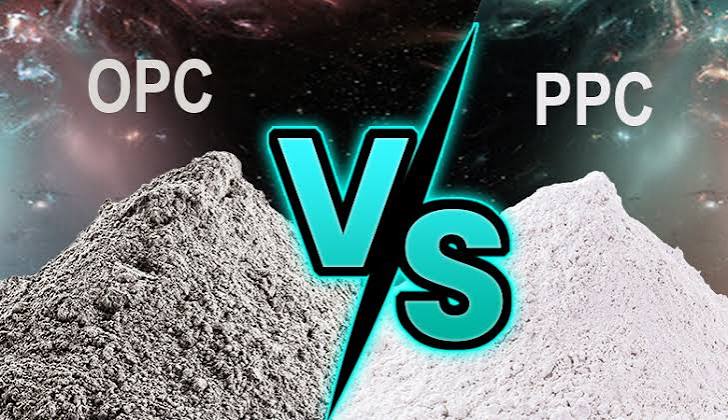
I have spent years around construction sites, and one question still comes up every single time a project begins: which cement types should we actually use?
If you are planning to build a house or any other structure, this OPC vs PPC Cement blog will walk you through everything you need for making an informed decision.
Both Ordinary Portland Cement and Portland Pozzolana Cement are common names in India, and while both are used to create robust structures, their compositions, strength, setting time and overall performance are quite different.
Choosing the right cement types matters for long-term safety, whether you’re pouring columns, doing plastering, or handling general masonry work. Many home builders get stuck here because they don’t fully understand the suitability of each type for different applications.
This guide breaks down OPC and PPC, their heat of hydration, benefits, and practical use cases, so you can pick the right cement for your construction projects and construction needs whether it’s a concrete structure, a residential home, or heavy-duty slabs.
What is OPC Cement
OPC, or Ordinary Portland Cement, is one of the most widely used cement varieties across India, and it’s made through a simple process of grinding clinker together with gypsum roughly 95% clinker and 5% gypsum.
This mix gives OPC its impressive compressive strength, and it’s why builders lean on it for general construction, from buildings and bridges to roads and flyovers.
You’ll find OPC available in 33 grade, 43 grade, and 53 grade, with 43 grade commonly chosen for RCC work and everyday structural applications, while 53 grade is reserved for precast work and heavier loads.
It sets fast thanks to its faster setting time, which is exactly why it delivers high early strength and works so well in slabs, beams, and columns.
But there’s a catch when water meets OPC, a chemical reaction kicks off, releasing heat known as the heat of hydration.
In small constructions, that heat is barely noticeable, but in large constructions or thick concrete structures, it can build up fast, so proper curing becomes essential to prevent cracking.
What is PPC Cement
PPC, short for Portland Pozzolana Cement, is a blended cement made by combining Portland clinker with pozzolanic materials such as fly ash, volcanic ash, or silica fumes typically around 65-70% clinker, 25-30% pozzolanic material, and the remainder gypsum.
The addition of OPC clinker with these materials, along with calcium hydroxide, forms compounds that boost workability, durability, and moisture resistance.
Because of its stronger resistance to sulphate attacks, PPC is the go-to choice near water bodies, which is why it shows up in dams, sewage pipes, and dykes. It also comes with a lower heat of hydration, making it far better suited to mass concreting and thermal cracks prevention.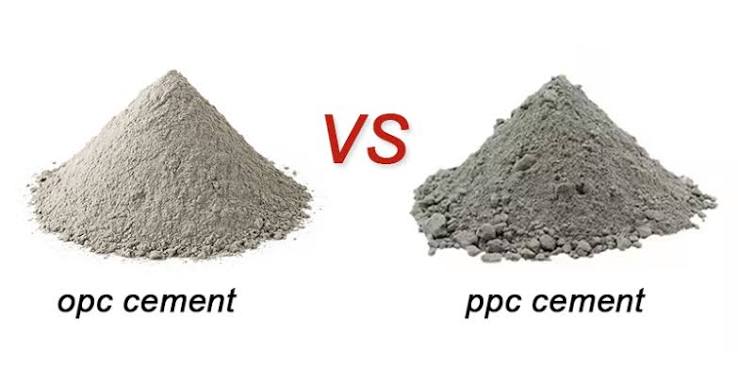
I always tell people planning a build in hot climates or near coastal areas that PPC is the smarter pick it’s used widely in residential buildings, plastering, and general construction, and it happens to be environmentally sustainable since it reuses industrial waste. The trade-off is a slow strength development, but that’s a fair exchange for the extra long-lasting structures it delivers.
Composition
Look closely at the composition of both cements, and the differences jump out immediately. OPC relies on limestone, calcareous materials, argillaceous materials rich in silica and alumina, along with gypsum, plus trace amounts of magnesia, sulphur trioxide, and oxides of iron, sometimes even soda.
These raw materials get heated in kilns to form clinker, which is then ground down landing at roughly 95% clinker and 5% gypsum.
PPC, meanwhile, brings Portland clinker together with pozzolana materials like fly ash, clay, pumice, and shale, alongside gypsum, all finely ground into one uniform blend, usually working out to 65-70% clinker and 25-30% pozzolanic material.
Strength Development
When it comes to strength development, OPC wins the sprint it delivers early strength right from the initial stage of casting, which is ideal for time-sensitive projects like buildings and bridges that need quick setting.
PPC starts slower, with weaker initial setting, but don’t let that fool you its gradual strength eventually catches up and even overtakes OPC, giving it better long-term strength.
That’s exactly why PPC shows up in standalone houses, schools, and residential building slabs. On durability, PPC again takes the lead, especially where moisture, sulfate, or sulphates are present, such as coastal areas, humid areas, and other chemically aggressive areas in constant contact with soil or water.
OPC offers only moderate durability with lower absorbency, whereas PPC brings better durability, making it the safer bet for residential construction and long-term constructions, with comparable strength that holds up over time.
Setting Time
Setting time simply means how long cement takes to reach its desired consistency and harden. OPC has a genuinely faster setting time, moving through its initial stages quickly and speeding up construction progress perfect for quick construction needs.
PPC, on the other hand, has a slower setting time, but that slower pace works in your favour by allowing extended time for concrete placement and finishing, ultimately giving a better finish and greater longevity to the structure.
Heat of Hydration
The pozzolanic materials inside PPC create a denser concrete that’s more impermeable concrete structure, which naturally boosts resistance against cracking caused by shrinkage, thermal expansion, or other external factors. OPC, by contrast, releases higher heat during the hydration process, which makes it a poor fit for mass-concreting where excessive heat and large pours can trigger thermal cracks. Simply put, PPC’s lower heat and lower overall heat generation make it the safer option for big pours.
Site Performance
Curing time providing steady moisture and temperature control plays a bigger role than most people realise. OPC needs a minimum curing period of 7 days, and it demands continuous curing, or you risk surface cracks, hairline cracks, and reduced strength.
I’ve personally seen houses built with rushed curing of concrete develop cracks within months. PPC needs a longer minimum curing period of 10 days, but its slower reaction with water allows even hydration and stronger bonding with aggregates, improving durability and reducing shrinkage over time which is why it suits foundations, brickwork, and plastering so well.
PPC also stays workable longer, a real advantage for small-town construction where weather or labour availability can pause work, while OPC’s faster pace demands skilled labour for quick, precise handling.
Grades
Under the Bureau of Indian Standards (BIS), OPC grades come in three options 33 Grade, 43 Grade, and 53 Grade with the classification based purely on compressive strength. PPC, however, has no such split; it comes as a single PPC variant only.
Environmental Impact
If sustainability matters to you, PPC has a clear edge. Its use of fly ash and other industrial by-products cuts down reliance on clinker production, a genuinely carbon-intensive process, giving PPC real environmental advantages while supporting natural resources conservation.
OPC, meanwhile, produces far higher carbon dioxide emissions, making PPC the better choice for anyone thinking about carbon emissions and long-term sustainability.
Best For Your Project
Both cements serve general construction, but each shines in different applications. OPC 33 grade works well for everyday masonry and plastering work, OPC 43 grade handles high-strength concrete work, and OPC 53 grade is built for precast concrete, prestressed concrete, long-span structures, bridges, slabs, columns, and beams.
PPC, meanwhile, is the natural fit for hydraulic construction, marine construction, and other mass concrete structures, plus general plastering work across hot climates.
Picking correctly here directly protects your building life and cuts down future maintenance issues a lesson I learned the hard way on an early project.
Comparison Tables
To sum up the core differences at a glance: Full Form, Composition, Strength Gain, Setting Time, Durability, Heat of Hydration, Workability, Environmental Impact, Cost, Best For, Long-Term Performance, Water Exposure Areas, and Usage Consideration every one of these factors tips in a different direction depending on whether you’re comparing OPC or PPC.
Conclusion
At the end of the day, the right choice between OPC and PPC comes down to the nature of construction, your budget, and your long-term durability goals.
If you’re building in a moisture-prone area or want a structure that ages gracefully, PPC is genuinely the smarter choice.
But the final call should always weigh climate conditions, the type of construction, and your planned curing practices both cements bring real advantages to the table.
Key Takeaways
Here’s the short version: the real difference between opc and ppc cement comes down to strength, durability, and heat generation.
OPC wins on early strength, while PPC wins on long-term performance, crack resistance, and the benefits of PPC it brings to a build.
Making the right cement choice protects your building life and saves you from future repair costs and understanding the benefits of OPC helps you know exactly when to reach for it instead.
Why Do You Need to Know the Difference Between OPC and PPC Cement?
Every type of construction reacts differently depending on the cement used in real construction conditions. I’ve watched builders pick cement blindly, and it almost always leads to cracks, moisture problems, or unnecessary costs down the line. OPC is known for its early strength, while PPC performs better in long-term durability.
Factors like climate, your curing method, and the type of build all affect proper cement selection and this matters even more in villages and small towns, where high temperatures make the decision far more critical.
Benefits of OPC
OPC brings high early strength, a genuinely faster setting time, and strong suitability for RCC structures, plus solid cold weather performance. Because it gains strength so quickly, it allows early formwork removal on site. Just remember improper curing can hurt its durability, since its heat of hydration needs careful management.
Benefits of PPC
PPC offers lower heat generation, better crack resistance, and improved long-term strength, all while being genuinely eco-friendly thanks to its fly ash usage. Its strong durability makes it a favourite for house construction where lasting quality matters more than raw speed.
Cost
PPC tends to be more cost-effective than OPC, largely because of its pozzolanic materials. It also needs less maintenance, which makes it genuinely economical over the long run.
Workability and Finish
PPC offers noticeably better workability, which makes it a favourite for plastering and finishing work. OPC, though undeniably strong, doesn’t quite match that smooth application.
FAQs
Are there regional variations in OPC and PPC cement availability in India?
Yes, there are real regional variations across India. OPC remains more widely available almost everywhere, but in areas near coal-fired power plants, PPC built on fly ash is often easier to find, giving builders more flexibility in local availability.
Are there any standards or certifications specific to OPC and PPC cement in India?
Absolutely. The Bureau of Indian Standards (BIS) sets clear standards for both cements OPC follows IS 269:2013, while PPC follows IS 1489:2015, so buyers across India can trust the certifications on the bag.
Can OPC and PPC be used together in a single project?
Yes, you can use OPC and PPC together in one project by carefully blending them in the right proportions. Get this wrong, though, and the strength and durability of your concrete may suffer so it’s worth getting expert guidance first.
Which cement type is more suitable for large concrete structures?
PPC is generally the better fit for large concrete structures because of its lower heat of hydration, which meaningfully lowers the risk of thermal cracks forming inside massive concrete elements.
What is PSC in cement?
PSC, or Portland Slag Cement, is formed by finely grinding Portland clinker with granulated blast-furnace slag a by-product created during the smelting of ores.
Is PPC cement good for RCC?
Yes, PPC works well for RCC, especially in residential buildings where long-term durability genuinely matters more than early speed.
Is PPC available in 53 grade?
No. Unlike OPC, PPC doesn’t come in 53 grade its performance is simply measured differently.
Is OPC cement waterproof?
Not on its own OPC isn’t naturally waterproof. Proper curing along with the right additives is needed to build genuine water resistance.
Can we mix OPC and PPC?
It’s not recommended. Mixing OPC and PPC can disturb setting time and hurt overall strength consistency.
What is the shelf life of OPC?
The shelf life of OPC is typically around 3 months from its manufacture date, provided it’s kept in proper storage conditions.
What is the main difference between OPC and PPC cement?
The main difference lies in composition and performance OPC delivers faster initial strength, while PPC offers better durability and is far more environmentally friendly.
Does the choice between OPC and PPC affect curing time and methods?
Yes, it does. PPC usually needs a longer curing time and slightly different curing methods, but it rewards you with stronger crack resistance and better strength in the long run.
Which cement has a faster setting time, OPC or PPC?
OPC sets faster, making it ideal when you need speed. PPC is slower, but it earns a better finish and greater staying power.
What are the environmental benefits of using PPC over OPC?
PPC uses industrial by-products like fly ash, which lowers carbon emissions and supports genuine sustainability — a real win compared to standard OPC.
Is OPC better than PPC for structural components like beams and columns?
OPC has traditionally been the go-to for structural components like beams and columns because of its early strength, but modern PPC now performs impressively well even in critical applications, adding chemical resistance and long-term durability to the mix.