

Every company builds a product mix the moment it starts selling more than one item. A strong product mix speaks directly to your target audience, because it lines up with real business goals, and any growing business feels this pressure eventually.
From my own experience working with small brands, a messy catalog confuses customers faster than almost anything else.
Think of a product portfolio as a living combination of products and services that grows with the company. Some brands stick to a narrow variant of one core service, while others stretch across many individual items and product lines to shape a sharper customer perception.
This mix product mix assortment, shifts how a brand competes and how well it protects its brand identity. Behind every healthy mix sit four core dimensions: width, length, depth, and consistency, and each one pulls its own weight.
Get these right and you free up resources, open new revenue opportunities, and support long-term goals rather than short-term wins.
This article walks through real-world examples and practical strategies so you can optimize your own mix and steer real business growth.
What Is a Product Mix?
A product mix is simply the full category of goods a business puts up for sale, and understanding it clears up a lot of related terms people mix together.
A product line, on the other hand, is one subset of that bigger picture say, a company’s toothpaste, toothbrushes, and mouthwash, which count as closely related products because they share similar functions and reach the same target customers.
Each line contains individual products, and a specific product, or product item, might come in a certain flavor or size, while a single product stands alone without close siblings.
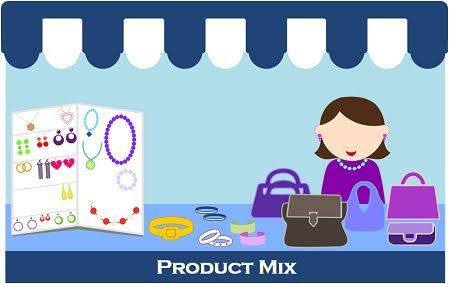 When a brand talks about its product lines, it usually means every group of customers-facing goods sold through its distribution channels, all under one company name.
The Four Dimensions of a Product Mix
Marketers use several frameworks to break down a product mix, but most agree on the same core concept. Once you grasp the four key dimensions how wide, how long, how deep, and how consistent your range is the whole idea of managing dimensions becomes far less intimidating.
Width
Width, sometimes called breadth, counts how many distinct product lines a company runs at once. A business that sells electronics, home appliances, and fitness gear together spans several unrelated categories, which gives it a genuinely wide product mix across multiple fronts.
Length
Length looks at the total number of individual products a company sells once every product lines are combined into one count.
Picture a company running five product lines, each holding four products that gives a product mix length of 20 items in total.
Depth
Depth measures the variations hiding inside a single product line, whether that means a different color, flavor, size, or model. Take a phone line that ships as a standard, Pro, and SE version that setup gives the line a depth of three, or simply 3.
Consistency
Consistency shows how closely related your product lines really are, whether that’s their end use, their production process, or the distribution channels they travel through.
 A brand with tightly consistent product lines finds it easier to manage production and marketing because everything aims at the same target market.
Low consistency shows up when a company runs diverse, unrelated lines that call for different strategies at every turn.
Why a Product Mix Matters
A thoughtful mix lifts customer satisfaction because shoppers get real variety instead of one flat option, and it protects brand identity at the same time.
It also hands a business genuine strategic flexibility, letting leaders expand into new territory or contract when a competitor starts pulling ahead.
Smart teams adjust offerings the moment market demand shifts, and rising production costs often push a brand toward discontinuing a product that no longer pays its way.
This kind of responsiveness builds real competitive advantage, since a well curated mix strengthens the customer relationship far more than a random pile of goods ever could.
Good resource allocation depends on this too leadership needs to know exactly where to invest, which lines to grow, and which underperforming products to cut before they drag everything down. Over time, this discipline sharpens customer perception and keeps the whole competition honest.
Real World Examples of a Product Mix
Apple makes this easy to picture, since its Mobile, Personal Computing, and Music groups sit side by side as separate lines. Under Mobile alone, you’ll find iPhones and iPads, plus Pro and SE models that add extra choice for buyers.
Coca-Cola tells the same story on a smaller scale a single can of Coke counts as one product item, and every Coke variant together forms the beverage line, which then joins the company’s juice lines to build the wider mix. A growing apparel brand shows this pattern too, once it starts selling T-shirts, socks, and pants side by side.
That apparel brand now carries a product mix width of three lines, and if each line offers five styles, the product mix length lands at 15 in total.
Product Mix Strategies
Expansion means rolling out new product lines, fresh features, or extra variations to win new customer segments the moment demand appears.
Contraction, its opposite, means pruning underperforming products or dropping entire lines to simplify operations and cut costs.
Line modernization keeps things fresh by updating existing products so the brand stays competitive and stays relevant in a crowded market.
 Repositioning takes a different route, marketing existing products to a different audience instead of changing the product itself.
Altering consistency is the boldest move of all a brand can choose to diversify into unrelated categories or stay close to home with tightly related product lines.
Product Mix vs. Product Category
People often confuse a product mix with a product category, but the two work at different levels. The product mix is the complete set of products and services a company offers, while a product category is a specific grouping of similar products or related products within that bigger set.
The product mix stays broad and company wide, whereas a category is really just a narrower subset feeding into the overall business strategy and portfolio strategy. Categories exist mainly to organize products for easier marketing and smoother customer navigation.
FAQs About product mix
What is a product mix in simple terms?
A product mix is the complete collection of every product line and item a company sells to its customers — everything the business offers, taken together.
What’s the difference between a product mix and a product line?
A product line is a specific group of closely related products, like a company’s whole range of shoes, while the product mix is the entire combination of all its product lines put together.
What are the four dimensions of a product mix?
The four dimensions are width, or the number of product lines; length, the total number of products; depth, the variations within one line; and consistency, or how closely the related lines connect.
Why is product mix important for a business?
It protects brand identity, boosts customer satisfaction through real variety, and gives a company strategic flexibility to allocate resources effectively.
How can a company improve its product mix?
Start by reviewing performance across all product lines, expanding wherever strong demand shows up, and pruning underperforming products, always keeping things mix aligned with your brand strategy and target audience.
Is product mix the same as marketing mix?
No — a product mix covers only the range of products and services you sell, while the marketing mix is a broader strategy that also folds in price, place, distribution, and promotion.