

Buying a home is a proud financial milestone, and with property prices climbing steadily across Indian cities, a home loan has become the practical route for most families chasing that dream.
What many borrowers don’t fully use to their advantage is the housing loan tax exemption available under the Income Tax Act, 1961.
Between the interest paid on the loan and the principal repaid every year, a well-planned home loan can meaningfully cut down your taxable income provided you stick with the old tax regime and know exactly which sections apply to you.
Housing Loan Tax Exemption on Interest
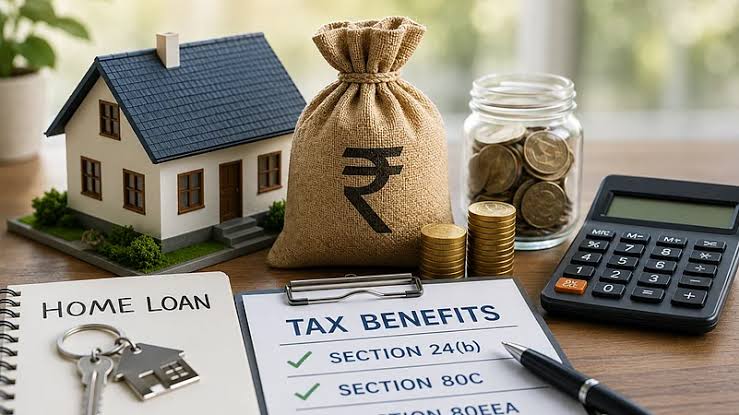
The interest component of your EMI is where Section 24(b) does most of the heavy lifting.
- For a self-occupied property, you can claim a deduction of up to ₹2 lakh per financial year on interest paid.
- For a let-out (rented) property, there is no upper limit on the interest you can claim, though the loss you set off against your other income (like salary) is capped at ₹2 lakh in a given year under the house-property loss head. Any excess loss can be carried forward for up to eight assessment years, but only under the old tax regime.
- The loan qualifies whether it was taken to buy, construct, repair, or reconstruct a home. One condition worth watching: if construction isn’t completed within 5 years from the end of the financial year in which the loan was sanctioned, the interest deduction on a self-occupied property drops to just ₹30,000 a year until the house is ready.
Housing Loan Tax Exemption: Complete Guide to Saving Tax on Your Home Loan
Interest paid during the pre-construction period before you take possession isn’t lost either. It can be claimed in five equal annual instalments starting from the year construction is completed.
Even processing fees paid on a home loan or a balance transfer are treated as interest for this purpose and qualify for the same deduction.
Housing Loan Exemption on Principal Repayment: Section 80C
Section 80C rewards you for repaying the principal portion of your EMI, but it isn’t a standalone limit of its own. The overall cap of ₹1.5 lakh is shared across several 80C instruments PPF, ELSS, life insurance premiums, tax-saving fixed deposits, and your home loan principal all draw from the same pool.
A few things to keep in mind:
- You can only start claiming this deduction after construction is complete and possession is in hand.
- Stamp duty and registration charges also qualify under Section 80C, but only in the financial year you actually paid them.
- If you sell the property within 5 years of taking possession, every rupee of principal deduction you claimed earlier gets added back to your taxable income in the year of sale.
Extra Exemption for First Time Buyers: Section 80EE
Section 80EE gives first-time homebuyers a small additional cushion on top of what Section 24(b) already offers — an extra deduction of up to ₹50,000 per year on interest paid.
This benefit is tightly time-bound: it applies only to loans sanctioned between April 1, 2016 and March 31, 2017, with the loan amount capped at ₹35 lakh and the property value not exceeding ₹50 lakh. You cannot claim both Section 80EE and Section 80EEA on the same loan.
Extended Exemption for Affordable Housing: Section 80EEA
Section 80EEA widened the first-time buyer benefit for a later window, offering a deduction of up to ₹1.5 lakh per year on interest, over and above the ₹2 lakh already allowed under Section 24(b).
To qualify, the loan must have been sanctioned between April 1, 2019 and March 31, 2022, and the stamp duty value of the property must not exceed ₹45 lakh.
The sanction window has not reopened since, so this benefit is only available to those still repaying a loan taken within that period a fresh loan today does not qualify.
Section 80EEA is available to individuals only, including NRIs; companies and HUFs are excluded. You must also not own any other residential property on the date the loan was sanctioned.
Housing Loan Tax Exemption on Joint Home Loans
Taking a home loan jointly with a spouse, parent, or sibling can multiply the household’s tax savings, because every co-borrower who is also a co-owner can claim deductions independently, in proportion to their share of the loan and the property.
 Where a single borrower is capped at ₹2 lakh under Section 24(b) and ₹1.5 lakh under Section 80C, a couple repaying together can each claim these limits separately.
Add eligible amounts under Section 80EEA where applicable, and a household could realistically claim well over ₹7 lakh in deductions across two borrowers in a single year.
Housing Loan Tax on Balance Transfer
Switching your home loan to another lender for a better interest rate does not cost you your tax benefits. Processing fees and other charges tied to the transfer are still treated as interest, and the deduction continues under Section 24(b) in the financial year those charges were actually paid.
Can You Claim Housing Loan Tax Under the New Tax Regime?
This is where most borrowers get caught out. Under the new tax regime, Sections 80C, 80EE, and 80EEA are not available at all, and Section 24(b) stops applying to a self-occupied property entirely.
The one benefit that survives is interest on a let-out property since rental income is taxable, the interest paid against it can still reduce that income.
However, any resulting loss cannot be set off against your other income sources, nor can it be carried forward to future years under the new regime.
For FY 2026-27, the deduction limits and rules under the old regime remain unchanged from prior years. Whether the old regime still works out better for you depends largely on how much interest and principal you’re paying borrowers with modest EMIs often find the new regime’s lower slab rates and higher rebate threshold more attractive, while those with substantial home loan interest usually still come out ahead in the old regime.
It’s worth running the numbers through a tax calculator, or speaking with an advisor, before deciding which regime to pick for the year.
Housing Loan Tax Exemption and HRA Can You Claim Both?
Yes — you can claim HRA exemption and home loan tax benefits at the same time. This works cleanly when your employer pays you House Rent Allowance while you live in a different city from where your own property is located, or when that property is rented out rather than self-occupied.
The one restriction: you cannot claim HRA for a rented home in the same city where you’re also self-occupying a home loan property.
Documents Required to Claim Housing Loan Tax Exemption
Before you file your return, gather the following:
- Home loan sanction letter and loan agreement from your lender
- Annual interest certificate that separates interest paid from principal paid for the year
- Loan account statement
- Completion certificate and proof of possession
- Stamp duty and registration receipts, if paid during the relevant financial year
- PAN details of the lender, if it’s an individual loan rather than an institutional one
It’s advisable to hold on to all of this for at least six years from the end of the relevant assessment year.
Tips to Maximise Your Housing Loan Exemption
- Take a joint loan with a spouse or family member to spread deductions across the household rather than resting them on one person.

- Choose carefully which Housing Loan Tax Exemption if you own more than one, since that decision shapes how much you can claim under Section 80C each year.
- Keep documents organised well ahead of tax-filing season instead of scrambling at the last minute.
- Remember that prepayments raise your principal component for that year, which can boost your 80C claim.
- Compare regimes every year with a tax advisor rather than assuming last year’s choice still makes sense.
FAQs About Housing Loan Tax Exemption
Who can claim housing loan tax exemption?
Anyone who has taken a home loan to purchase, construct, repair, or reconstruct a residential property can claim interest deductions under Section 24(b) and principal deductions under Section 80C, including on a second home loan, subject to the applicable limits.
Can I claim HRA and home loan benefits together?
Yes, as long as you are not self-occupying a home loan property in the same city where you are claiming HRA.
Can I claim Section 80EE and Section 80EEA together?
No. You can claim Section 80EE alongside Section 24(b) if eligible, but not Section 80EE and Section 80EEA on the same loan.
Are these benefits available under the new tax regime?
Mostly not. Section 80C, 80EE, and 80EEA don’t apply under the new regime, and Section 24(b) only survives for a let-out property, not a self-occupied one.
Can I carry forward unused housing loan deductions?
Interest deductions under Section 24(b) itself cannot be carried forward, but house-property losses arising from them can be carried forward for set-off in later years only under the old tax regime.
What happens if I sell my house within 5 years of possession?
Any principal deduction already claimed under Section 80C gets added back to your taxable income in the year of sale.