
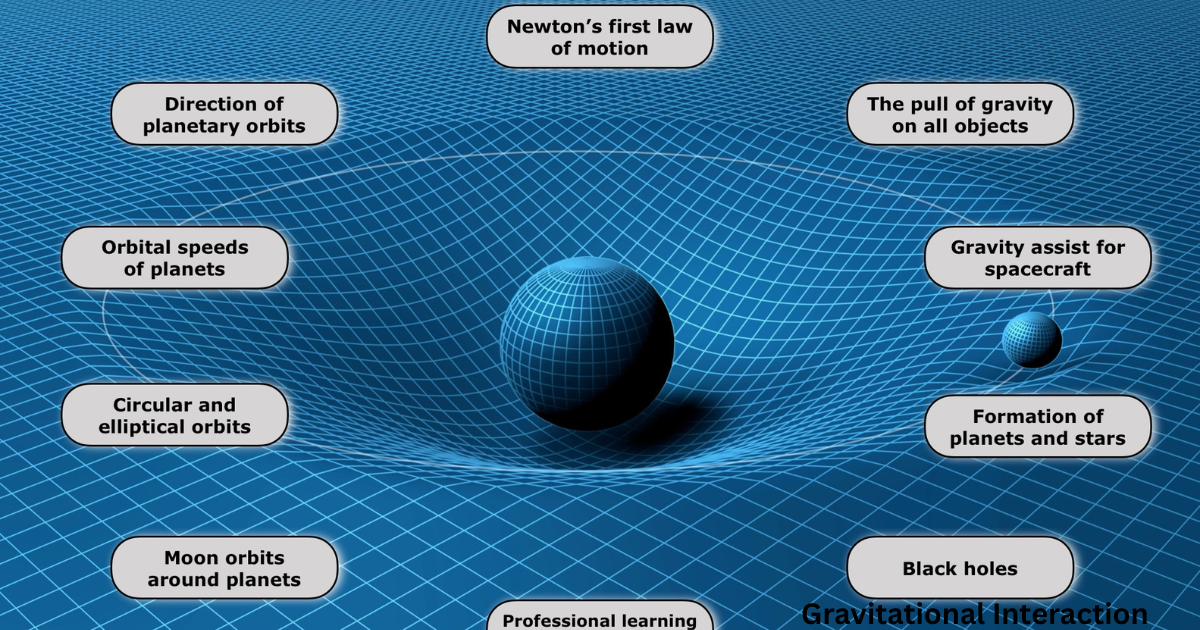
Gravity is something we live with every single day, yet hardly anyone stops to ask what actually defines it at a scientific level.
Students often come across a question phrased as “the gravitational interaction has one of the following property,” and it can feel confusing without a clear breakdown of what gravity truly involves.
This guide walks through every core property of this force in plain language, so the idea sticks with you long after you close the page.
What Is Gravitational Interaction?
Gravitational interaction is one of the four fundamental forces of nature, working quietly alongside the strong nuclear force, the weak nuclear force, and the electromagnetic force to hold the universe together.
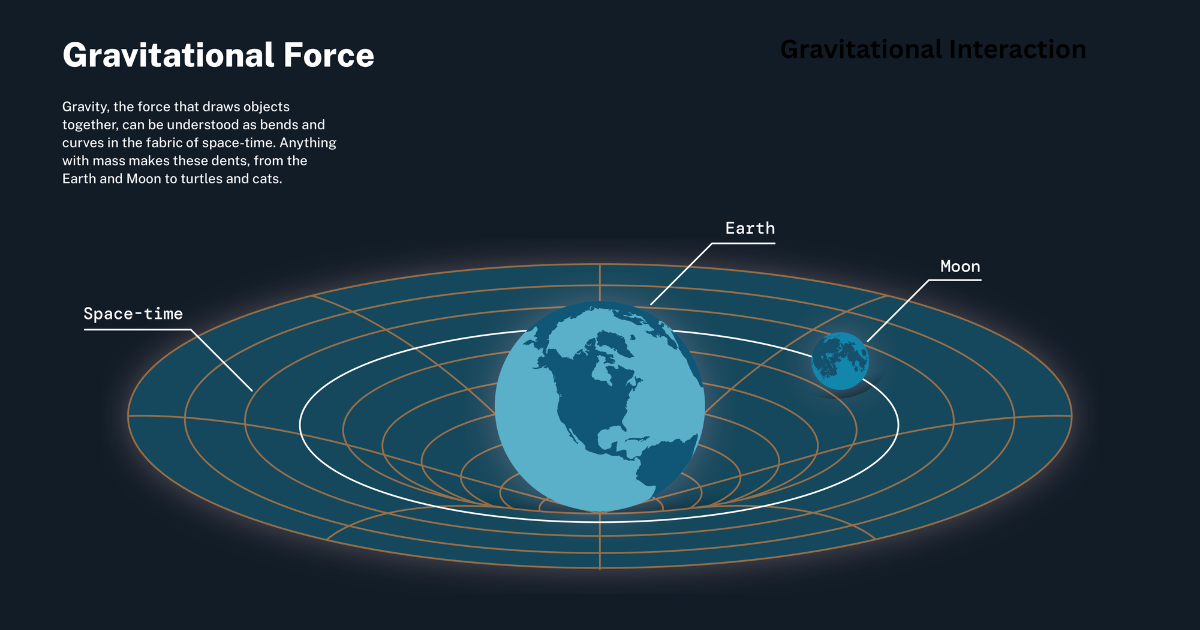
Back in the seventeenth century, Isaac Newton first worked out behind this pull between masses, and centuries later Albert Einstein reshaped our understanding by describing gravity as a curvature of space and time rather than a simple push or pull.
What makes this natural attraction so unique is that it needs no special particle property or electric charge to act any two objects with mass are drawn to each other, no exceptions.
It Is Always Attractive
One of the most important properties of gravitational interaction is that it is always attractive, never repulsive. Unlike electric charges, which carry a sign and can either attract or repel depending on their nature, mass only ever pulls other mass closer.
This is exactly why planets, stars, and galaxies form tight clumps instead of drifting apart, and why every object on Earth falls downward instead of floating away.
It Is a Long-Range Force
Gravitational interaction behaves like a force with an almost infinite range, which means its effect on distance never truly drops to zero, no matter how far apart two objects sit.
This long-range nature of gravity is exactly what keeps planets locked into their orbits around the sun, and it governs the motion of moons as they circle their parent worlds. Even the grand structure of entire galaxies owes its shape to this quiet but relentless strength stretching across space.
It Is Directly Proportional to Mass
The strength of gravitational interaction depends directly on the masses of the two objects involved, so a heavier object always exerts a stronger pull.
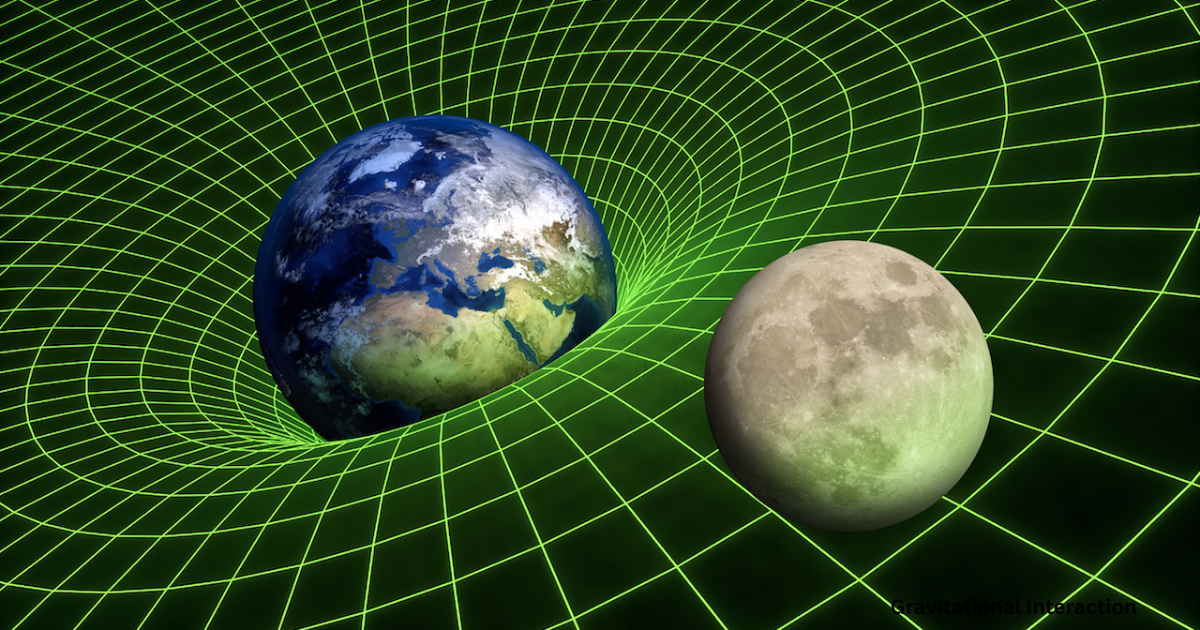
This is precisely why Earth, with its enormous mass, produces a far more noticeable gravitational pull on us than the smaller Moon ever could. Simply put, more mass always means more attraction.
It Is Inversely Proportional to the Square of the Distance
As the distance between two objects grows, gravitational force falls away quickly, following what scientists call the inverse-square law.
Doubling the gap between two bodies cuts their gravitational pull down to just one-fourth of its original strength, and this simple relationship explains a lot about space. It’s why distant stars exert only a negligible pull on Earth compared with the much stronger tug from nearby objects.
It Is the Weakest of the Four Fundamental Forces
Despite shaping the large-scale structure of the universe, gravitational interaction is actually the weakest of the four fundamental forces by a huge margin, falling well behind the strong nuclear force, the weak nuclear force, and the electromagnetic force.
It only becomes noticeable and truly dominant once large masses enter the picture, such as entire planets or stars. In everyday life, gravity is barely felt precisely because it is so weak at small scales.
It Is Additive in Nature
Gravitational interaction carries a unique additive property, meaning it builds up across every particle and every atom inside a body.
Every speck of matter within an object adds to its total gravitational pull, which is exactly why massive objects like planets and stars generate such powerful gravitational fields.
Compare that to everyday objects around your house, and their pull on you is far too small to ever feel, since their mass is tiny by comparison.
It Acts Universally on All Matter
Gravitational interaction applies to every object carrying mass, no matter its temperature, composition, or electric charge, and this universality sets it apart from electromagnetism, which only touches charged particles.
Even light, despite having no traditional mass, is still bent by gravity because it carries energy, and mass and energy are known to be equivalent. Nothing in the universe truly escapes this pull.
Why These Properties Matter
Understanding these properties helps explain countless real-world phenomena, from why the Moon loops around Earth in steady orbits, to why galaxies hold themselves together across vast stretches of empty space between stars.
These same ideas form the foundation for higher-level physics topics like orbital mechanics, tidal forces, and even Einstein’s theory of general relativity.
 Gravitational Interaction core characteristics makes it far easier to tackle exam questions and multiple-choice questions, since most listed options are built directly around gravitational interaction.
Gravitational Interaction vs Other Fundamental Forces
Gravitational interaction stands apart from the other three fundamental forces in several clear ways. The strong nuclear forces and weak nuclear forces only act at short distances deep inside the atomic nucleus, while gravity reaches across the entire universe without limit.
The electromagnetic force can be either attractive or repulsive depending on charge, but gravity stays purely attractive and never repulsive, and although it is the weakest among all four forces at small scales, it never cancels out this additive nature is exactly why it becomes the dominant force at large scales.
Conclusion
Gravitational interaction is defined by a consistent set of properties: it is always attractive, spreads across an infinite range, depends directly on mass, weakens with the square of distance, ranks as the weakest of the four fundamental forces, stays additive across all matter, and acts universally on anything carrying energy.
At its fundamental level, this quiet force shapes the motion of planets, stars, and galaxies throughout the entire universe. Simple as it looks on paper, gravity is truly the invisible thread holding everything together.
FAQS About Gravitational Interaction
What is meant by gravitational interaction?
Gravitational interaction is simply the natural attractive force that exists between any two objects with mass, pulling them toward one another.
Is gravitational interaction always attractive?
Yes, gravitational interaction is always attractive and never repulsive, unlike electric forces or magnetic forces, which can push as easily as they pull.
Why is gravity considered the weakest fundamental force?
Gravity is called the weakest fundamental force because at the scale of individual particles, it is completely overpowered by the strong force, the weak force, and electromagnetic forces.
Does gravitational interaction depend on distance?
Yes, the force of gravitational interaction decreases as distance between objects grows, following what is known as the inverse-square law.
Does gravity affect objects without mass?
In modern physics, gravity still affects light because it carries energy, and mass and energy are considered equivalent.
What makes gravitational interaction different from electromagnetic interaction?
Gravitational interaction depends purely on mass and only ever attracts, while electromagnetic interaction depends on electric charge and can either attract or repel.