
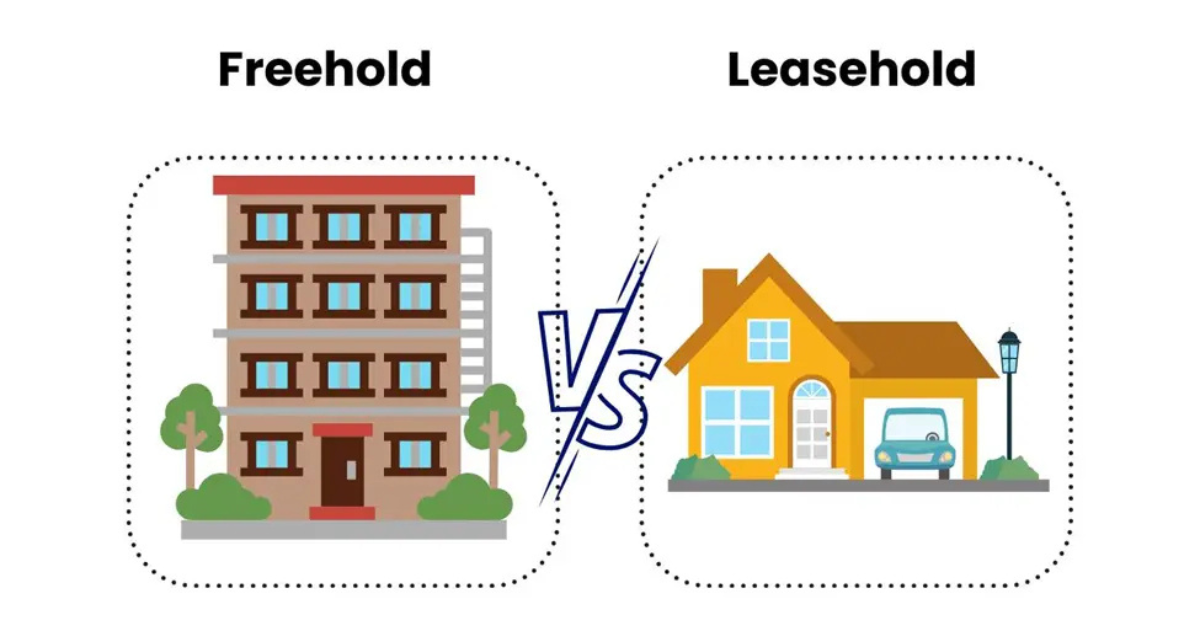
Anyone hunting for a home in India runs into this word sooner or later, and it changes everything about how a purchase actually works. Freehold property meaning is simple at its core.
It is absolute ownership of both land and building, with no lease, no ground rent, and no superior landowner standing above the buyer.
My own experience walking clients through property listings has taught me that most people nod along to this term without ever checking what it means for their property-related decisions, and that gap is exactly where trouble later shows up.
A property free of any outside claim gives the buyer full rights to use, sell, or pass it on, and that type of ownership is what most Indian families actually want.
There is no time-bound lease, no periodic charge, and no risk of the land reverting to a bigger State authority down the line.
Complete ownership also means the owner’s name sits cleanly in the sale deed and title deed, with nothing tying it back to a government allotment.
Buying a home this way is meant to feel like a clean, transferable win, yet buyers rarely stop to verify freehold status before signing anything.
A Bangalore buyer I once advised assumed her flat was fine simply because the paperwork looked normal, only to discover an unconverted government lease buried deep in the building’s history.
This is why every serious guide on freehold property meaning should walk through the actual verification steps, not just the definition, since the word “free from hold” only protects you once you have confirmed it applies.
Money matters here too, because freehold homes typically carry a higher cost than leasehold properties, and that price gap reflects real freedom the owner gets in return.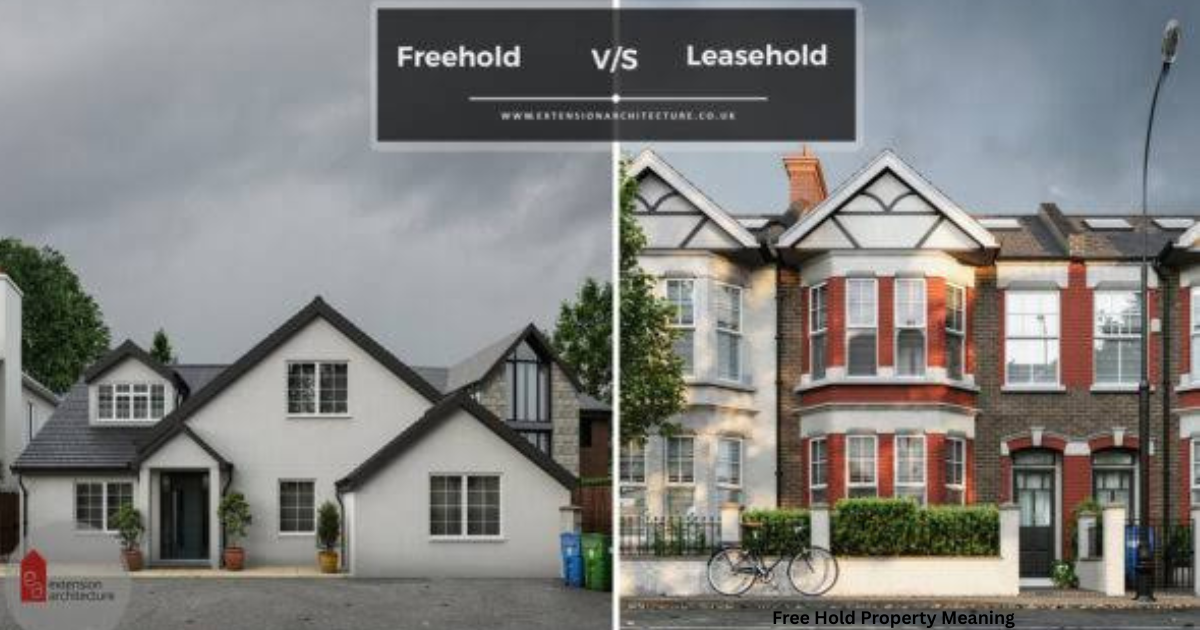
Investors like this asset class because it can later be financially leveraged; a loan against property from a lender such as Bajaj Finance lets the owner unlock value without giving up control.
Ownership like this can also be inherited by descendants without extra restrictions, and every transfer carries no encumbrance against the absolute title.
Once the registration is done through the Land Acquisition Law framework and confirmed with the relevant State authority, the buyer’s claim to the private land stands.
Even against infrastructure facilities or industrialization projects the government may pursue for urbanization, provided fair compensation reaches the landowner.This whole picture explains the type of ownership many Indian families quietly prefer.
Legally, this status is described as legally free, giving the owner control, a clean claim, and complete ownership with permanent rights to use the asset for any lawful purpose.
There is no time limit attached, so once a property is sold, transferred, or passed on to heirs, it never needs state approval or sign-off from any external authority.
Compared to leasehold properties, this path also involves simpler sale procedures, fewer documentation requirements, and no chasing of prior permissions, giving the buyer real independence, flexibility, and none of the anxiety that comes with a fixed tenure running out.
This holds true whether the buyer is an individual unit owner in a co-op-style block paying a fixed maintenance charge, or a plot owner enjoying that same sense of perpetuity over open land.
Freehold vs Leasehold: The Practical Differences
The clearest gap between the two shows up at resale time, because a freehold sale skips any third-party authority and never needs a no-objection certificate from an allotting authority, while a leasehold sale often gets slowed down by exactly that kind of transfer registration hurdle.
This extra procedural requirement makes a leasehold resale take longer and cost more, and it also explains the price difference you see between two otherwise comparable properties.
Anyone doing a market valuation in Delhi will notice this convenience and certainty gap immediately, since converted freehold properties in old DDA colonies trade at.
Aclear premium over the still-unconverted leasehold properties nearby, largely because of their unrestricted transfer and full lender acceptance with no additional conditions attached.
A leasehold property, by contrast, is simply leased and not owned, and once its lease period expires it either gets extended or reverts back, with the exact terms varying state by state.
Buyers should always check the number of years left on lease, budget for service charges and other related expenditures, and understand how the remaining term affects a mortgage or the resale value down the road.
This distinction runs through commercial property too, since businesses, companies, factories, and shops all sit on land where the underlying estate belongs to either the owner outright or an investor for a decided amount of time.
A freehold owner enjoys full perpetuity, and can carry out modifications without asking for owner permission before any alteration, Free Hold Property Meaning who answers to a landowner for every change and every maintenance costs decision. 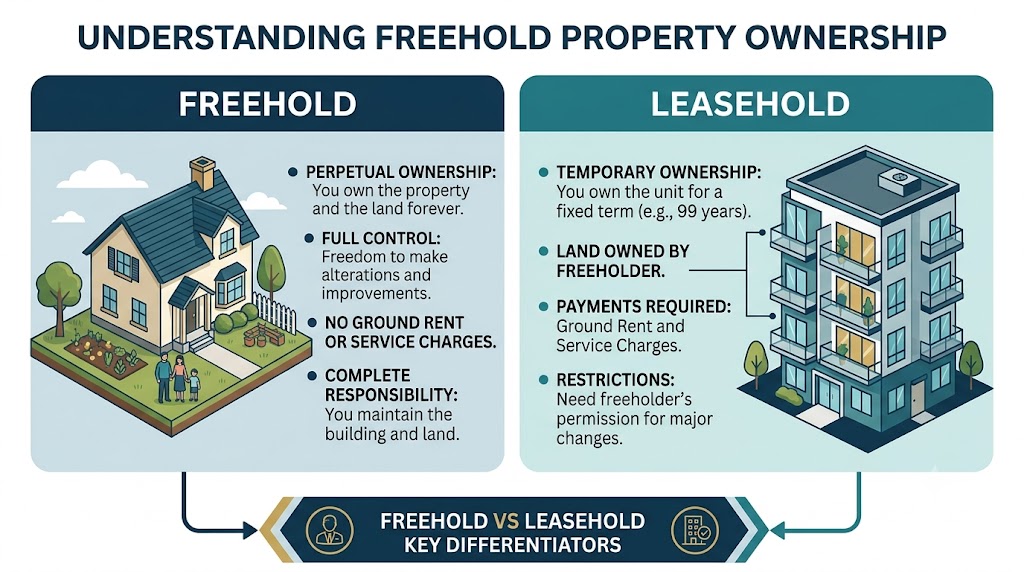 In practice, residential properties lean freehold far more often than commercial properties, and getting a bank loan is noticeably easier here since banks stay reluctant wherever a transfer of ownership needs extra legal consent or State permission.
Once you line up these property ownership categories side by side, complete ownership with no time limit clearly beats a right that only lasts for a specific period.
Especially since how the estate belongs to owner and how long the lease runs both state varies, and banks reluctant to fund anything murkier only add to that gap.
Rights, Features, and the Real Value of Freehold Title
The single most significant right tied to a freehold estate is complete freedom to use it for an unspecified length of time, without particular restraints standing in the way.
That absolute freedom covers transfer, being inherited by the next generation, and facing no hindrance to the full title, since the owner can move the asset from one name to another simply by registering a transaction document.
An apartment owner sits in a slightly different position than a plain flat owner, because becoming a shareholder in the building matters here.
Some houses sold as freehold differ sharply from flats sold on lease, which is exactly why more customers are choosing to buy freehold property whenever the option exists.
That title represents the highest form of ownership the law recognises, covering the land, the structures on it, and every set of associated rights that comes bundled in, unlike what leaseholders get, which is what gives it such long-term benefits.
Permanence sits at the centre of this, since being permanent in nature separates it sharply from a leasehold property with a fixed tenure; a freehold asset stays with the owner indefinitely until it is sold, transferred, or passed on to heirs, offering real long-term financial security.
FAQS About Free Hold Property Meaning
What is the meaning of freehold property in India?
A buyer who owns freehold property holds the land and building completely outright in perpetuity, with no lease, no ground rent, and no superior landowner standing above them. This kind of absolute and transferable title never needs anyone’s third-party consent before it changes hands.
What does freehold property mean for a flat buyer?
For a flat buyer, it simply means the flat and its share of transferred land inside the complex sit owned absolutely, split as a proportional undivided land share among neighbours. The one key verification worth doing is confirming the developer actually handed the underlying land to the housing society, rather than leaving it stuck under an old government lease.
How do I confirm a property is freehold?
Start by pulling the original title deed and a clean encumbrance certificate, ideally covering the last 30 years, and scan carefully for any stray lease entries. A property genuinely free of ground rent obligations will show no trace of a government allotting authority acting as some hidden superior landowner.
Is a DDA flat freehold?
Most DDA flats originally sit on leasehold land, though DDA has periodically run conversion schemes letting units in certain DDA colonies shift over. That conversion only becomes legally effective once it is properly registered, so a flat can only be called converted to freehold after this paperwork step is complete.
Can I sell a freehold property without any third-party permission?
Yes, a freehold property can be sold, gifted, or mortgaged freely, with no consent required from any government authority or other landowner sitting above the seller. That is exactly the freedom this kind of ownership is built to protect.
Is most builder-developed property in India freehold?
Yes, most privately developed residential projects across major Indian cities including Bangalore, Pune, Hyderabad, Mumbai, and Chennai stand on privately owned freehold land, so buyers here usually get a clean freehold title by default. It is really only older, authority-linked pockets that carry the risk.
What is the freehold property in the UK compared to India?
Both the UK and India treat freehold as absolute ownership of land and building with no lease, but the two markets differ in how common it stays. Flat buyers in the UK run into leasehold structures even in modern developments, while in India that pattern shows up mostly in older government-developed areas.