
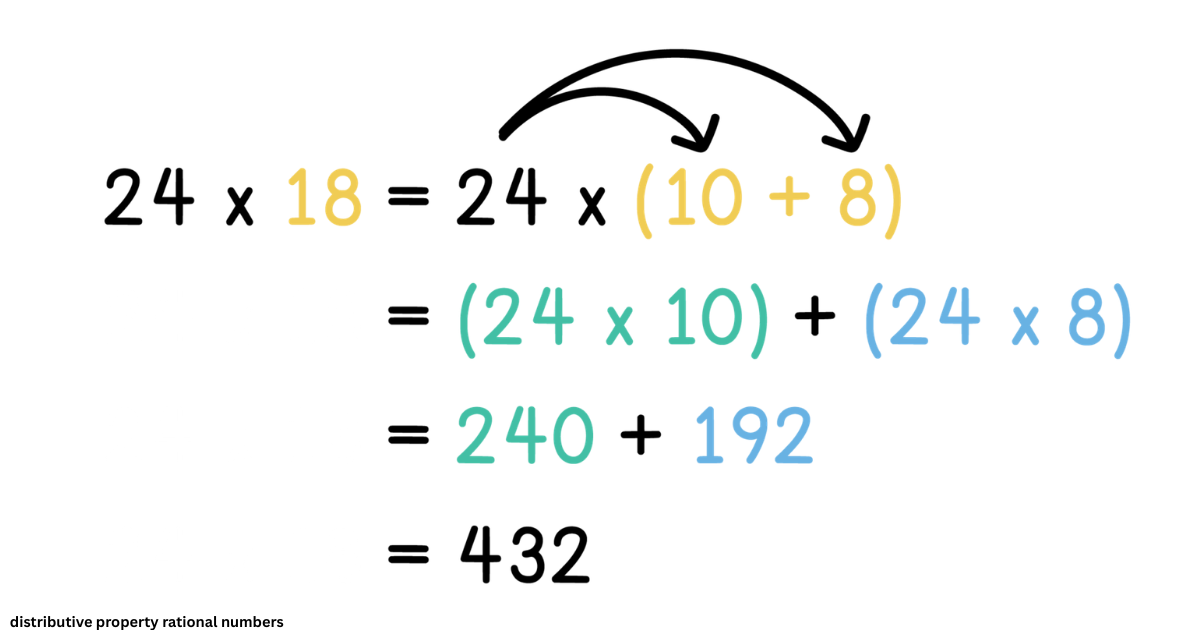
Every student preparing for exams knows that strong math fundamentals build real confidence, and the distributive property stands as one of those predictable rules that makes a complex expression easier to handle.
In simple terms, this property connects multiplication with addition and subtraction, letting you break a tough problem into smaller, easier-to-solve parts instead of getting stuck on a single formula.
This guide is written for anyone brushing up on the definition of rational numbers, and it walks through calculations, step-by-step examples, common mistakes, and frequently asked questions.
By the end you’ll simplify expressions with rational numbers faster and with a clearer understanding of why this shortcut is so useful, and we cover everything a logical learner needs in one place.
What Is the Distributive Property of Rational Numbers?
In simple terms, the distributive property explains how multiplication interacts with addition and subtraction whenever a rational number gets involved in an equation with brackets.
Picture a multiplying number standing outside the brackets: instead of solving the sum or difference inside first, you can multiply that number by each term separately, and the final answer stays exactly the same, because every value is distributed evenly across the equation.
This is why the rule earns two names depending on the operation used the distributive property of multiplication over addition, where you add the results together, and the distributive property of multiplication over subtraction, where you subtract them instead.
Once each part is multiplied on its own, combining the pieces gives you the same outcome you would reach by working with the full rational numbers at once.
Distributive Property Formula
When three rational numbers call them a, b, and c sit inside one equation, the distributive property can be expressed in two clean ways. Over addition, the rule reads a × (b + c) = (a × b) + (a × c), and over subtraction, it becomes a × (b − c) = (a × b) − (a × c), with the number a getting distributed to every term inside the bracket.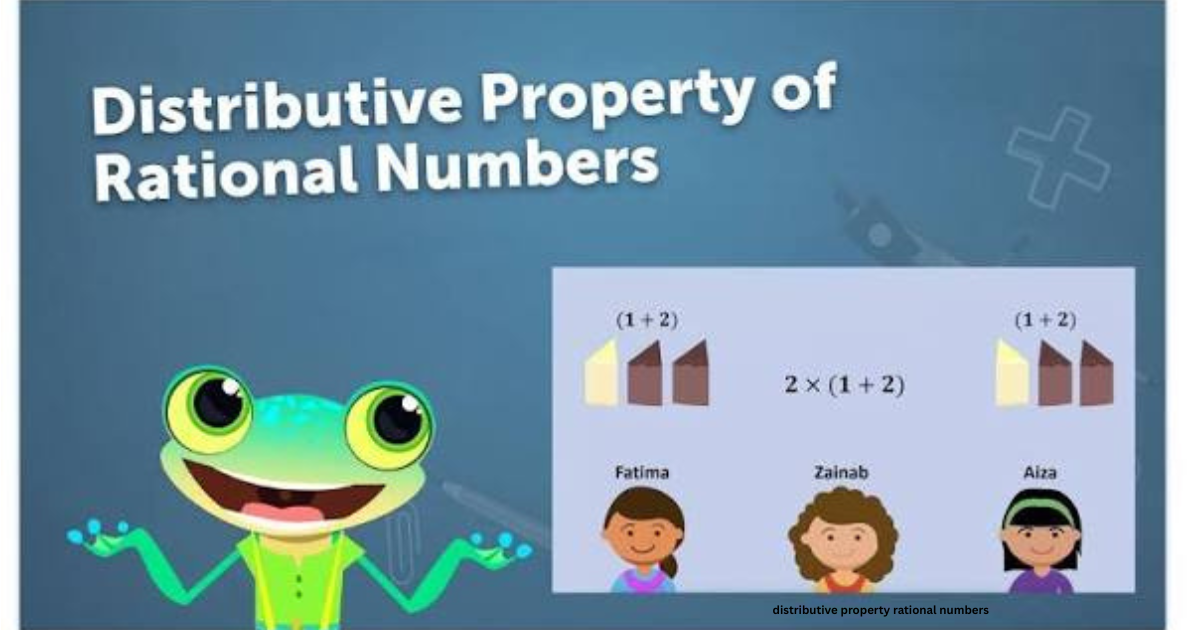 Rather than trying to solve the whole bracket in one go, you multiply each piece individually and then combine the results at the end, which lands you on the same answer either way. This small shift in approach is exactly what makes the property so practical for everyday problem solving.
Distributive Property Over Addition Example
I always tell students to try this one on paper: 2/3 × (1/2 + 1/4) is a friendly place to practice the distributive property. In step 1, you distribute 2/3 to both terms inside the bracket rather than trying to solve the sum first. In step 2, you multiply each pair on its own, giving 2/6 and 2/12.
In step 3, you simplify those fractions down to 1/3 and 1/6, then you add them together to get 3/6, which reduces neatly to 1/2 and that small win is usually the moment a student stops fearing fractions.
Distributive Property Over Subtraction Example
Subtraction works the same way, and I like using 1/3 × (1/2 − 1/5) to show how the distributive property handles a minus sign. In step 1, you distribute 1/3 across both terms instead of trying to solve the bracket first. In step 2, you multiply each pair separately, which gives 1/6 and 1/15.
In step 3, you find the LCM, which is 30, rewrite the fractions as 5/30 and 2/30, then subtract to land on 3/30, and once that fraction is reduced, the final answer is 1/10.
Why the Distributive Property Matters
Beyond passing a test, the distributive property matters because it becomes the foundation for algebra, where expanding algebraic expressions depends entirely on this same logic.
Breaking a tough problem into smaller parts turns complex calculations into simple multiplication steps, and distributing a number across a bracket often makes solving and simplifying a division or multiplication problem far quicker than tackling it head-on.
This same logic applies well beyond rational numbers; it works for whole numbers, natural numbers, and integers too, which is exactly why teachers call it a universal math concept.
When large numbers feel overwhelming, break them down the same way, and everyday mental math and calculations suddenly feel smaller and far more manageable.
How the Distributive Property Differs From Other Properties
Students often mix up the core properties of a rational number, so let’s separate them clearly. The closure property simply confirms that adding, subtracting, or multiplying two rational numbers always keeps the result inside the same family of numbers.
The commutative property says changing the order doesn’t matter, written as a + b = b + a, while the associative property shows that changing the grouping doesn’t matter either, written as (a + b) + c = a + (b + c).
The distributive property stands apart because it connects two operations working together multiplication with addition or subtraction instead of relying on a single operation alone, so a number gets distributed across a bracket rather than staying fixed in one spot.
Common Mistakes to Avoid
Over the years, I’ve noticed the same slip-ups show up again and again when students practice the distributive property. Some forget to multiply the second term, and end up applying the number to only one part of the bracket instead of both terms.
Others make sign errors while distributing across subtraction, because the negative sign has to be carried correctly through to the second value, not left behind on addition by mistake.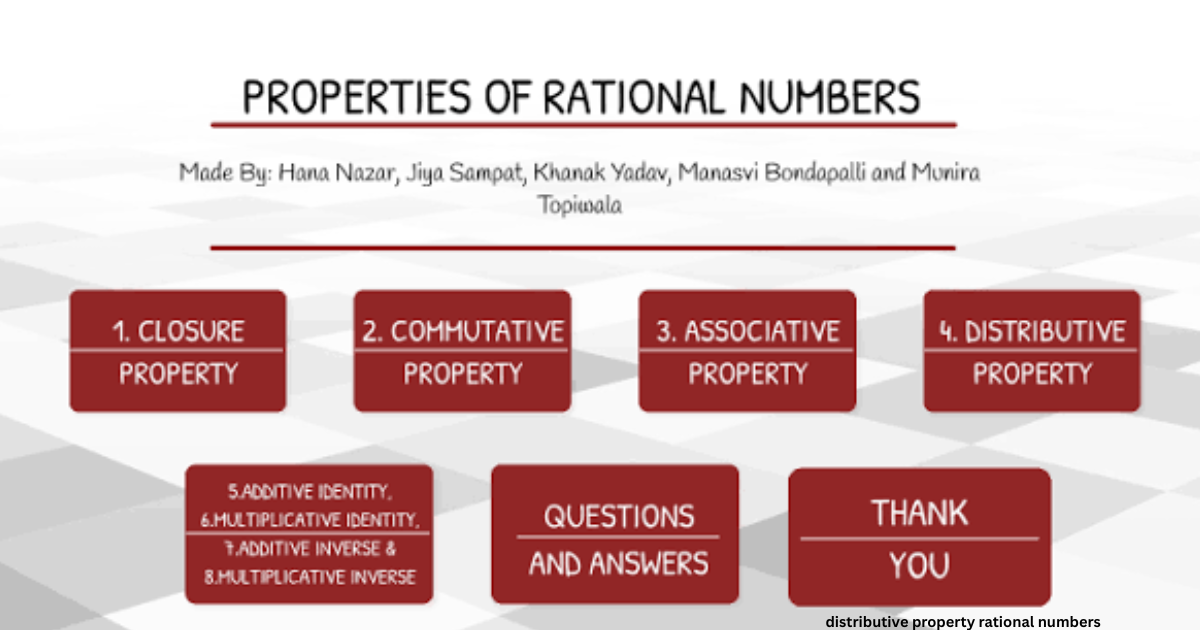 Skipping simplification is another common issue an accurate answer needs the final fraction reduced to its lowest terms, not left half-finished. And one more thing worth remembering: this rule offers a direct way to handle addition and subtraction, but division needs separate handling, so forgetting that distinction is a mistake worth avoiding.
Real-Life Application
The distributive property isn’t just a classroom concept locked inside a textbook this logic shows up almost every week without anyone even thinking about it.
Say you need to calculate the total cost of 3 items priced at $10 and $8; instead of adding the prices first, you can distribute the 3, giving 3 × 10 and 3 × 8, which equal 30 and 24, and adding those gives $54 in total.
This same trick shows up in shopping calculations, budgeting, and other everyday calculations, and it even helps with dividing big amounts, since large numbers feel far less intimidating once you break them into manageable parts for quick mental math.
If you’re curious how similar step-by-step calculations apply outside the classroom, you can check this related resource on property tax calculation in Aurangabad.
FAQs About Distributive Property ational numbers
Definition and Formula
What is the distributive property of rational numbers, and what is its formula? The distributive property of a rational number says that multiplying one number by the sum or difference of two other rational numbers gives the same result as multiplying each one separately and then adding or subtracting the products. The formula covers both directions: for addition, it’s a × (b + c) = (a × b) + (a × c), and for subtraction, it’s a × (b − c) = (a × b) − (a × c).
How It Applies Across Numbers and Operations
Does the distributive property work for subtraction, and is it the same for whole numbers, integers, and rational numbers? Yes, the distributive property works for subtraction just as smoothly as it does for addition multiplication simply distributes across each term, as long as the correct sign is carried through properly. It also follows the same underlying rule no matter the type of numbers involved, whether the value is distributed across whole numbers, integers, or rational numbers. Division, however, needs to be handled differently, since it doesn’t follow the same straightforward way the distributive property works elsewhere.
Why It Matters
Why is the distributive property important in math? It simplifies complex expressions, supports algebraic expansion, and makes both problem-solving and mental math noticeably faster and more accurate small comforts that add up over a whole exam.