
still remember struggling with Geometry in school until one fundamental concept clicked for me the angle sum property of quadrilateral.
This single concept became the foundation for everything else I learned in mathematics, especially when I later moved on to higher-level concepts.
Simply put, this definition tells us that the sum of all interior angles inside any quadrilateral always equals 360 degrees, no matter its shapes or size.
Students preparing for exams often find this formula confusing at first, but once you see the proof behind it, the whole idea of basic geometry feels far less intimidating.
In this article, I want to walk you through the types of quadrilaterals, their properties, and a few solved examples so this topic one of the most useful branches of mathematics finally makes sense for good.
What is a Quadrilateral?
A quadrilateral is simply a closed, two-dimensional polygon that has four sides, four vertices, and four angles — nothing more complicated than that.
Think about the everyday shape of squares, rectangles, parallelograms, rhombuses, and trapeziums; even playful kites fall into this same family.
What amazes me is that regardless of size, every one of these figures follows the same geometric rules, and the angle sum property stands out as one rule that never changes across the group.
Angle Sum Property of Quadrilateral: Definition
The angle sum property states that the measures of all four interior angles of a quadrilateral always add up to this stays true whether the shape is regular, like a square, or completely irregular.
It doesn’t matter what type of simple figure you’re dealing with either as long as it stays non-self-intersecting, the rule holds firm. Mathematically, if we label the angles their sum will equal degrees every single time.
Angle Sum Property of Quadrilateral Formula
To calculate the sum of interior angles for any type of polygon, including a quadrilateral, mathematicians use one neat formula where n stands for the number of sides the figure carries.
Since a quadrilateral always has the working becomes which gives exactly degrees, as most textbooks prefer to write it.
Proof of Angle Sum Property of Quadrilateral
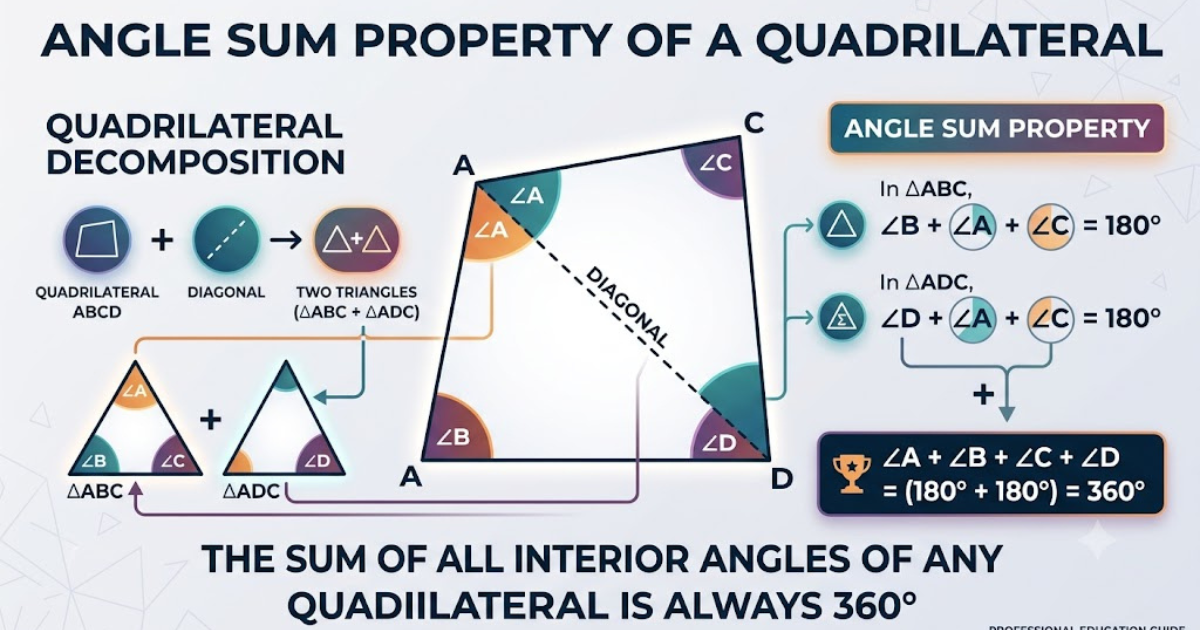
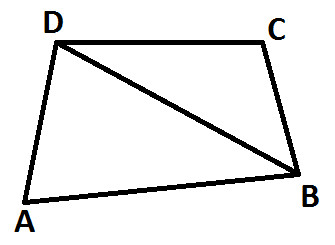
One of my favourite ways to explain this proof uses a simple method called diagonal division. Picture a quadrilateral ABCD; now draw a diagonal and label it AC.
This single line splits the figure into two neat triangles Every triangle carries a sum of interior angles equal to 180°, so adding both triangles together gives us a total sum of .
The diagonal shares out the four angles exactly between the two shapes, so the whole quadrilateral confirms the angle sum property all over again. It’s a small concept, but once it clicks, you’ll never forget it.
Angle Sum Property in Different Types of Quadrilaterals
Different quadrilaterals carry different properties, yet the total sum of their interior angles never changes. In a Square, all four angles measure each, adding up to the familiar degrees.
A Rectangle behaves the same way, with every angle sitting neatly at In a Parallelogram, opposite angles stay equal while consecutive angles remain supplementary, yet the total still lands on.
Angle Sum Property of Quadrilateral Formula Step by Step Proof and Solved Examples
In geometry, understanding the geometric attributes of polygons is fundamental to mastering complex space and structural equations. Among these shapes, a **quadrilateral** a flat, closed two-dimensional geometric figure bounded by four straight line segments holds a highly critical place. One of the most important theorems related to this polygon is the **Angle Sum Property of a Quadrilateral**, which outlines the absolute mathematical behavior of its interior geometric vertices.
The fundamental rule states that **the sum of all four interior angles of any quadrilateral is always equal to 360 degrees ($360^\circ$)**, regardless of its shape, classification, or boundary symmetry.
The Core Formula
Whether you are evaluating a standard square, a rectangle, a trapezoid, an irregular parallelogram, or a kite, the core summation formula remains completely identical:
$$\angle A + \angle B + \angle C + \angle D = 360^\circ$$
Mathematical Proof of the Theorem
To systematically understand why the interior vertices sum up exactly to a full circle rotation, we can break down the polygon into simpler structural units utilizing triangles.
Given:
A standard four-sided quadrilateral $ABCD$ containing four distinct interior corners: $\angle A$, $\angle B$, $\angle C$, and $\angle D$.
Objective:
To prove mathematically that: $\angle A + \angle B + \angle C + \angle D = 360^\circ$.
Step-by-Step Execution
Draw a Diagonal Draw a straight internal line segment connecting vertex $A$ to vertex $C$. This diagonal structurally divides the single quadrilateral $ABCD$ into two individual triangles: $\Delta ABC$ and $\Delta ADC$.
Apply Triangle Angle Sum Rule.
According to the established *Angle Sum Property of Triangles*, we know that the sum of interior angles inside any triangle is always exactly equal to $180^\circ$.
* For the first triangle ($\Delta ABC$):
$$\angle CAB + \angle ABC + \angle BCA = 180^\circ \quad \text{(Equation 1)}$$
* For the second triangle ($\Delta ADC$):
$$\angle CAD + \angle ADC + \angle DCA = 180^\circ \quad \text{(Equation 2)}$$
3. **Combine the Systems:** Add Equation 1 and Equation 2 together:
$$(\angle CAB + \angle BCA + \angle ABC) + (\angle CAD + \angle DCA + \angle ADC) = 180^\circ + 180^\circ$$
4. **Group the Split Vertices:** Regroup the parts that form the unified corner values:
* $\angle CAB + \angle CAD = \angle A$
* $\angle BCA + \angle DCA = \angle C$
5. **Final Substitution:** Substituting these collective values back into our main structural layout gives the ultimate unified result:
$$\angle A + \angle B + \angle C + \angle D = 360^\circ$$
Hence, the geometric theorem stands completely verified and proven.
Solved Practice Examples
Example 1: Finding a Missing Angle Value
Three interior vertices of a specific four-sided plot evaluate to $70^\circ$, $110^\circ$, and $85^\circ$ respectively. Find the numeric value of the remaining fourth corner ($\angle X$).
**Solution:**
Using our established mathematical property equation:
$$\text{Sum of all interior angles} = 360^\circ$$
$$70^\circ + 110^\circ + 85^\circ + \angle X = 360^\circ$$
$$265^\circ + \angle X = 360^\circ$$
$$\angle X = 360^\circ – 265^\circ$$
$$\angle X = 95^\circ$$
Therefore, the definitive measure of the fourth vertex is **$95^\circ$**.
FAQs About Angle Sum Property of Quadrilateral
Does the angle sum property apply to concave quadrilaterals?
Yes, the angle sum rule applies universally to both convex and concave quadrilaterals. Even if an interior angle extends past $180^\circ$ (a reflex corner), the summation of all four internal angles will still total exactly $360^\circ$.
Why do the internal vertices of a four-sided shape always yield $360^\circ$?
This is because any standard four-sided polygon can be split into exactly two triangles using a single diagonal. Since each individual triangle contains internal vertices that equal $180^\circ$, the dual system naturally delivers $180^\circ \times 2 = 360^\circ$.
Can a quadrilateral have four acute interior corners?
No, a quadrilateral cannot contain four acute angles. An acute angle is strictly less than $90^\circ$. If all four corners were acute, their total sum would be less than $360^\circ$ ($4 \times 89^\circ = 356^\circ$), breaking the law of the theorem.
Key Points to Remember
Angle Sum Property of Quadrilateral let’s lock in the basics. The sum of interior angles of any quadrilateral is always whether the figure is regular or irregular.This angle sum result comes straight from the formula which applies to every polygon, not just four-sided ones.
 Diagonals splitting a shape into two triangles form the basis of the proof we discussed earlier, and this same property also explains why the exterior angles of a quadrilateral add up to 360° as well.
What is the angle sum property of a quadrilateral?
The angle sum property simply tells us that the sum of all four interior angles in a quadrilateral equals 360 degrees, always.
Why is the sum of angles of a quadrilateral 360 degrees?
Draw a diagonal across any quadrilateral and it splits into two triangles; since each triangle carries an angle sum of 180°, the total naturally becomes 360°.
Does the angle sum property apply to all quadrilaterals?
Yes, the angle sum property of 360° applies to every simple, non-self-intersecting shape among quadrilaterals, whether regular or irregular.
What is the formula for the sum of interior angles of a polygon?
The formula is (n − 2) × 180°, where n represents the number of sides in a given polygon.
What is the sum of exterior angles of a quadrilateral?
Just like any polygon, the sum of exterior angles in a quadrilateral always comes out to 360°.
How do you find a missing angle in a quadrilateral?
Add up the three known angles, subtract that sum from 360°, and what remains is your missing fourth angle.
Is the angle sum property different for concave quadrilaterals?
The angle sum property of 360° stays consistent across both convex and concave simple quadrilaterals.