
I still remember the day my math teacher told our class that big, scary-looking arithmetic operations are just smaller pieces hiding inside one big operation.
That single line changed how I looked at the number system forever. In simple terms, mathematics gives us a law called the distributive property, and it works beautifully with rational numbers any value that can take the form p/q, where.
This little rule lets us distribute one number across a group being added or subtracted, and it holds true across integers, whole numbers, and fractions alike.
Every rational number carries its own structure, built on six properties, and the distributive law is one of the most useful among them.
It connects multiplication with addition and subtraction in a way that feels almost like common sense once you see it in action.
Students preparing for school tests or competitive exams often rely on this rule for algebraic simplification, because it turns a messy expression into something you can divide and solve step by step.
What makes this concept so powerful is how naturally it shows up in real-life situations — splitting a shopping bill, calculating a recipe, or working out a discount.
Once you understand how p and q interact through logical reasoning, the whole idea of fractions and rational values stops feeling intimidating. That is really the heart of this guide: showing you how one small rule ties together so much of everyday math.
What Is the Distributive Property
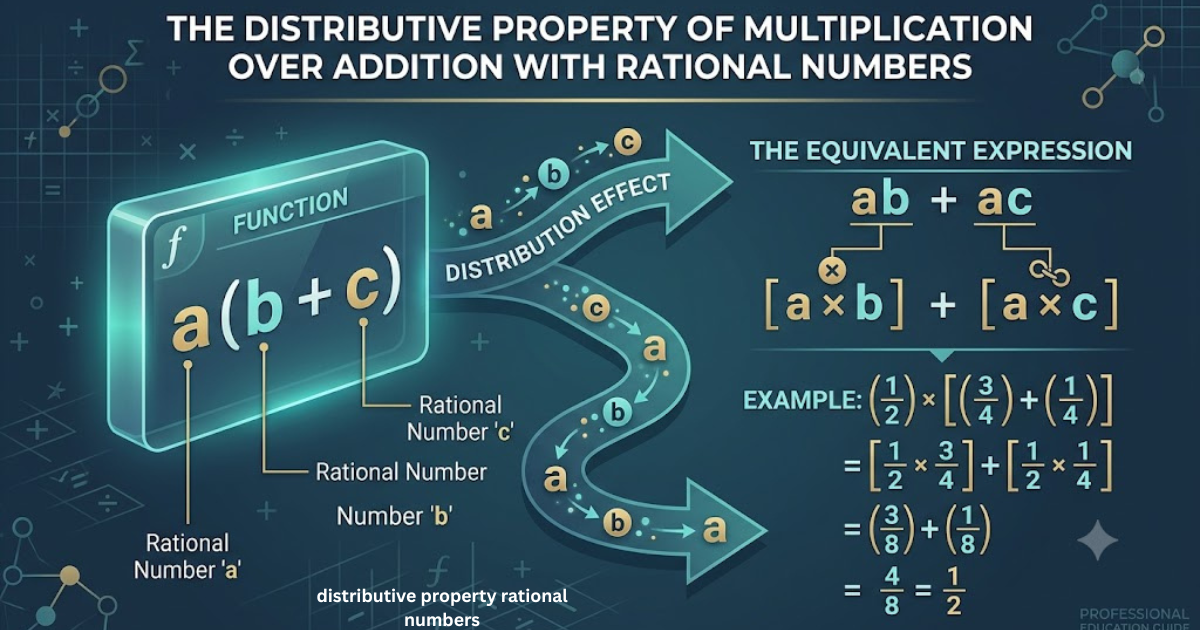
Picture three rational values sitting inside one expression: a, b, and c. The distributive property simply says that when a is multiplied by a group of terms being added, each part gets multiplied on its own before anything is added back together.
 Mathematically, this is written as it works the same way when subtraction is involved, giving us This second case has its own name, distributive property over subtraction, while the addition version is naturally called distributive property over addition.
Think of it like this: instead of solving the whole equation at once, you take the factor outside the brackets and hand it to every operand individually.
So if X, Y, and Z stand for three separate values, the rule still holds the outside number gets distributed across each one.
A working example makes it click faster: take ½ multiplied by the sum of then add the two results you land on This is exactly why the formula feels so reliable; it never changes no matter which rational numbers you plug in.
Formula
Every good formula deserves a clear representation, and this one is no different. Written plainly, it looks like which expands into Swap the letters for X and Y, and you get which opens up into XY+XZ. The same pattern applies in reverse for subtraction.
Many textbooks show this distributive rule using a small table or an image beside the written expression, simply because seeing the equation laid out visually helps it stick in memory.
Whether you are working with whole numbers or rational numbers, this formula stays exactly the same nothing about the fraction changes how the rule behaves.
Examples of Distributive Property
Numbers make everything easier to trust, so let’s walk through a few. Take multiplied by the sum of 4 and 5: multiply add them, and you get Try times the sum of that giveslanding on One more.
Fractions follow the exact same worked example logic. Multiply 3 by 11 plus 4, and you get 45; flip it to subtraction with 11 minus 4, and the answer becomes 21.
To check that everything lines up correctly, try a equal to work out the LHS and the RHS separately, and both sides come out equal to the rule is proved and verified.
Another neat check uses Add the fraction inside the brackets first, then multiply by you land on Do the multiplication separately .
The pieces, and the solution still comes to difference case and the addition case both behave exactly as the rule promises, whether you useor any other rational value, including something as small as.
Unique Headings
Beyond the distributive property, there are several close cousins worth knowing, and they usually get grouped together whenever people study rational number rules.
The closure property simply means an operation stays closed within the same family of numbers addition always gives a rational result, and so does multiplication, but division sometimes lands you on undefined, especially anywhere near division by zero.
That is one of the most common mistakes students make, along with mixing up additive identity with multiplicative identity.
The commutative property covers order swapping two numbers around still gives the same answer for commutative for addition and commutative for multiplication, though it is not commutative for subtraction or not commutative for division.
Move on to the associative property, and you’ll notice grouping numbers differently doesn’t change the outcome either: this holds for associative for addition and associative for multiplication, using values like but it breaks down for not associative for subtraction and not associative for division.
A quick verification with numbers such as shows the LHS always matches the RHS, which is how the quick chart in most textbooks confirms it, right down to results like.
Then there is the additive property, split into additive identity adding zero changes nothing and additive inverse, where a number plus its opposite equals 0.
The identity property and inverse property work the same way for multiplication, using the multiplicative identity and the multiplicative inverse, also known as the reciprocal.
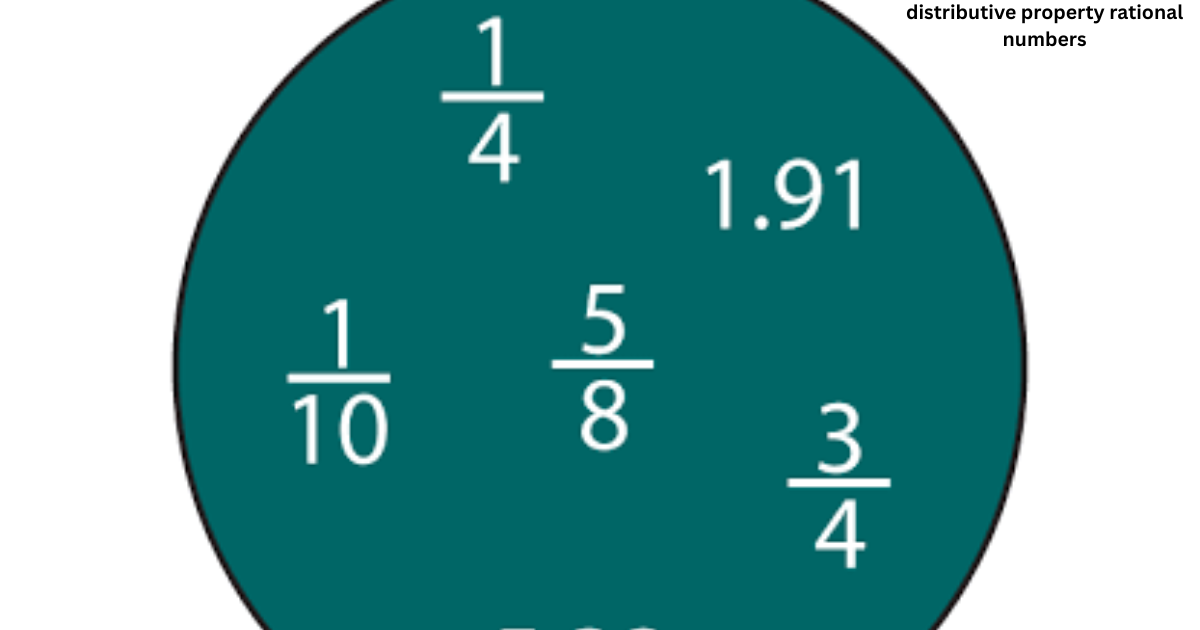
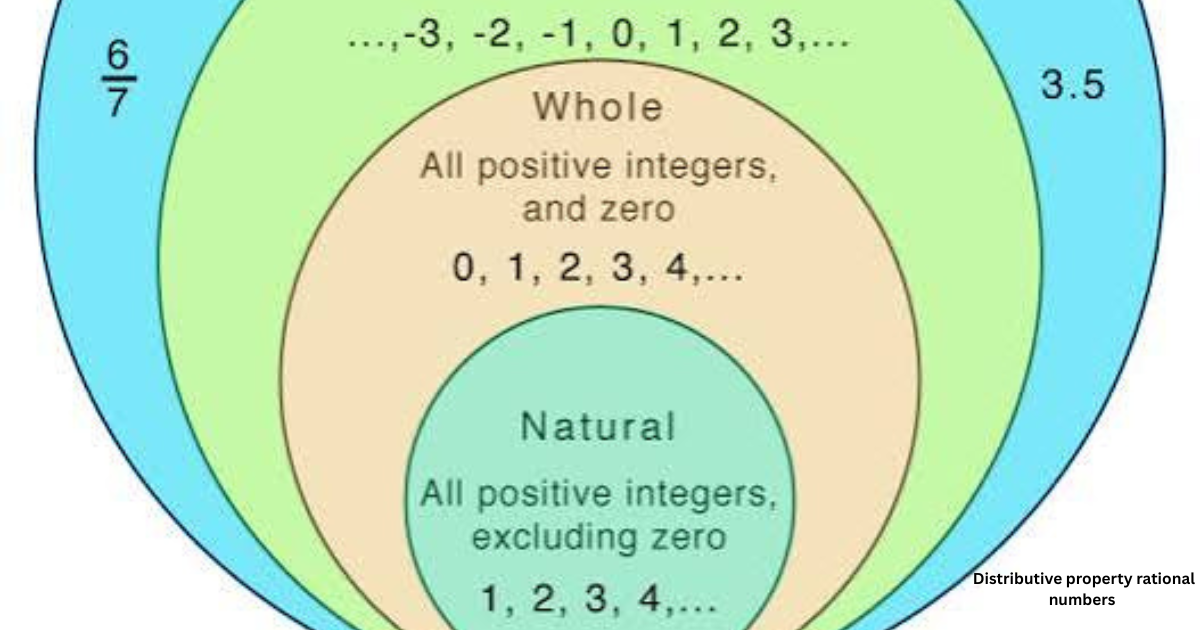
Rational numbers form a field because every non-zero rational number has this reciprocal, and this idea connects rational values to integers, whole numbers, and even natural numbers or the broader family of real numbers.
 It also helps to know how rational numbers behave compared to irrational numbers. Rational values give terminating decimals or repeating decimals, while irrational values produce non-terminating decimals that never settle into a pattern.
On a number line, both sit comfortably side by side, and understanding order of operations, along with rules like BODMAS, helps avoid confusion.
Many guides finish with solved examples, practice questions, and internal links so learners can revisit the closure property, commutative property, associative property, and distributive property together often working distributive property rational numbers confirm each rule holds true.
FAQs About Distributive property rational numbers
What Is the Distributive Property of Rational Numbers?
The distributive property of rational numbers simply means that multiplication distributes over addition or subtraction. If p, q, and r are three rational numbers, then multiplying p by the sum of q and r gives the exact same answer as multiplying p by q, multiplying p by r, and then adding those two results together.
What Is the Distributive Property in Math? What Is Its Formula?
In plain terms, the distributive property is also called the distributive law of multiplication, and it works over both addition and subtraction. The formula simply says: take the outside number, multiply it with each inside term, and then add the two products together. It really is that straightforward once you break it down piece by piece.
How Does the Distributive Property Work?
Here’s an easy way to picture it: if you had fifteen groups of four plus three items, you would not need to add four and three first. Instead, multiply fifteen by four, multiply fifteen by three separately, and add both answers together.
How Do You Use the Distributive Property Formula to Solve an Equation?
Say you have an unknown value inside brackets, multiplied by a number outside. You simply multiply the outside number by each term inside separately, which turns the expression into a simpler line. From there, solving for the unknown value becomes a matter of basic addition and subtraction, just like solving any ordinary equation.
What Is the Distributive Property of Multiplication in Math?
This version of the rule kicks in whenever you multiply a number by the sum of two or more addends. It works smoothly with both addition and subtraction, and it is mainly used to solve expressions faster by handing the outside number to every value tucked inside the brackets, rather than solving the bracket first.
Where Is the Distributive Property Used?
Honestly, this rule shows up everywhere adding, subtracting, multiplying, and dividing large numbers all become easier once you start grouping and breaking numbers into smaller parts. It does not matter what order you tackle the pieces in; the calculations still come out faster and the equations feel far less overwhelming.
How Do You Use the Distributive Property With Variables?
Variables follow the exact same logic as plain numbers. You multiply the outside value with each variable term inside the brackets, one at a time, and then combine the results. Once the expression is simplified this way, solving for the variable becomes a quick, familiar process.
How Do You Use the Distributive Property With Fractions?
Fractions behave no differently here. You multiply the outside fraction with each fraction sitting inside the brackets, one after another, then add both results together and simplify if needed. It might look intimidating at first glance, but the steps are identical to working with whole numbers.