
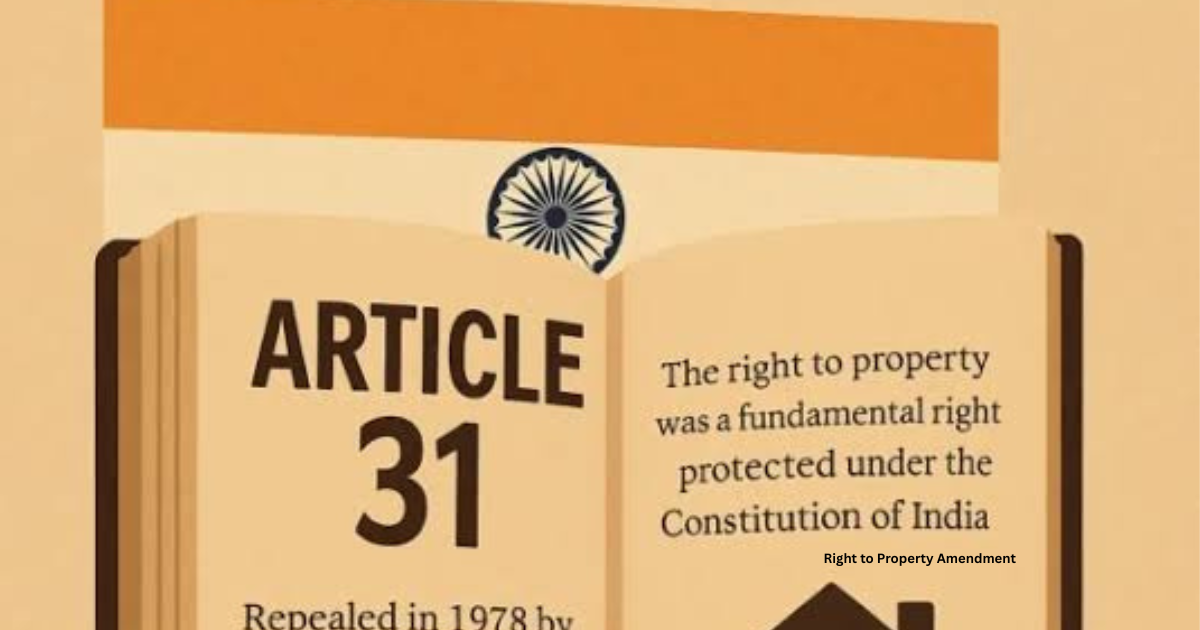
Every family that has ever built a home understands that property ownership is never just about bricks; it carries personal freedom and economic freedom woven into it. Across Indian legal history, the Constitution has walked citizens through a long transformation in legal status.
What began life as a Fundamental Right in India eventually settled into a Constitutional legal right. That single change still shapes how amendments and land laws work today.
What Was the Original Right to Property?
Years before 1950 arrived, the Government of India Act of 1935 already tried to shield zamindars and peasants, allowing the government to step onto property only for genuine public purposes. Once the Constitution of India was written, every citizen could acquire, hold, and dispose of property freely under Article 19(1)(f).
Article 31 stood guard, promising adequate compensation whenever the State compulsorily acquired anyone’s property. Back then, the right to property let citizens acquire land confidently, protected as a full Fundamental Right.
Why Was the Right to Property Amended?
As Independent India raced toward land reforms, zamindari abolition, and industrial development, a real tug-of-war kept breaking out between the government and everyday property owners. Citizens filed court challenge after court challenge, and the judiciary struck down reform laws, dragging the legislature into conflict.
This stalled infrastructure projects alongside other public projects for decades, and even the biggest agrarian reforms felt this pressure, since the push for abolition of feudal landholding touched nearly every village. To finally end this fight over the fundamental right to property, Parliament rolled out one constitutional amendment after another.
The 1st Amendment in 1951 brought the Ninth Schedule plus Articles 31A and 31B, shielding zamindari system rules from judicial review in the courts. The 25th Amendment in 1971 tightened how courts could question compensation during property acquisition for public purposes, and the 44th Amendment in 1978 closed the chapter by stripping the Fundamental Rights label off individual property rights and land acquisition completely.
The Turning Point
Passed under the Janata Party government, the 44th Constitutional Amendment Act of 1978 truly defines the right to property amendment. It wiped out Article 19(1)(f) and Article 31 from Part III of the Constitution, taking away compulsory acquisition cover and removing the topic from Fundamental Rights.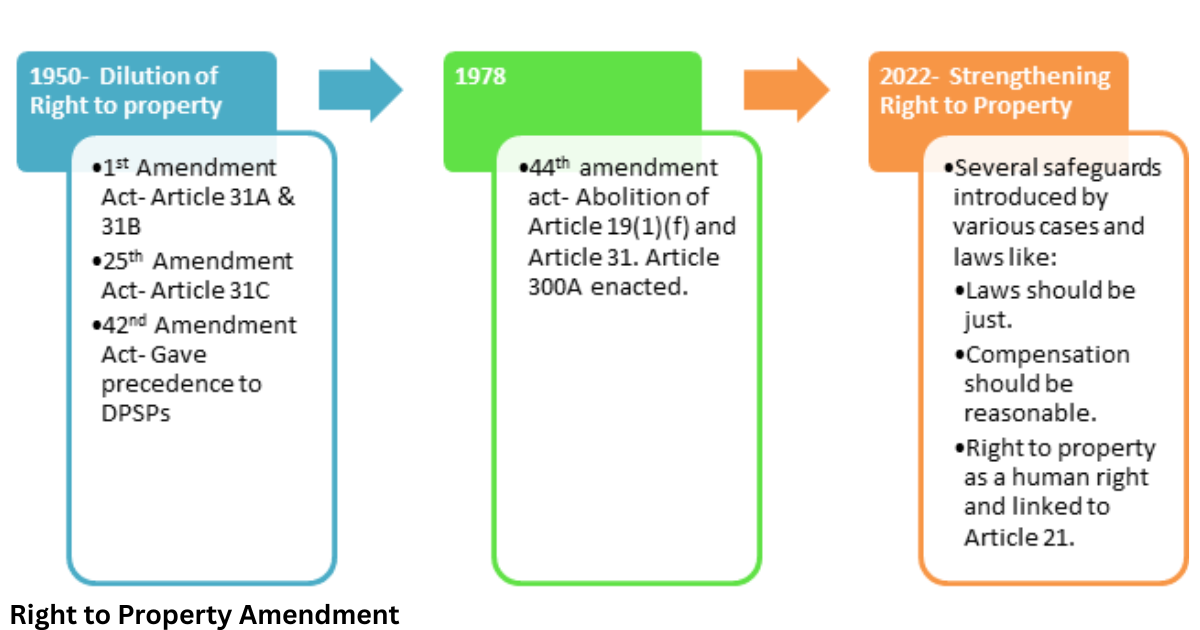
It then introduced a brand new Article 300A, framing it as a constitutional right instead of a strict legal right. From that point forward, citizens could not head straight to the Supreme Court under Article 32, yet Article 226 still let them reach High Courts and ordinary courts, because the government still has to respect authority of law, compensation, and basic property rights.
What Changed in Practice
Before the 44th Amendment, Article 19(1)(f) and Article 31 guarded land as a Fundamental Right, but after the amendment, everything shifted to Article 300A as a Legal Right, sometimes labelled a Constitutional Right.
Enforcement changed too, since old cases went to the Supreme Court through Article 32, while today’s cases travel to High Courts through Article 226 instead.
Protection level softened as well, letting Parliament and state legislatures shift rules through plain ordinary legislation and everyday statutes without a heavy constitutional amendment or a strict constitutional threshold standing in the way.
Where mandatory adequate compensation once covered every acquisition, nothing today feels constitutionally guaranteed, so the government enjoys extra flexibility for land reform, public welfare, and other development purposes, even while touching private property that can be regulated or restricted at will.
Key Supreme Court Judgments on the Right to Property
Reading through the landmark cases, it becomes clear how courts interpret property rights written into the Constitution. Back in 1973, Kesavananda Bharati v.
State of Kerala introduced the Basic Structure Doctrine, planting the seed of basic structure thinking that later limited how the 44th Amendment could reshape the fundamental right to property.
Then in 1980, Minerva Mills Ltd. v. Union of India knocked down sections of the 42nd Amendment Act from 1976, which had handed Parliament dangerous unchecked power, though the Supreme Court still let Article 300A survive as a constitutional right. Jilubhai Nanbhai Khachar v.
State of Gujarat later confirmed this right sits outside the basic structure, open to change through an ordinary amendment process, and further rulings insisted every deprivation of property stay fair, just, and reasonable, never simply technically lawful.
Present-Day Status of the Right to Property
Right to Property Amendment property runs entirely through Article 300A of the Constitution, holding steady as a legal right and a constitutional right rather than a fundamental right. People can still acquire, hold, use, and dispose of property, though it may be regulated, restricted, or abridged under plain ordinary law, with no constitutional amendment required. Whenever violations surface, a writ petition under Article 32 in the Supreme Court is off the table, but relief waits through High Courts and other courts, which always weigh whether state action honoured due process and stayed reasonable before allowing any deprivation.
Why This Amendment Still Matters Today
Even now, the right to property amendment ranks among the most debated changes in Indian constitutional history, sparking fresh conversation with every new land dispute.
Supporters credit it for unlocking land reforms, urban development, and infrastructure growth that used to drown in prolonged litigation.
Critics, on the other hand, warn it left individual protection thinner against arbitrary state action, since the government can reach private property through routine ordinary legislation instead of the sturdier old shield of Article 19(1)(f) and Article 31.
For students of law, real estate stakeholders, and ordinary citizens dealing with property disputes or land acquisition, tracing this path to Article 300A makes today’s property rights far easier to grasp.
FAQ About Right to Property Amendment
Which amendment removed the right to property as a fundamental right?
The 44th Constitutional Amendment Act of 1978 is the amendment responsible for pulling the right to property out of Fundamental Rights.
Under which article is the right to property protected now?
The Constitution of India now shelters the right to property under Article 300A, treating it as a legal right and a constitutional right.
Is the right to property still a fundamental right in India?
No, from 1978 onward, the right to property in India has stood as a constitutional legal right rather than a fundamental right.
Can the government take away private property without compensation?
The government may only touch private property under authority of law, and although Article 300A offers no built-in guarantee of compensation like old Article 31 once did, the applicable acquisition law still governs the process.
Can a person approach the Supreme Court directly if their property right is violated?
No Article 32 route to the Supreme Court exists anymore if a property right gets violated, since it is no longer a fundamental right, but the High Court remains open through Article 226.
Is the right to property part of the Basic Structure of the Constitution?
No, courts have confirmed Article 300A sits outside the Basic Structure Doctrine of the Constitution, so Parliament can freely amend the right to property through the ordinary constitutional amendment process without disturbing the Basic Structure.
What articles protected the right to property before the 44th Amendment?
Before the 44th Amendment of 1978, Article 19(1)(f) and Article 31 stood guard over the right to property.