
When I first sat down to prepare for JEE Main, I remember staring at a beaker of water and wondering why a single drop and a full litre behaved so differently on paper, even though both shared the same boiling point. That confusion became the spark for this article.
Here, we lay the foundation for understanding the classifications of physical properties that scientists use to study matter starting with clear definitions and the key differences between them.
Every material around us, whether it’s 1 litre of milk or 100 litres stored in a tank, carries certain characteristics that either change with quantity or stay fixed no matter the size of the sample.
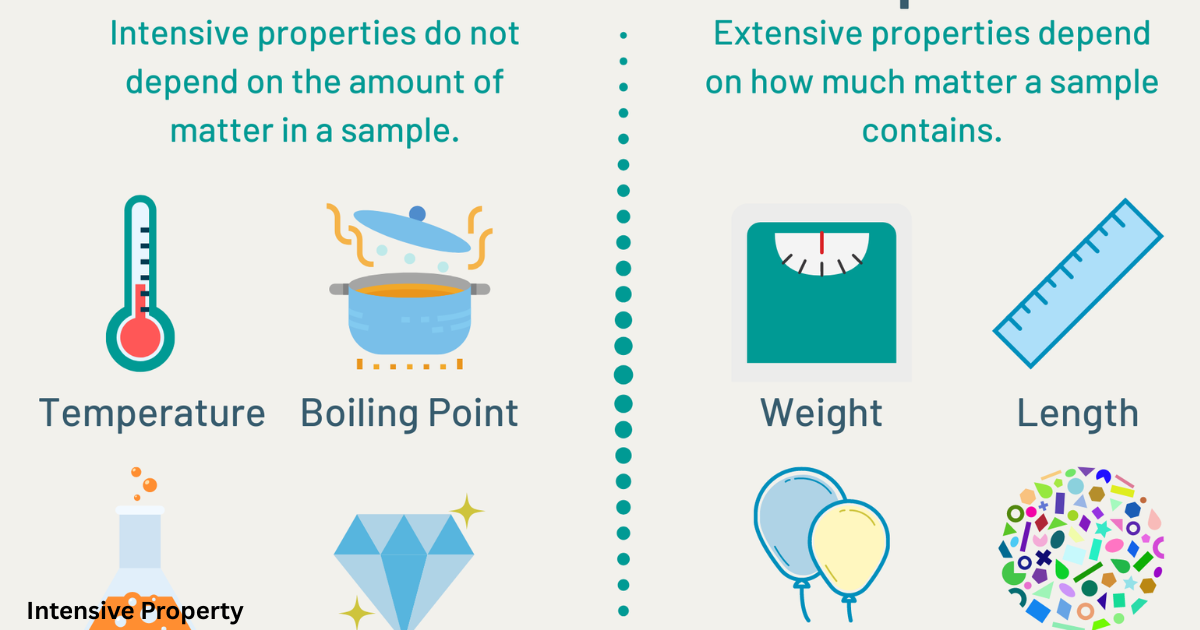
You’ll come across two broad types here: the intensive property, which stays the same regardless of amount, and the extensive property, which shifts along with mass, weight, and volume.
Alongside these, we’ll look at temperature, density, and colour as everyday examples, and connect them to real applications and scientific principles that explain the behaviour of any system.
By the end, describing and preparation of these concepts should feel less like memorising a system of rules and more like recognising understanding you already carry from daily life.
What is Intensive Property?
An intensive property is best described as a bulk property of a substance that stays constant no matter how large or small your sample is. Think of it this way: whether you scoop up a spoonful or a bucketful of the same material, its mass-independent physical property such as its inherent nature remains unaffected by any change in amount.
That’s what makes it so identifiable and reliable when scientists describe a system; the value doesn’t depend on the size of matter you’re holding, nor on its quantity or volume. In simple words, this chemical characteristics-driven trait belongs to the substance itself, not to how much of it you happen to have on your table.
Intensive Property Examples
Here’s where things get genuinely interesting, and I say that from personal experience of running simple kitchen experiments with my niece.
Take temperature: whether you heat a small cup or a large pot of pure water, it still begins to freeze at 0 degrees Celsius and boils at 100 degrees Celsius, showing that boiling point and melting point don’t shift with quantity.
The same logic applies to density a glassful of oil and an entire ocean of the same oil both settle at roughly 1 g/cm3, because density is a fixed ratio tied to mass and volume, not to sample size.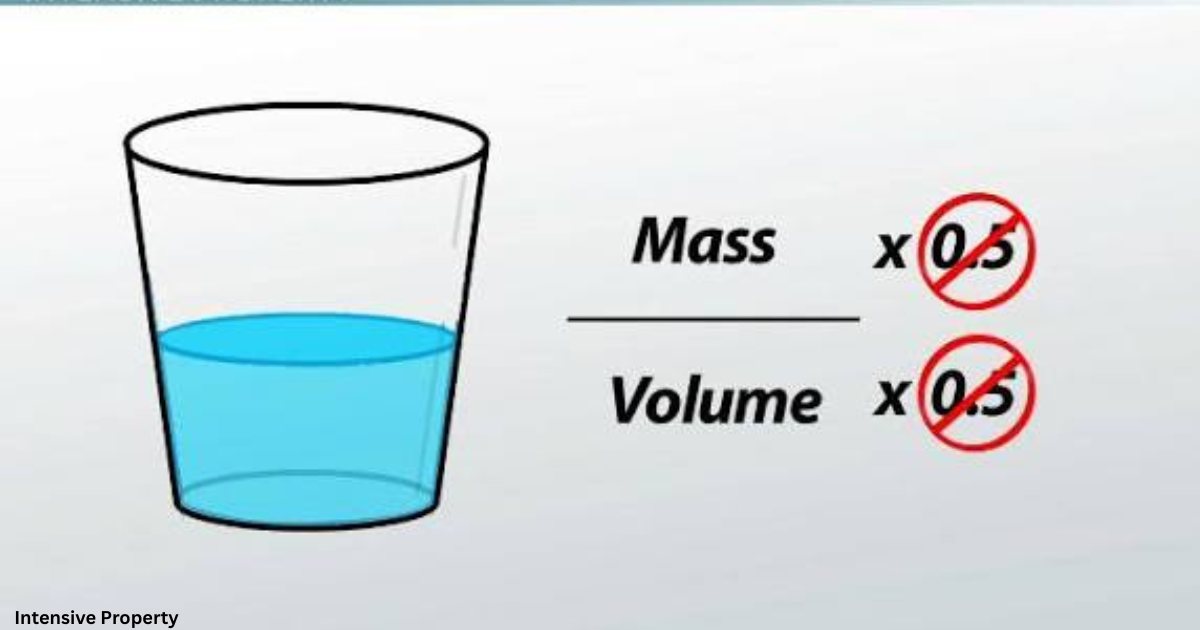 Pressure, magnetic permeability, charge density, concentration, energy density, and specific gravity behave the same independent way, staying constant regardless of whether you’re measuring 500 mL or 1 L of liquid at room temperature.
Even colour and lustre follow this pattern: a tiny gold flake and a heavy gold bar or nugget both flash the same yellow colour and shiny appearance, and the refractive index that tells us how light bends through a material stays the same too proof that these traits are truly independent of quantity.
What is Extensive Property?
Now flip the coin, and you land on the extensive property a physical property of a system that grows or shrinks along with the amount of matter present.
Unlike its counterpart, this value does depend directly on size; add more substance and the reading increases, remove some and it decreases.
It behaves as a sum of its parts, meaning the total for a whole system equals the combined readings of every smaller sample inside it.
Because such traits change in a manner that’s directly proportional and proportional to quantity, scientists label them non-identifiable on their own you can’t tell how much substance you have just by knowing its mass or volume reading; you need the actual amount too.
Extensive Property Examples
I like explaining this part with grocery shopping, because it makes the idea stick instantly. If you buy two identical boxes of the same material, their combined weight and mass simply add up 1 kg plus 1 kg gives you 2 kg, no surprises there.
The same goes for volume: pour 500 mL of oil into another 500 mL, and you get 1 L; combine a 4 litre container with a 10 litre one and your total capacity grows accordingly, just as 100 mL added to 200 mL gives a larger size. Energy, length, internal energy, heat, and work all scale the same way doing twice the work or generating twice the heat requires roughly double the substance or effort involved. Even total charge follows suit, since more charged particles mean a bigger reading; this doubling effect, where quantity and proportional increase go hand in hand, is the clearest signal that you’re dealing with an extensive trait.
Differences Between Intensive and Extensive Properties (Comparison Table)
| Basis of Comparison | Intensive Property | Extensive Property |
|---|---|---|
| Definition | An independent property that doesn’t rely on size or amount of substance | A dependent property that changes with quantity and size dependence |
| Dependency | Stays fixed regardless of mass, weight, or volume | Rises or falls proportional to mass, weight, or volume |
| Calculation | Easily identified without needing the whole sample | Must be computed by adding up every part of the system |
| Nature | Reflects the inherent nature of a material | Reflects the equilibrium analysis of the entire system |
| Examples | Melting point, colour, ductility, conductivity, pressure, boiling point, lustre, freezing point, odour, density, refractive index, solubility | Length, mass, weight, volume, internal energy, total charge |
| Applications | Useful in characterization and material design | Useful in equation representation and large-scale classification |
To really appreciate why this classification matters, it helps to step back into the world of thermodynamics, where the study of heat energy and its transformation first gave these ideas structure.
Historians credit Georg Helm in 1898 and later Richard C. Tolman in 1917 with sharpening the ratio-based distinction between properties tied to size and quantity of matter versus those that don’t budge.
In this sciences foundation, we also meet state functions and state variables quantities like temperature, pressure, density, internal energy, enthalpy, and entropy, plus specific heat capacity and volume, which depend only on the current state of a system rather than on how it got there.
Intensive Property a path function, such as work done against frictional force, which cares deeply about the journey from initial conditions to final conditions.
FAQS About Intensive Property
Which is the intensive property?
An intensive property is any physical property of a system that stays fixed no matter its size or sample size. Common examples include density, pressure, temperature, and boiling point, all of which describe a material without needing to know its total mass, volume, or quantity, unlike an extensive property such as internal energy.
What is the fundamental difference between intensive property and extensive property?
The heart of the matter is simple: an extensive property changes with the amount of matter think sample, mass, or volume while an intensive property does not. This single distinction is what separates every type of substance’s traits into one of these two camps.
Is density an extensive property?
No, density is actually an intensive trait, not an extensive one. Even if you take two different samples, small or large, density holds steady within a narrow range, because it’s calculated from mass divided by volume rather than from the initial mass alone.
Is work intensive or extensive?
Work is generally treated as extensive, since it results from applying force over a distance and depends on how much pressure, volume, or energy is involved the bigger the system, the more work gets done, unlike a purely intensive value.
Is weight an intensive or extensive property?
Weight falls firmly under extensive properties, because it rises and falls with mass and volume. This sets it apart from traits like colour, melting point, boiling point, electrical conductivity, and physical state, which stay steady regardless of temperature changes in quantity.
Why are extensive properties important in thermodynamics?
Extensive properties give thermodynamics its backbone, because they describe how entire systems behave as a whole. Concepts like the ideal gas law rely on pressure, volume, and temperature working together within equations to predict real-world outcomes accurately.
Can you provide examples of extensive properties?
Absolutely mass, volume, energy, and total charge are classic cases, along with the number of particles in a sample. Each one grows with the quantity and size of the substance you’re measuring.
How are intensive properties useful in material science and engineering?
Intensive properties such as density, refractive index, and melting point let engineers judge a material by testing only a small sample size, which makes material design faster and more efficient across countless real-world applications.
Can an extensive property become intensive under certain conditions?
Yes, in a sense dividing one extensive property by another (like mass by volume) often produces a new intensive property. This shows that classification isn’t always rigid; it depends on how the trait’s intrinsic nature responds to external conditions.