

Every buyer who checks land papers in Karnataka runs into one term again and again: RTC, also called RTC Paha Karnataka The first time a lawyer hands you a printout and calls it “the primary revenue land record” for a parcel, it’s easy to feel lost about what half the columns mean.
This guide walks you through what the document means, how banks and government offices use it, why courts treat it as central proof during disputes, and how it shapes property transactions across the state.
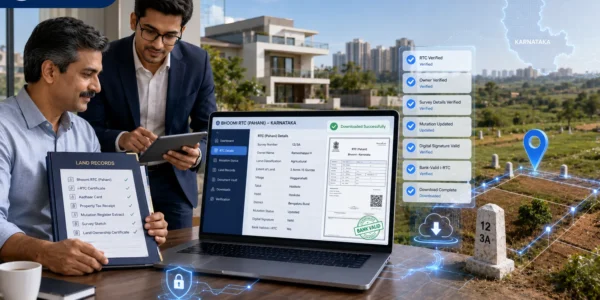
You can view this document for free through the official RTC Paha Karnataka portal at landrecords.karnataka.gov.in, and basic access does not require an Aadhaar login.
The record shows crops grown, type of land, and any liabilities attached, which matters a lot when subsidies or loans depend on clean records.
If you need a certified copy, a digitally signed version, called i-RTC, costs a small fee, currently around and stays legally valid for banks and courts alike.
Because entries are updated survey wise, every deal, from a small plot sale to a full property transaction, ties back to this one document, and verifying ownership starts here before anything else.
What is RTC Pahani?
Ask any Village Accountant, known locally as the Gram Lekhadhikari, and they’ll tell you RTC is Karnataka’s revenue record for every agricultural survey number in the district.
Issued under the Karnataka Land Revenue Act, this official extract functions as the primary land document and captures ownership details, the sub division or RTC Paha Karnataka and tenancy information tied to a specific agricultural parcel.
The name Pahani comes from the older Kannada word, and locals still use it more often than the formal term RTC. Because farming seasons change, the record is refreshed every crop season, covering both Kharif and Rabi cycles, so crop details and land-use classification stay current.
 Officers treat each survey number entry as presumptively correct, meaning it is accepted as true unless someone proves otherwise, which is why courts view it as central evidence in land related matters.
Whether you need it for a crop loan, ownership changes after a sale deed, or general land verification, the Revenue Department maintains this record as one of the primary documents establishing proof of ownership through ongoing cultivation.
What Does RTC Pahani Contain?
Open an RTC and the first thing you notice is the Survey Number, the land’s unique identifier, followed by the Hissa Number, or sub-division, and the Area recorded in acres and guntas.
Below that sits the Owner’s Name, the mode of acquisition, and any mutations logged after inheritance or sale, along with a Khata Number that acts as a revenue account reference back to municipal records.
Land classification comes next, and the Nature of Land can read as dry, wet, garden, or other Kannada land-use terms.
The Source of Irrigation notes whether the land is rain-fed, canal-irrigated, or dependent on a borewell, and this directly shapes what crops a farmer can plant that season.
Crop details track farming activity each season, while Nature of Possession explains tenant occupation versus cultivator details, showing who actually works the land.
Government acquisition notes, conversion status, and remarks for court orders also appear where relevant. Finally, the liabilities and encumbrances section flags mortgages, charges, and bank loans that a buyer must clear before the property changes hands.
Why is RTC Pahani Important?
Ownership confirmation sits at the heart of why the RTC matters so much for property purchases in Karnataka. Before any sale or registration goes through, buyers check the seller’s name against the recorded holder, because without that match the seller has no legal standing to complete a transfer.
Courts and revenue offices treat this record as primary evidence during ownership disputes, boundary fights, or usage disputes over the extent of land.
 Banks lean on the same document for agricultural and mortgage loans, checking whether land classification supports the intended use before loan approval, and whether the plot is already mortgaged.
A mutation application, triggered by a gift deed, sale, or inheritance, updates who counts as the current possession holder, while a J-Slip tracks that process behind the scenes.
Farmers rely on crop history and cultivation records to claim crop insurance, PM KISAN payments, Parihara payouts for crop loss, and other subsidies tied to proof of landholding.
Planners and dispute resolution bodies use the same data for land-use checks and DC Conversion Order approvals, cross checking soil and irrigation details before allowing land to change purpose.
Because encumbrances, tenancy status, and occupancy rights all sit inside this one document, due diligence teams also compare it against an Encumbrance Certificate to confirm the land carries no hidden risk. The Karnataka Land Reforms Act still governs many of these tenancy questions today.
How to Check RTC Online
Getting your RTC online through the Bhoomi portal takes less time than most people expect, and it helps to keep your sale deed handy before you start.
Head to the official Bhoomi portal at landrecords.karnataka.gov.in, no Aadhaar needed, and click “View RTC and MR,” which leads to the Record of Rights and Mutation Register lookup managed by the Karnataka Revenue Department.
On the search page, use the dropdowns to pick your District, Taluk, Hobli, and Village, then type in the exact Survey Number and Hissa Number as they appear on your registered deed.
Hit Fetch Details, and the screen shows ownership details, crop records, an RTC date, and any liabilities linked to the plot. You can print or download the result right away, though it won’t count as a certified copy for formal registration purposes.
If the survey number isn’t on hand, switch to the “Search by Owner Name” option, which lets you filter results using a village filter instead.
RTC vs Pahani Is There a Difference?
People often ask whether RTC and Pahani are two different papers, and the honest answer is no, they point to the exact same document.
Pahani is a colloquial term borrowed from Kannada speech, while government portals and official communications stick to the formal word RTC.
Brokers, lawyers, and everyday buyers still lean toward Pahani in common usage, simply because it rolls off the tongue easier during a quick conversation.
How to Get RTC Offline
For anyone who still prefers paper, offline still works fine across Karnataka. Walk into the Taluk office or find the Village Accountant in your village, and submit an application listing the district, taluk, and survey number.
Pay a nominal fee, somewhere between and most offices hand back a certified RTC the same day, though some take two to three days depending on staff load.
Key Red Flags in an RTC
Before signing anything, it’s worth scanning for a handful of red flags first. If the seller’s name doesn’t match the ownership column, that person is not the recorded owner, and the deal should stop right there.
Watch for a mortgage entry showing an active liability, since that debt doesn’t disappear just because a buyer signs papers, and check whether land classified as agricultural is actually being sold as a residential plot without proper DC conversion.
 A reservation tag or a note about government acquisition means the land might not stay transferable at all. Also confirm that mutation records reflect the correct current owner, and that no tenant claims occupancy rights that could complicate the sale later.
RTC and Land Verification in Bangalore
Around Bangalore, especially in growth corridors like RTC Paha Karnataka Sompura, Attibele, and Sarjapur, this kind of verification matters even more.
Many agricultural lands in these peripheral zones get marketed as investment plots to eager buyers without anyone confirming proper DC conversion, which leaves the purchase legally shaky from day one.
Types of RTC Available
Karnataka issues three versions of this record, and mixing them up causes real trouble. The Regular RTC, or Free View, gives you online viewing for reference only, and this version is not legally certified, so banks won’t accept it against loans.
The Digitally Signed RTC arrives as a downloadable PDF that counts as officially certified and fully valid for property purchases and most legal needs.
Then there’s the Certified Hard Copy, a physical copy carrying an actual Sub-Registrar stamp, which stays legally certified and is requested for specific court filings or situations where a printed original matters more than a screen.
How to Download RTC from Bhoomi
To get the certified version, go to rtc.karnataka.gov.in, the dedicated i-RTC portal, and register or log in using mobile OTP verification if you’re a first-time user.
Load a minimum balance into the RTC wallet using a debit card, credit card, net banking, or UPI. Fill in the district, taluk, and village fields, add the survey number, and choose the relevant year before you click Fetch.
Select Download RTC once the result loads, and save the PDF, which carries a digital signature that banks and courts across the state accept without question.
Bhoomi RTC Fees in Karnataka
Fees stay fairly modest across the board. A Basic RTC View is non-certified and completely free, while an i-RTC download as a digitally signed PDF costs roughly.
A Mutation Extract download for MR records costs around A RTC Paha Karnataka or Land Sketch, also runs about ₹15, and a Mutation Status Check remains free of charge.
If you need a Certified Hard Copy at an SRO or Bhoomi Kiosk, expect to pay somewhere between depending on which office you visit.
It’s always worth confirming the exact amount shown at checkout on the official portal, since fees can shift slightly with service updates.
What’s Changed Auto Mutation Since 2024
One of the more significant recent updates to the RTC Paha Karnataka system is auto-mutation, integrated with the Kaveri 2.0 registration portal.
Previously, buyers had to file a separate mutation application after registration, often waiting thirty to sixty days for it to process.
Now, when a sale is registered at the Sub-Registrar’s office, the transaction data is sent electronically toa RTC Pahani Karnatak via Kaveri a statutory thirty day notice period allows for public objections, and if a Revenue Inspector doesn’t act within fifty days, the case automatically escalates to a senior officer.
This has meaningfully reduced delays in getting ownership records updated after a sale, though it’s still worth checking mutation status separately rather than assuming it has gone through instantly.
Common Problems and How to Fix Them
A few glitches show up again and again. A survey number not found usually traces back to a tiny digit difference from your original registered sale deed, so always double check that first.
When an owner name search comes up empty, try alternate spellings, since transliteration from Kannada script can shift a name’s spelling more than expected.
 Portal not loading often happens on mobile browsers, so switch to a desktop running Google Chrome for a smoother experience.
If the RTC wallet doesn’t work, clear your browser cache, since a payment gateway hiccup or a session timeout is usually the real culprit.
And if records show an old owner even after a mutation, just check mutation status separately, because updates can take a little time to sync.
Conclusion
At the end of the day RTC Paha Karnataka forms the real foundation of every land transaction across Karnataka. The Bhoomi portal gives instant access to this official record, so use the free view whenever you just need to check details fast, and reserve the paid RTC application for moments when a certified copy is actually required.
Whatever route you pick, always match the survey number against your physical sale deed before you submit anything official.
Remember that RTC or Pahani works as a rural, agricultural land record tied to cultivation, while Khata acts more as an urban municipal account used mainly for property tax, and neither one alone counts as a full title document.
The first time a lawyer hands you a printout and calls it the primary revenue land record for a parcel, it’s easy to feel lost. You can view this document for free through the official Bhoomi Karnataka Land Records Portal to verify details survey-wise.
Keep digitally signed copies on hand, because banks, courts, and revenue authorities generally accept them without extra questions.
FAQs About RTC Paha Karnataka
What is the meaning of RTC Pahani?
RTC stands for Record of Rights, Tenancy, and Crops, and it works as the official land record document that the Karnataka Revenue Department issues for every agricultural land parcel in the state. It shows who owns the land, tracks crops grown each season, and flags any legal attachments or loans registered against the property.
What does RTC mean in real estate?
In Karnataka real estate, RTC works as the foundational ownership document for any piece of land. Every buyer, bank, or court doing due diligence on a land parcel checks this property record first to confirm legal ownership, land type, and whether liabilities exist against it.
Is RTC the same as Khata in Karnataka?
No, RTC and Khata are not the same thing. RTC works as a revenue record covering agricultural land ownership, crops, and liabilities, maintained by the Revenue Department, while Khata is a municipal record kept by the local body mainly for assessment of property and tax purposes. Both documents can matter for different property transactions.
Is Pahani and RTC the same thing?
Yes, Pahani is simply the local name used across Karnataka for RTC, and both point to the same document, the Record of Rights, Tenancy, and Crops.
How do I get an RTC in Karnataka fast?
The quickest route runs through the Bhoomi portal at landrecords.karnataka.gov.in, where entering your district, taluk, village, and survey number brings up the RTC instantly. For a legally certified copy, head to rtc.karnataka.gov.in and download the i-RTC, with no office visit needed at all.
Are RTC and Khata the same in Karnataka?
No, they serve different purposes. RTC counts as a Revenue Department record, while Khata works as a municipal or panchayat record depending on the area, and both get requested when buying or transferring land.